
Cryptocurrency
Binance’s DEX and the Future of Decentralized Exchanges
Binance Exchange has been a disruptor in the cryptocurrency landscape ever since its inception. Binance launched their exchange platform in 2017 and shortly became one of the most profitable exchanges in the space. According to a Linkedin post from Binance CEO, Changpeng Zhao (aka CZ), “Binance is the world’s largest cryptocurrency exchange. In the first […]

Binance Exchange has been a disruptor in the cryptocurrency landscape ever since its inception. Binance launched their exchange platform in 2017 and shortly became one of the most profitable exchanges in the space. According to a Linkedin post from Binance CEO, Changpeng Zhao (aka CZ),
“Binance is the world’s largest cryptocurrency exchange. In the first 3 months from inception, profits amounted to $7,500,000 USD. In the 2nd quarter, profits amounted to $200,000,000 USD. The 3rd quarter is still in progress, and is expected to have further growth.”
Even with Binance’s success, they are still under attack from disruption and decentralized technology. As a result, Binance is taking the initiative to reinvent their exchange, and in effect, jeopardize their current business model. Most companies never successfully reinvent themselves in order to protect themselves from a disruptive technology. But in the field of cryptocurrency, the rate of disruption is immense and unpredictable. Binance understands that decentralized exchanges will dominate the space once the technology is inevitably perfected. Ultimately, if you don’t disrupt yourself, someone else will.
Earlier in August, CEO of Binance, CZ released a “sneak peak” video of the decentralized exchange. This short video was a demo of the pre-alpha technology. The new update was mentioned recently when CZ posted this tweet:
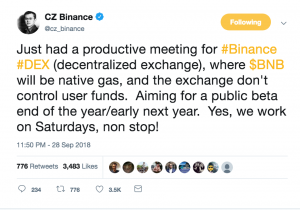
Using BNB on Binance frees the user from exchange fees. However, there are not many use cases for the Binance Coin (BNB), other than being a means of exchange on Binance. Up until now, BNB has merely been a digital representation of the value of Binance. Also, BNB is designated as an ERC20 token built on the Ethereum network.
Binance understands their coin has limited use cases and is attempting to create a new use case for the BNB token. When CZ refers to ‘native gas’ he is referring to the value of computational expenses on the Binance DEX. One of the best ways to simplify the concept of computational gas is with an analogy from investopedia.com,
“To draw an analogy, running a real-world car for X miles may require Y gallons of fuel, or moving X amount of money from your bank account to your friend’s credit card account may cost you Y dollars in a processing fee. In both cases, X indicates the utility value, while Y indicates the cost for performing the process of the car trip or financial transaction.
Similarly, a contract or transaction on Ethereum may be worth 50 ether (X), and the gas price to process this transaction at that particular time may be say, 1/100,000 ether (Y).”
Therefore, if the Binance DEX uses BNB for its native gas, then Binance Coin will have another use case. Nevertheless, extremely high gas prices discourage users from making transactions. Just as automobile owners will look for alternative methods of transportation if gasoline prices increase to quickly, users of BNB DEX will use a different exchange if the cost of gas increases for each transaction. Subsequently, the use of BNB as native gas in Binance DEX is not meant to skyrocket in price, but rather remain steady will a mild increase over a long period of time.
Currently, there are not many decentralized exchanges with effective user interfaces or reliable connections. In addition, DEXs have no customer support, therefore a user is entirely responsible for their passwords and funds. The public may see this as a negative, but most people in the cryptocurrency community understand that centralized exchanges will be forced to embrace regulation. For example, a US user trading on Coinbase or Gemini exchange will most likely have to verify their identity with a drivers license or state ID. Once their account is verified, their exchange wallet is compromised and a user’s funds will no longer be private. Above all, well-developed decentralized exchanges are a necessary requirement for the preservation of privacy in the cryptocurrency space.
In addition, massive centralized exchanges are responsible for significantly large amounts of customer funds. Furthermore, they become a target for hackers and create a centralized point of weakness. Also, a government could halt trading or freeze funds on a centralized exchange if they wanted to. However unlikely these situations are, they are still possible.
Although Binance is a trusted company within the field, not all exchanges will be. As more decentralized exchanges emerge, existing centralized exchanges will attempt to ‘decentralize’ themselves. Most will appear to be decentralized, but under the hood they may still be heavily centralized. When more exchanges attempt to decentralize themselves, the word ‘decentralized’ will become another marketing technique, similar to what we saw with the word ‘blockchain.’ There are many companies who say they are in blockchain technology, but in actuality they are just a complicated database. This comparison will most likely occur in the word ‘decentralized’ as well.
Above all, Binance is taking the initiative to disrupt their current business model to adapt to the changing technological environment. If the world’s largest crypto exchange is preparing for severe disruption, so should investors.
Disclaimer: I am not a financial advisor, this is not financial advice. Please do your own research and make objective decisions. This article is intended to educate readers on the possible future upgrades of Binance’s Decentralized Exchange. Disclosure: the author of the article owns cryptocurrency.