
Trading Insights
A Look Inside Stock Market Volatility
While everything appears to be blue skies for the stock market these days, it’s important to keep recent history in mind. Just over a year ago we saw COVID-19 lockdowns tank the markets. Volatility surged as the markets tripped circuit breakers on their way to the downside. It was an ugly scene. Today, the S&P […]


While everything appears to be blue skies for the stock market these days, it’s important to keep recent history in mind. Just over a year ago we saw COVID-19 lockdowns tank the markets.
Volatility surged as the markets tripped circuit breakers on their way to the downside. It was an ugly scene.
Today, the S&P 500 and Dow are hitting all-time highs and volatility has cooled off. Government stimulus and hopes for a total economic recovery has fueled the market into the stratosphere.
So, given the frothy market of late, there’s simply no better time than now to understand the importance of volatility when you trade.
Volatility gets a bad rap. It’s synonymous with high risk and declining returns. After all, in long-term portfolios, volatility often is experienced more on the declines than the upswings.
But is volatility really a bad thing? For an options trader, understanding volatility and what it means for your trades can be critical to your success.
What is stock market volatility?
Volatility is the variance of returns measured for a particular security over a certain time frame. It represents the change of price and the velocity in which that price changes.
So, if a stock’s price remains relatively stable over the course of time, it has low volatility. But if the market becomes unstable and the security makes a dramatic move very quickly (regardless of direction), volatility will increase. Think Tesla in 2020 or GameStop in early 2021. Both stocks surged higher, but they did so with force. That’s volatility.
The reason volatility is often talked about in a negative light is because markets tend to make big and fast moves to the downside during a sell-off. But they typically recover much more slowly, which lowers volatility as investors steadily regain confidence. They take the elevator down, as the saying goes, and the stairs up.
The two types of volatility
There are a couple different ways to gauge volatility. We can analyze the past and reference data points we already know. Or we can try to predict future volatility based on several key factors.
Historical volatility gauges the change in a stock price by measuring it over an established time frame. You can calculate the standard deviation of a stock price month to month over the course of a year. That allows you to compare one month’s change with the average.
But while understanding the past is valuable, history almost never repeats itself exactly. Analyzing historical volatility is like looking in the rearview mirror, when sometimes it’s more important to be looking out the windshield. For options trading, we need to be more forward looking. So, we have another measure of volatility specifically for predicting future price action.
Implied volatility (IV) allows options traders to determine the expected change in price at a certain point in the future (usually tied to an options expiration date). This gives the trader an idea of current conditions and the degree in which the price of an underlying stock is expected to change over time. It’s accounting for the probability of change and by how much, even though there’s no way of knowing what will happen for sure.
Implied volatility is essentially fluid and becomes more and more predictable as an option approaches expiration. In most situations, options nearer today will have lower IV than options that expire farther out on the curve. An exception would be if there is a highly expected news event (earnings or drug trial announcements) that might cause IV in the short-term to be much higher than long-dated options.
Take a look at this options chain for the SPDR S&P 500 ETF (SPY).
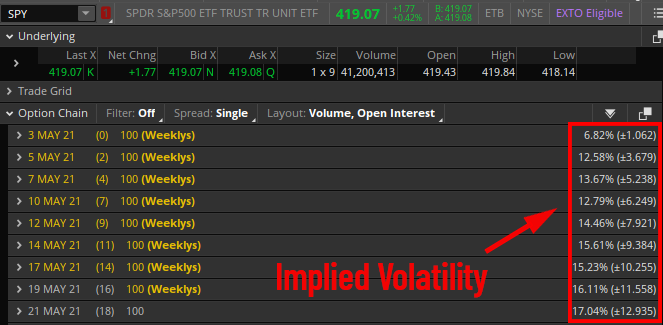
You can see the implied move the market maker believes the stock could make based on several variables, both known and unknown. Implied volatility is key for options traders because it’s directly reflected in the price of an option (higher IV increases the price of both calls and puts over lower IV).
Understanding IV allows you to better predict the potential move of a security. It gives you a better chance at capitalizing on a trade by putting the odds in your favor.
Introducing the VIX
The Chicago Board Options Exchange’s CBOE Volatility Index (VIX) is a popular index for many traders. It measures the market’s expectation for volatility based on S&P 500 index options.
At the start of last year, the VIX traded in a range between 11.92 and 19.99. Keep in mind, a VIX under 20 is generally considered a relatively low period of volatility.
Then on February 24, 2020, COVID-19 and nationwide lockdown fears began permeating the market. Uncertainty came into the equation, and investors started selling. The VIX popped above 20 and eventually closed the week at 40.11. That’s certainly above the typical range for VIX during a calm market.
Over the next couple weeks, travel restrictions were announced, and volatility picked up steam. Investors began to panic, sinking the market even faster. By March 18, the VIX exploded to a high of 85.47, indicating EXTREME volatility.
As economic stimulus and coronavirus vaccines were announced, investors began buying back in. The VIX slowly changed direction, floating back to earth over the following weeks and months.
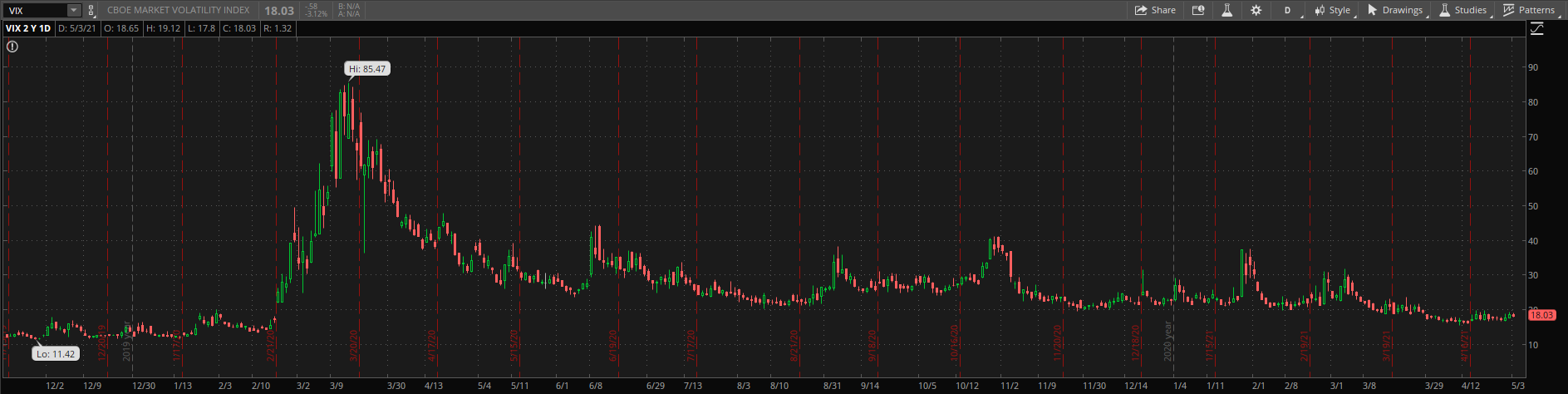
At writing, the VIX is trading near 18. But as we’ve seen, the market can change on a dime. That’s why understanding volatility and how to read the VIX is so important. It can give you an indication of how the market is moving and help you decide how to play it.
The bottom line
Volatility isn’t a bad word. It’s really just a gauge on how markets move. Understanding how it impacts the market is one of the most important lessons you can learn as a trader.
Make sure you always keep an eye on the VIX. It’s a great tool that can help you understand the market you’re trading and the best way to maneuver in volatile times.