
Trading Insights
Inverted Yield Curve: Should You Worry?
Inverted yield curve is a phrase you’ll hear a lot this week. For those of you who don’t have an economics degree, an inverted yield curve is simply when a short-term treasury yield surpasses a long-term treasury yield. It’s an indicator that investors are getting pessimistic about long-term economic prospects — and it’s something that […]

Inverted yield curve is a phrase you’ll hear a lot this week. For those of you who don’t have an economics degree, an inverted yield curve is simply when a short-term treasury yield surpasses a long-term treasury yield. It’s an indicator that investors are getting pessimistic about long-term economic prospects — and it’s something that just happened this week.
On Tuesday, the U.S. 2-Year Treasury Yield rose above the 10-Year Treasury at the 2.39% mark.
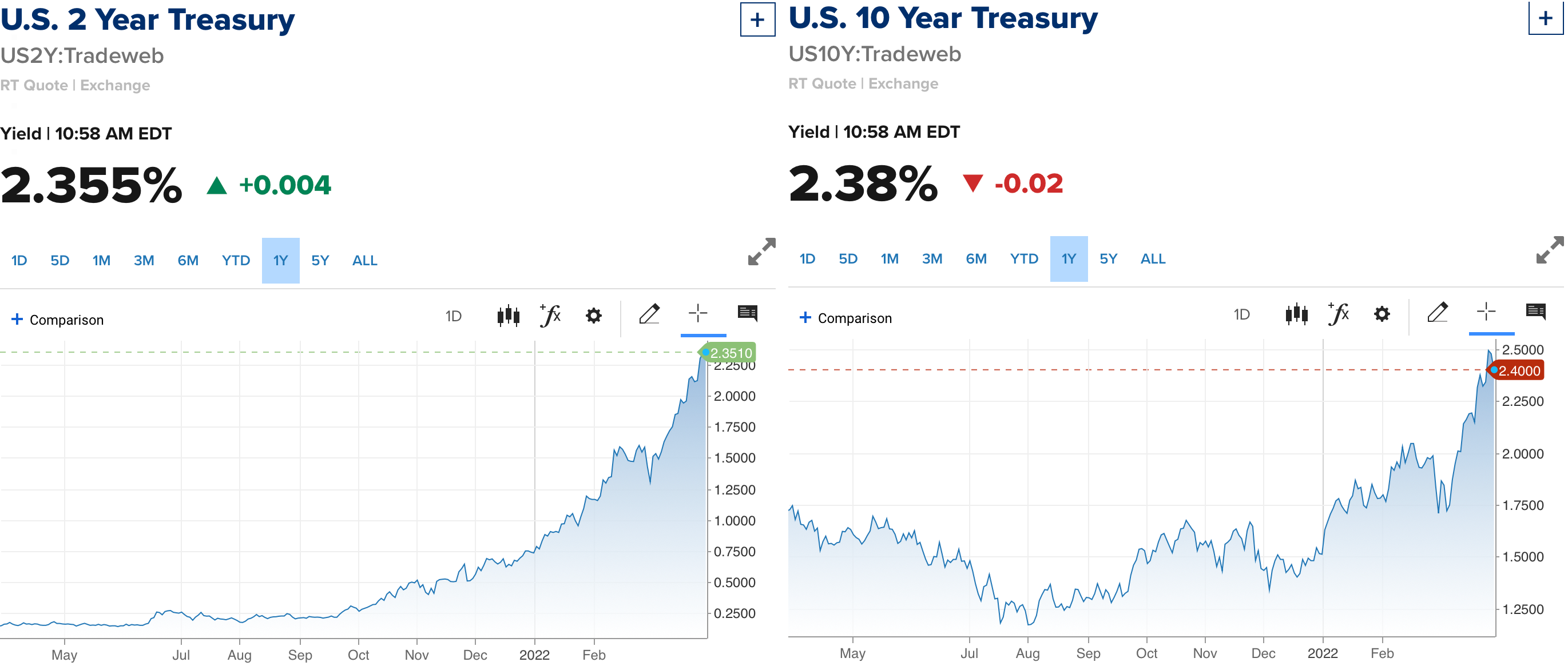 Since Tuesday, the yield curve has reverted, with the 10-Year pulling back ahead. Source: CNBC
Driven by expectations for impending rate hikes, the surge in the 2-Year Yield happened at a stunning pace, up over 36% since March 4th.
Yield curve inversion hasn’t happened since 2019, and it has some economists worried that we’re heading straight for a recession. Prior to 2019, the last time the yield curve inverted was in 2007. Recessions followed both instances.
The recession that came after the 2007 yield-curve inversion was serious, lasting one-and-a-half years (December 2007-June 2009), spurred by the subprime mortgage crisis. However, the 2020 recession was likely due to the panic surrounding the outbreak of Covid-19, and lasted only two months (February 2020-April 2020) — the shortest recession in U.S. history.
This time, there’s staunch debate among economists about the seriousness of the 2-Year surpassing the 10-Year. The opinions generally fall into one of two camps.
Inverted Yield Curve Is Bad News
According to analysts at Bank of America, the inverted yield curve represents fundamental weakness in the economy. And they aren’t mincing any words about what they think that means for the market.
Here’s an excerpt from Bloomberg’s piece, titled, “Stock Surge Is a Bear-Market Trap With Curve Inverted, BofA Warns”
“The S&P has managed to rally despite ‘clearly weaker fundamentals’. The 11% surge in U.S. stocks in the past two weeks has the hallmarks of a bear-market rally that might give way to deeper losses.
That’s the conclusion of analysts at Bank of America, who say warning signs are flashing for a market that has climbed “despite clearly weaker fundamentals,” including a Federal Reserve bent on raising rates sharply this year to battle persistent inflation.”
Sharing BofA’s bearish view on the inverted yield curve is none other than legendary activist investor Carl Icahn. During an interview with CNBC last week, Icahn said,
“There very well could be a recession or even worse. We have a strong hedge on against the long positions.”
Moody Analytics Chief Economist Mark Zandi took it a step further, telling CNN Business,
“There is at least a one-in-three chance the US economy will have a recession over the next 12 months. The harder the Fed steps on the brakes, the higher the probability the car seizes up and the economy goes into recession,”
But not all economists share this bearish view, with some notable analysts taking a more sanguine approach.
Inverted Yield Curve Is a False Positive
If you ask the Chief Economist & Macro Strategist at MKM Partners, he would give you a much different read on the situation.
Here’s an excerpt from his interview with Yahoo! Finance:
“Should we be looking at the spread between twos and tens as a harbinger of recession?” asked the interviewer.
“So we have some of these so-called “belly of the curve” measures getting very flat. Twos to tens is dead flat, as you mentioned. […] The problem is that those “belly of the curve” measures are really not reliable. They’ve inverted in the past, but you don’t always have a recession afterwards.
What you tend to see essentially before every recession is the t-bill yield or the fed funds rate up above longer term rates on the curve. And not only did we not see that, but those measures have actually been steepening, not flattening, but steepening this year.
The New York Federal Reserve maintains a recession probability model based off of the 10-year yield relative to the t-bill rate, and that model has only about 2% recession risk over the course of the next year.” answered the MKM Strategist.
He’s not alone. The MKM economist shares this optimistic viewpoint with sitting Fed President Jerome Powell. Asked about the strength of the economy and likelihood of a near-term recession, Powell said this:
“In my view, the probability of a recession in the next year is not particularly elevated. Aggregate demand is currently strong and most forecasters expect it to remain so. If you look at the labor market, it’s also very strong. Conditions are tight, and payroll job growth is continuing at very high levels. Household and business balance sheets are strong. And so, all signs are that this is a strong economy.”
Skybridge Capital’s Anthony Scaramucci shares this optimistic viewpoint.
Here’s an excerpt from his recent interview with CNBC, where Scaramucci explained why he wouldn’t be too hasty to predict a recession.
“You’ve got two conflicting things happening at the same time. The ending of the pandemic or at least the lockdown procedures in most of the world. And you’ve got the uncertainty about a cease-fire, potentially, in Ukraine and Russia,” the hedge fund founder said.
“And I think that, that has to abate before we can really look at and analyze the data and determine whether or not it’s consistent with the historical guidance and the indication of recession,” he added.
But Scaramucci said he’s “not convinced that there’ll be a recession,” adding that the “economy is booming around the world.”
“So for me, I want to be cautious and I’m still very optimistic about the U.S. economy specifically and the overall stock market,” he said.
What’s The Takeaway?
This is all just data. It’s important to be as informed as possible. But equally important not to act with emotion or fear when a barrage of frightening headlines enters your morning newsfeed.
After all, there are plenty of very intelligent people debating this issue from both sides. And no consensus has really been reached about what this means for the future of the U.S. economy.
While it’s completely reasonable to stay cautious when a signal like this arises, it’s equally important to stay calm. Creating an entry and exit plan for every trade or investment you make can help you stay disciplined during unique circumstances like this.
If you’re interested in learning how to develop a consistent trading plan with the help of Market Rebellion’s sales specialists, take this short quiz about your trading style and experience level.