
Cryptocurrency
3 Strategies for Dealing With Tether FUD
Tether is no stranger to controversy as it has been criticized since 2017. Everyone likes to speculate whether or not Tether is actually backed 1:1 by USD. Throughout the past week, Tether has been trading at a discount relative to other stable coins. For example, the TrueUSD/Tether pairing on Binance was valuing 1 Tether at […]

Tether is no stranger to controversy as it has been criticized since 2017. Everyone likes to speculate whether or not Tether is actually backed 1:1 by USD. Throughout the past week, Tether has been trading at a discount relative to other stable coins. For example, the TrueUSD/Tether pairing on Binance was valuing 1 Tether at $0.96. This should theoretically never happen, as Tether is intended to be a stable coin and should be incapable of fluctuation.
The reason Tether has dropped in value is simple: the market has lost trust in Tether’s actual supply and has serious doubts about whether Tether is solvent. This has led some traders to sell Tether for less than 90 cents on the dollar. However, this is not the first time Tether has been trading for less than a dollar. On April 24th, 2017, Tether was trading at $0.91 on some exchanges because traders and investors were afraid of potential insolvency.
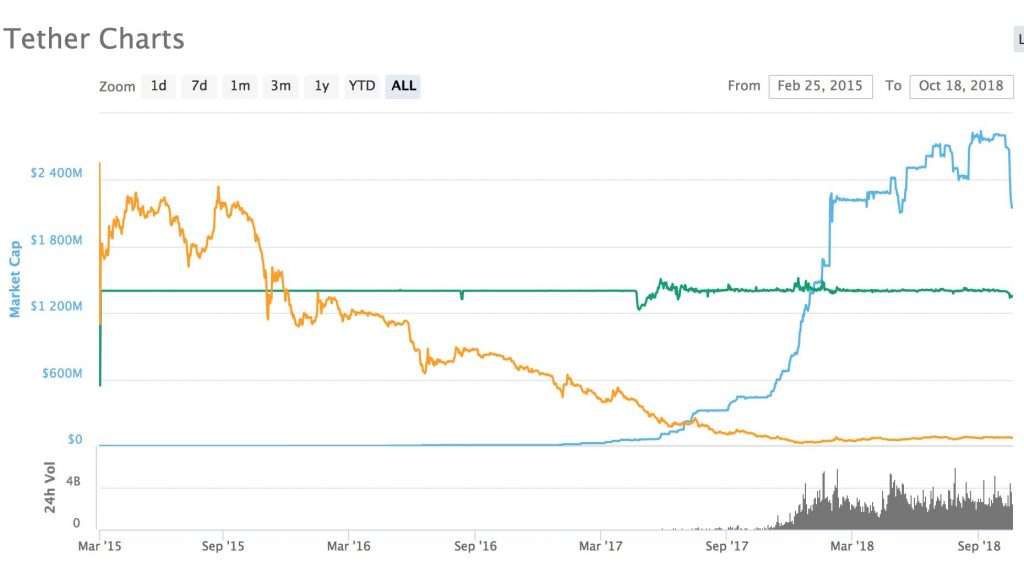
In return, many traders panic sold at $0.91, but the price eventually returned to $1. Current Tether FUD may blow over in the coming weeks or USDT may have serious insolvency problems. The situation has yet to be resolved. Also, it is important to recognize systematic FUD and manipulation. For example, Michael from Boxmining pointed out a fake email claiming Binance was delisting Tether. CZ, the CEO of Binance, later confirmed that the email was a fake.

Traders saw this propaganda earlier in the week and began to panic sell. Exchanges who use USDT as their main trading pair saw an increase in the price of Bitcoin simply because Tether was trading below a dollar. When the price of Tether fell, traders and investors moved their money from Tether into Bitcoin, alt coins, and other ‘more reliable’ stable coins. This caused an artificial price increase in the market. Consequently, the price of Bitcoin surged from $6,200 to $6,800. The price even increased to $6,950 on some exchanges. However, this pump was completely artificial and current prices are most likely higher than they should be. This is true because the price of Bitcoin never reached $6,800 on exchanges with real fiat trading pairs. For example, on Coinbase, the price never increased above $6,625.
There are about three logical actions and/or outcomes for traders who own Tether:
1. Sell Tether and take a 4% loss. Trade Tether for Bitcoin or a ‘more reliable’ stable coin. Then get the crypto off of the exchange and into a hardware wallet or a reliable custodial service.
2. Wait for the FUD around Tether to die down. There has been FUD around Tether in the past which has caused the price to drop below $1. There’s a chance this FUD was orchestrated manipulation mainly due to the fake Binance email stating, “Tether is big scam.” This raises suspicion to who would temporarily manipulate the price of Tether. If Tether proves to be solvent, it should theoretically return to its value of $1. As a result, the currently inflated Bitcoin price will return to the $6,100 level. Then, if one is still doubtful about Tether, they can trade their USDT for a more legitimate stable coin without taking the original 4% loss. At this point, it is most likely preferable to be in USD or a stable coin. This is mainly because Bitcoin is currently in a descending triangle formation at $6,000. According to classical charting theory, descending triangles break to the downside about 7 times out of 10.
3. The third scenario is much more bleak. Let’s assume Tether is insolvent and there is a ‘run on the bank.’ Traders will begin to sell their Tether for 70 or 80 cents on the dollar and there will be limited liquidity. If Tether is proven to be insolvent, that means billions of dollars have been artificially propping up the cryptocurrency market. Those Tethers which were supposed to be backed 1:1 by USD are now worthless and would effectively destroy one of the most fundamental pieces of cryptocurrency market infrastructure.
Add this potential catalyst to Bitcoin’s existing descending triangle formation and you have an interesting shorting opportunity. At the very least, an event of this magnitude could lead to a decline which would create an optimal entry point. Although this risky opportunity could be lucrative, a collapse of Tether should be welcomed by no one.
Disclaimer: I am not a financial advisor. This is not financial advice. Please do your research independently and make objective decisions. This article is intended to educate readers about Tether and its impact on the cryptocurrency market. The author of the article owns cryptocurrency.