
Trading Insights
Big Bank Earnings: A Glimmer of Hope?
It’s the first week of earnings season. Wednesday morning, we’ll hear from Delta Air Lines ($DAL, the first airline to report earnings this season), as well as Blackrock ($BLK) and JPMorgan ($JPM) among several others. This will likely set the stage for the five major financial institutions reporting on Thursday morning. Source: Earnings Whispers And […]

It’s the first week of earnings season. Wednesday morning, we’ll hear from Delta Air Lines ($DAL, the first airline to report earnings this season), as well as Blackrock ($BLK) and JPMorgan ($JPM) among several others. This will likely set the stage for the five major financial institutions reporting on Thursday morning.
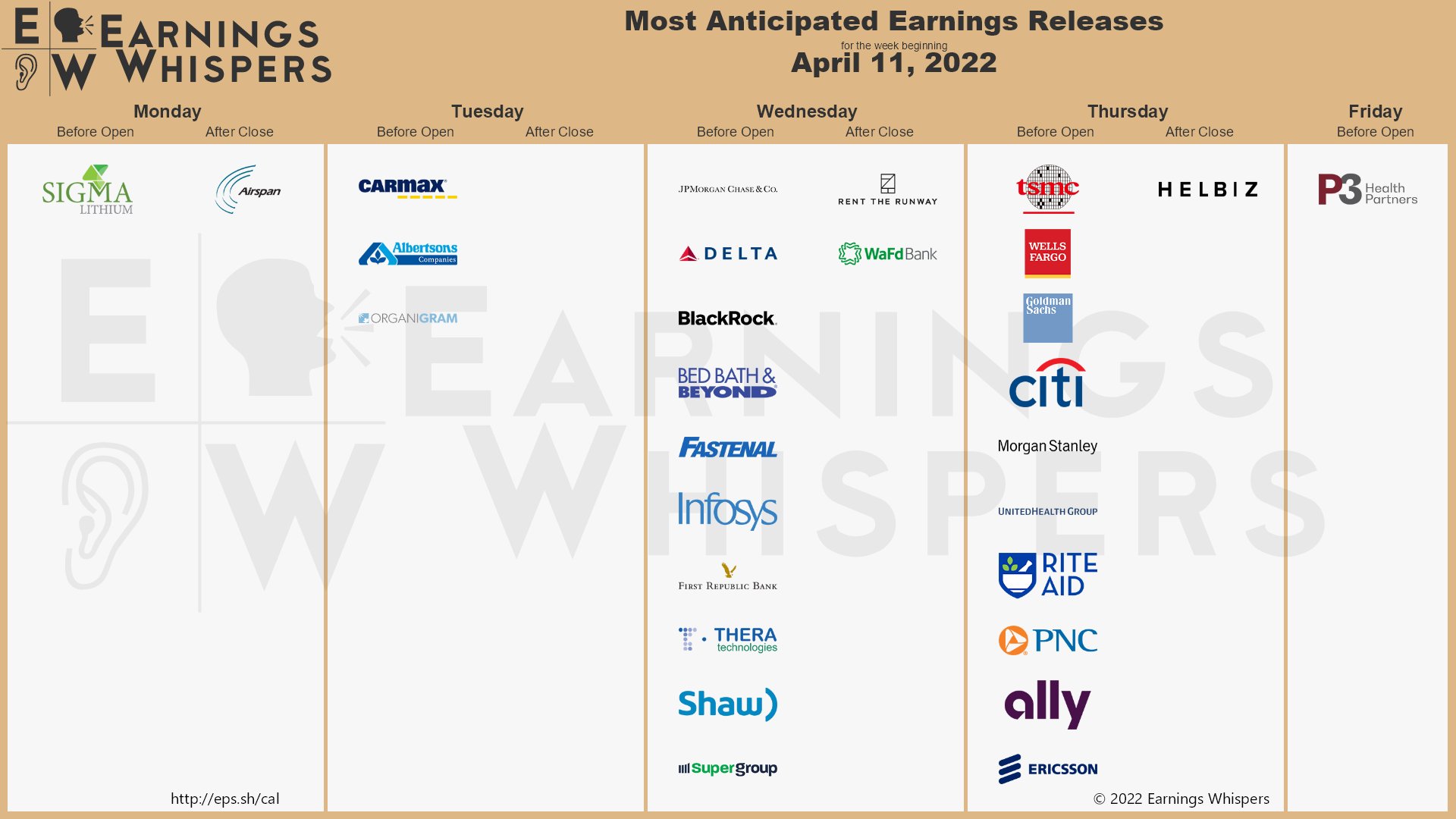 Source: Earnings Whispers
And today’s important CPI report (the first report to come in near expectations in months) could be the first step in easing some of the recessionary worries baked into the prices of big banks.
Here are the quick takeaways from Tuesday’s CPI report.
- Prices are 8.5% higher currently than they were last March.
- Wages are meaningfully higher than they were, but the increase is not in line with inflation.
- This is mirrored globally, as the war in Ukraine rages on, creating new supply chain issues in goods like fertilizer, corn, wheat, and certain precious metals.
- The soaring price of gas was to blame for more than half of this months inflationary increase.
- Travel demand is rising alongside the rapidly increasing cost of fuel, opening the door for airlines to increase the cost of seats and travel ancillaries, like luggage and add-ons.
- Biden has announced that higher-ethanol gas can now be sold throughout the summer, in hopes of adding to the overall supply.
- This has not affected the Fed’s plan to raise rates several more times this year.
Later in the day, key Fed official Lael Brainard spoke at the Wall Street Journal Jobs Summit to cheer on the results of Tuesday’s report.
Brainard spoke optimistically, saying she “welcomes the moderation in the core goods sector”, which was mostly due to a decline in used-car prices. She went on to say that economic recovery can be sustained, even as the Fed seeks to bring inflation down through a series of rate hikes, citing strength in the labor market and continued economic growth in the face of adverse global conditions.
This combination of a reasonable CPI Report with cautiously positive Fed commentary seemed to give stocks a new breath of life. The question now is: can it continue into the first week of earnings season? Let’s look at what the market is expecting of Wednesday’s big players.
What the Market Expects
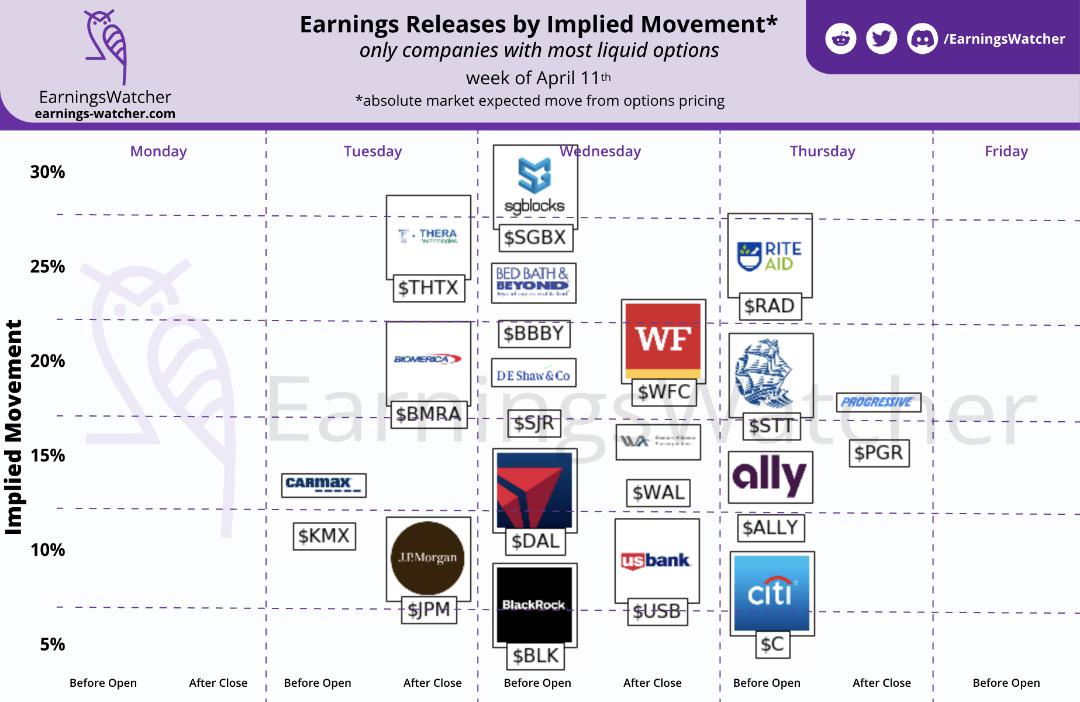 Source: Earnings Watcher, snapshot of implied movement from April 11th, market open
We can’t look into the future, but we can look at what the option market is pricing in, using a metric called implied movement. The implied movement is a measure of what the option market is pricing in a particular stock, using the total cost of the at-the-money straddle (in the closest expiration post-earnings) divided by the stock price. Higher implied move means more expensive options, and a higher expectation of big price action.
Of course, without relative comparisons, these are all just nebulous figures. Using this snapshot of implied movement from Earnings Watcher puts the option market’s expectations into perspective.
Blackrock ($BLK)
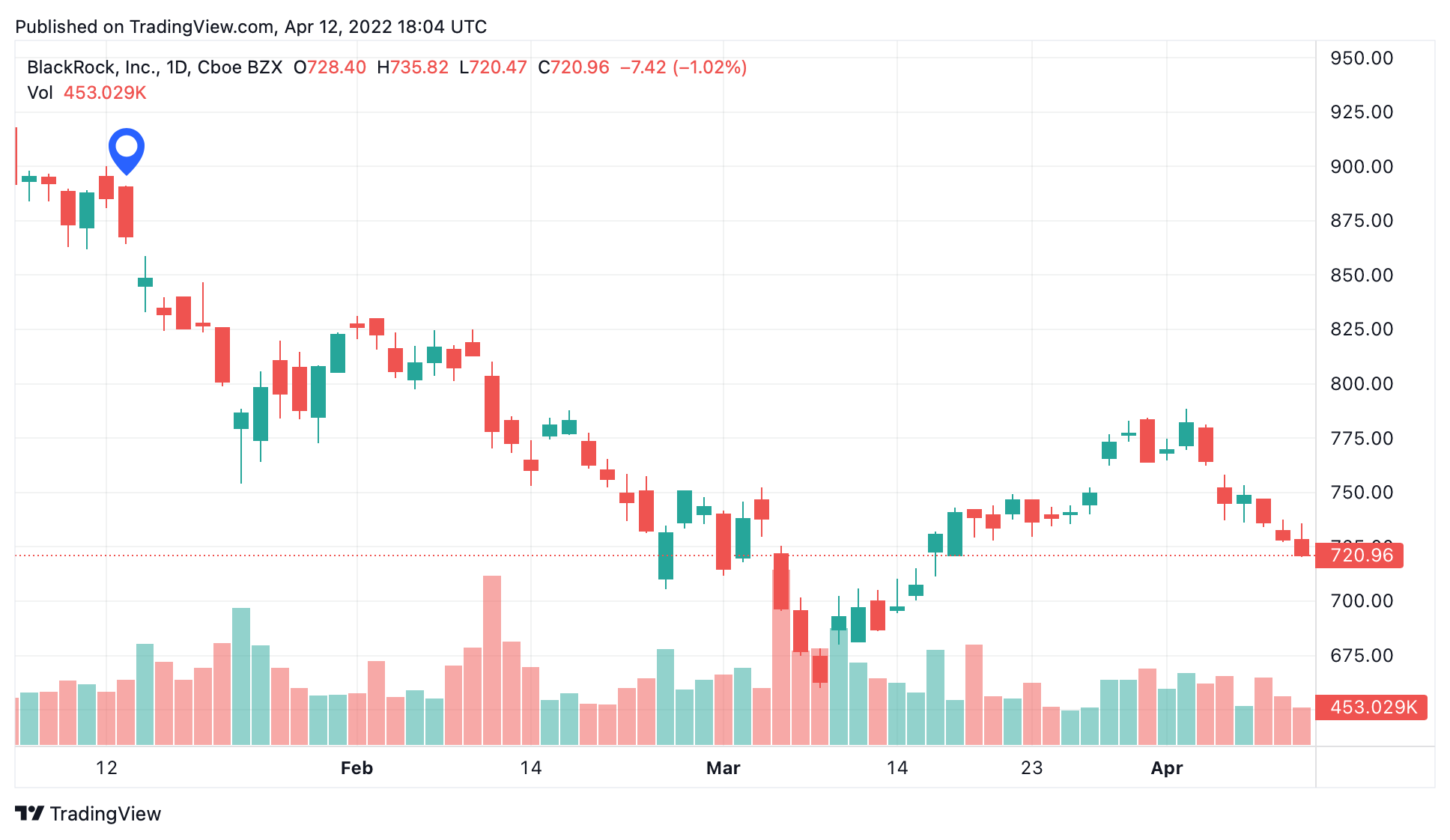 Chart courtesy of TradingView, prior earnings represented by blue arrow.
Blackrock, for instance, places among the lowest of ‘implied earnings moves’, coming in at around 3.47% at the time of writing. (Calculated by dividing $25.00 (cost of the $720 strike at-the-money straddle expiring 4/14) by a share price of $720.59)
For comparison, Blackrock’s prior earnings move was only -2.18%. That means that even though the options market is pricing in a relatively small move for Blackrock when compared to, say, Bed Bath and Beyond, it’s still a move that’s about 60% greater than they experienced in January.
Satisfying $BLK’s 3.47% implied move would mean an upside share price of $745.59, or a potential downside share price of $695.58.
In-line with that downside price potential, today one option trader picked up two 100-contract orders of $700 strike puts expiring October 21st, 2022, for a total cost of $912,000 ($45.60 per contract). These puts are out-of-the-money, but within striking distance of $BLK’s expected downside move.
Blackrock is expected to report EPS of $8.87, and revenue of $4.76B.
JPMorgan ($JPM)
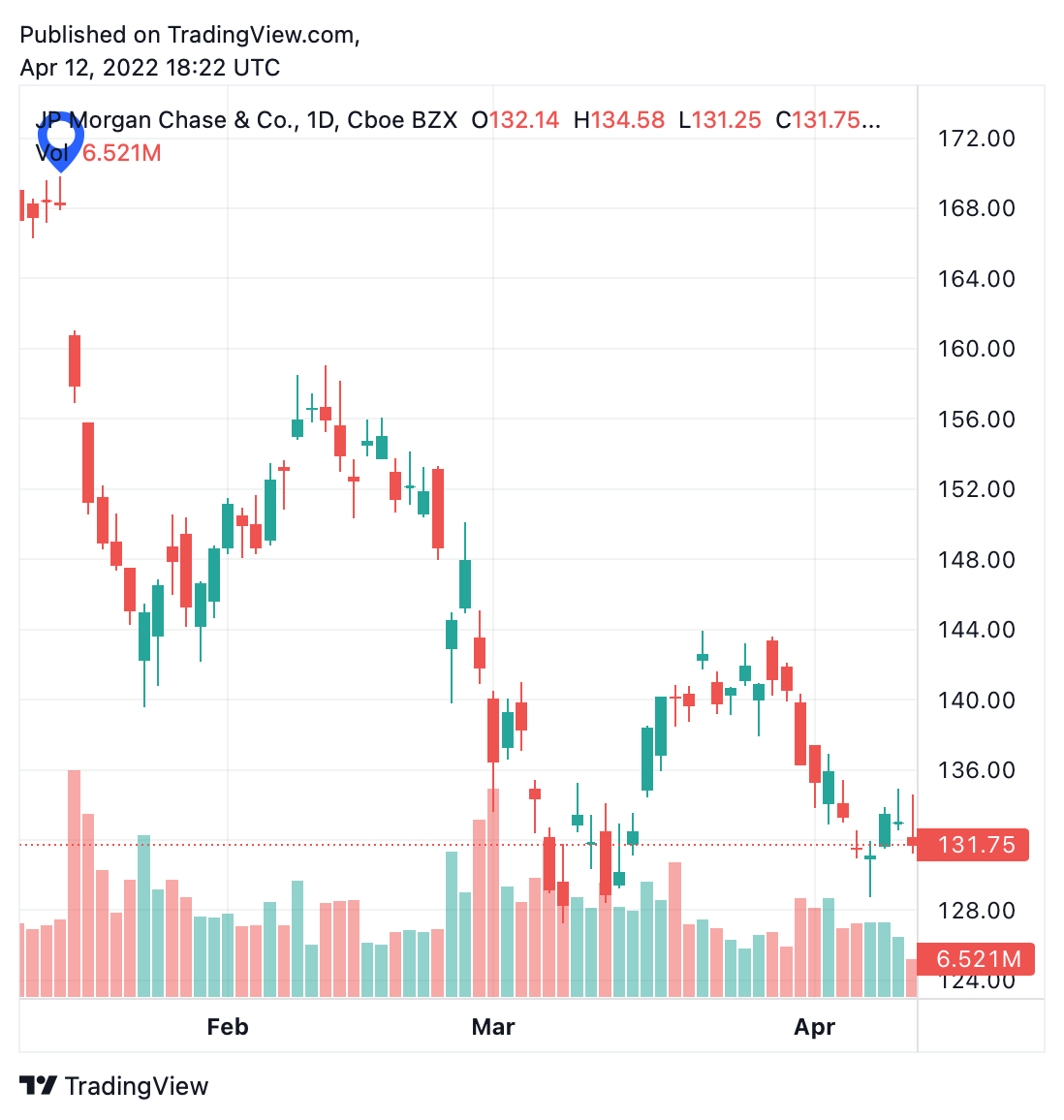 Chart courtesy of TradingView, prior earnings represented by blue arrow.
JP Morgan comes in with a slightly higher implied move of 4.07% ($5.37 for the at-the-money $132 straddle expiring 4/14, divided by a share price of $131.79). This is lower than their prior earnings move on January 14th of -6.14%, but higher than Blackrock’s implied move.
Is the options market underestimating $JPM’s earnings movement? A move of 4.07% would give $JPM a downside price of $126.43 and an upside price of $137.15.
Large option trades in $JPM skew in both directions today, with plenty of short-dated action — such as a $79K order of out-of-the-money $135 strike calls (for $2.37 per contract), and a $25K order of out-of-the-money $129 strike puts (for $1.27 per contract). With both trades expiring Thursday, the 14th, it’s clear that one of these traders will have to lose for the other to see profit.
$JPM is expecting $2.7 EPS, and revenue of $30.53B.
Delta ($DAL)
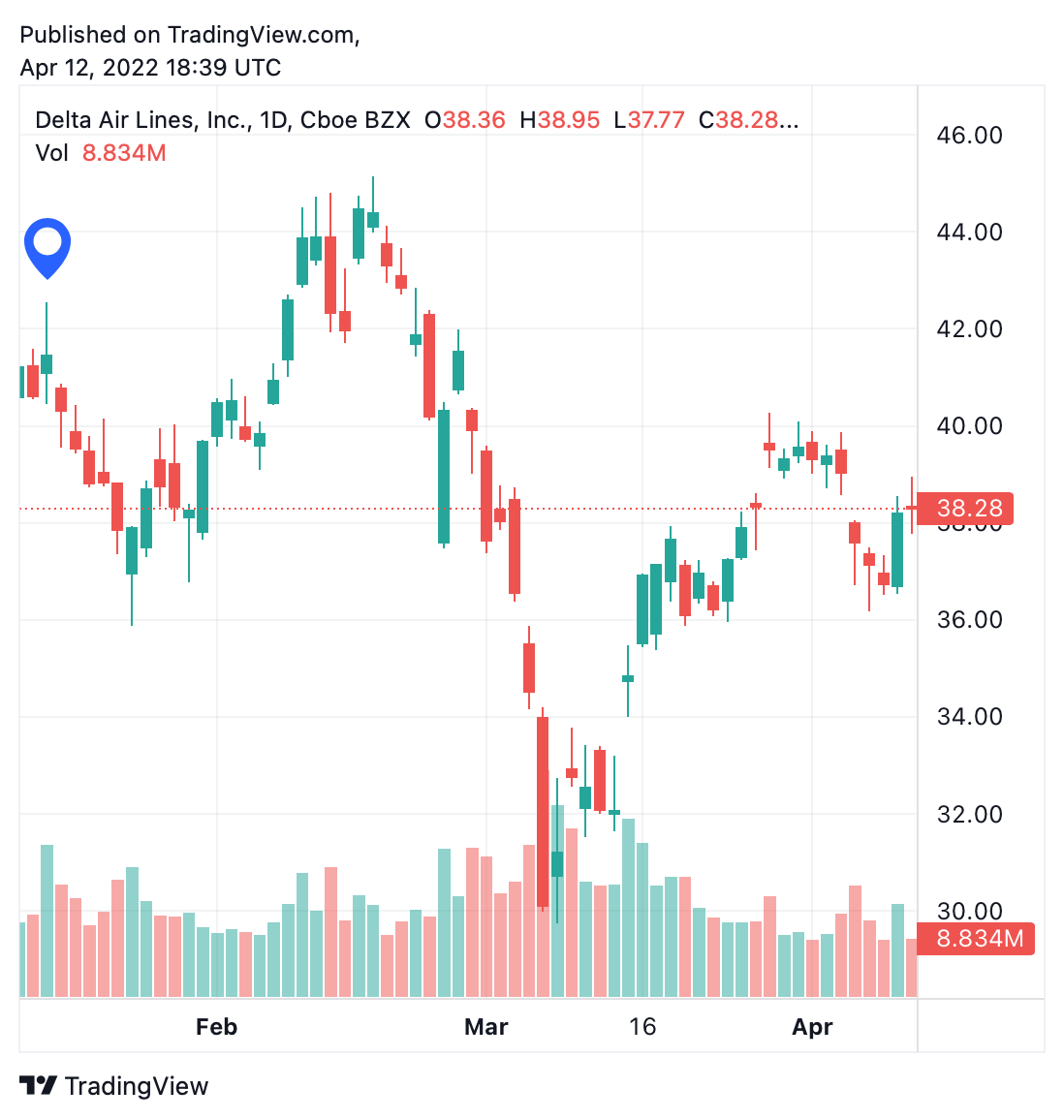 Chart courtesy of TradingView, prior earnings represented by blue arrow.
Delta Airlines is clocking in an implied move of 4.9% ($1.88 for the at-the-money straddle expiring 4/14, divided by a share price of $38.29), compared with a prior earnings move of just 2.11%! That means the market is expecting a move 132% greater than last season!
That would mean a potential upside share price of $40.17 and a potential downside share price of $36.41.
This pumped up implied movement hasn’t scared away option traders, with one trader purchasing 1,351 contracts of out-of-the-money $39 strike calls expiring this week! That purchase rang the register for a total price of $108,215, and was immediately followed just 40 seconds later with another $36,045 purchase in the same contracts! This trader spent just $0.80 per contract, and if the upside-implied-movement is right, he might get the move he’s looking for!
$DAL is expecting an EPS of -$1.28, and a revenue of $8.99B.
Bed, Bath and Beyond ($BBBY)
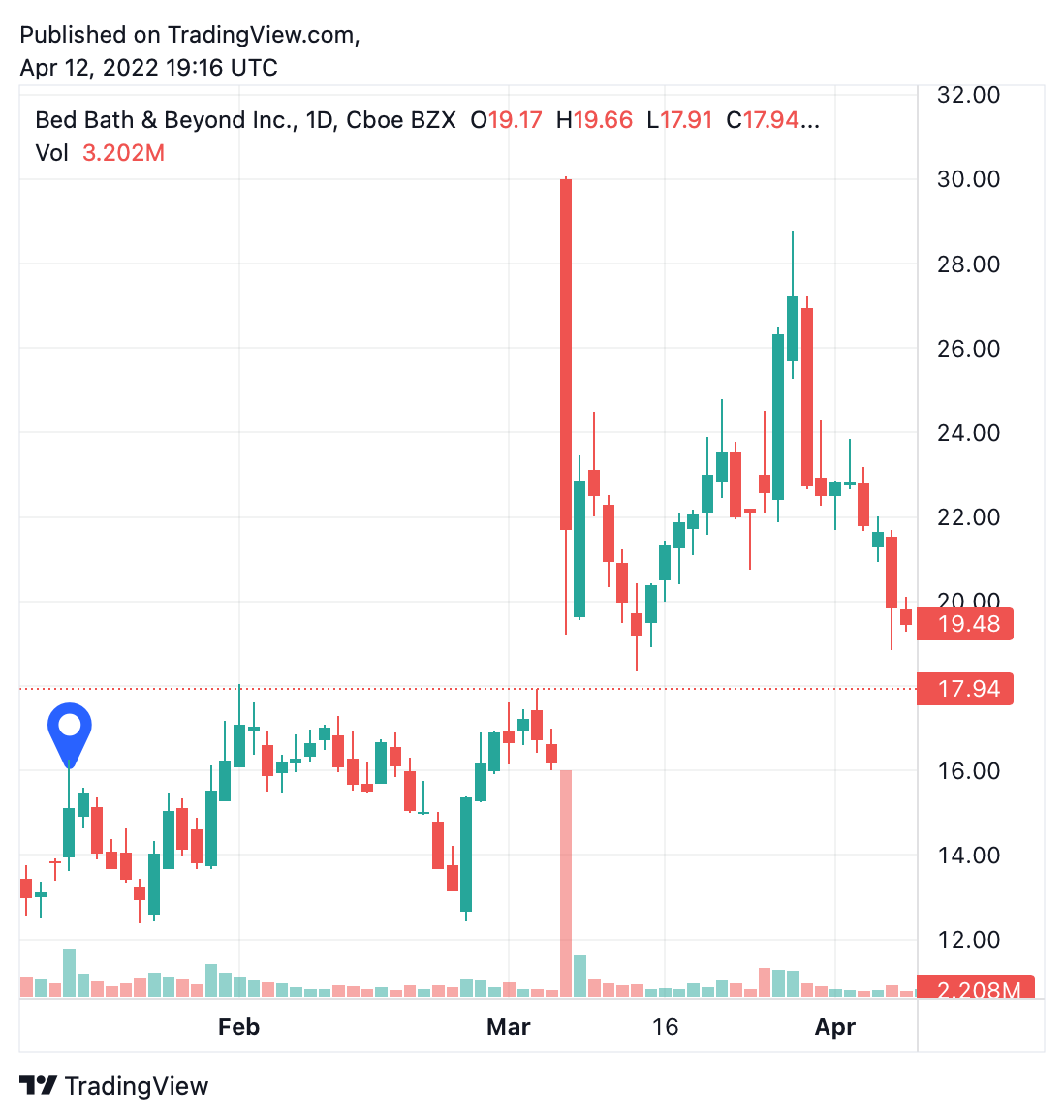 Chart courtesy of TradingView, prior earnings represented by blue arrow.
Last but not least, we have meme-darling $BBBY. Bed, Bath and Beyond went from struggling retailer on the edge of bankruptcy to potential buyout target after Ryan Cohen (CEO of another previously struggling retailer, Gamestop) revealed his stake in the company. $BBBY has a monstrous implied move of 16.47%! ($2.97 for the at-the-money, $18-strike straddle expiring 4/14, divided by a share price of $18.03) This is a truly huge expectation, given that $BBBY’s previous post-earnings move was just 7.92%!
If the options market is correct, that means a potential upside price of $21.00, and a potential downside price of $15.06!
Today’s option activity saw modest buying in the $19 strike weekly calls; two orders placed within 18 minutes of each other for $27.4K and $29.5K respectively, at an average price of $1.30 per contract.
$BBBY is expecting an EPS of $0.03 and a revenue of @2.08B.
The Bottom Line
Sometimes, when analyzing an earnings report, we need to read between the lines of EPS and revenue results. Often, it’s things like guidance, and little comments that CEO’s may make on the call that can make all the difference. For instance, people will be listening closely to the calls of $BLK and $JPM for comments about whether or not they feel a recession is in the cards for 2023. A recession would be disastrous for the entire financial sector, and comments about it would likely impact not only Blackrock and JPMorgan, but the rest of the big banks as well.
On the Delta earnings call, listeners will be watching for forward guidance, particularly as it relates to the recent increase in airline travel. Listeners will also be ready for comments about how the rising cost of fuel is affecting Delta’s bottom line, and if the airline has plans to mitigate that impact by raising costs elsewhere.
As always, the options market presents great opportunity and great risk every earnings season. By monitoring volatility, comparing it amongst similar stocks reporting in the same time period, we can gain insight into whether the prices that we could potentially pay for these options are over, or under priced. By keeping a close eye on all the data, we can give ourselves an edge when trading near-term options.