
Cryptocurrency
Bitcoin and the Gartner Hype Cycle
During the hype cycle of an emerging technology, ‘society tends to overestimate the impact of a development in the short run and underestimate the impact in the long run.’ This pattern has been seen in many technologies overtime. Within the last decade, this pattern has been recognized not only in blockchain technology, but also in […]
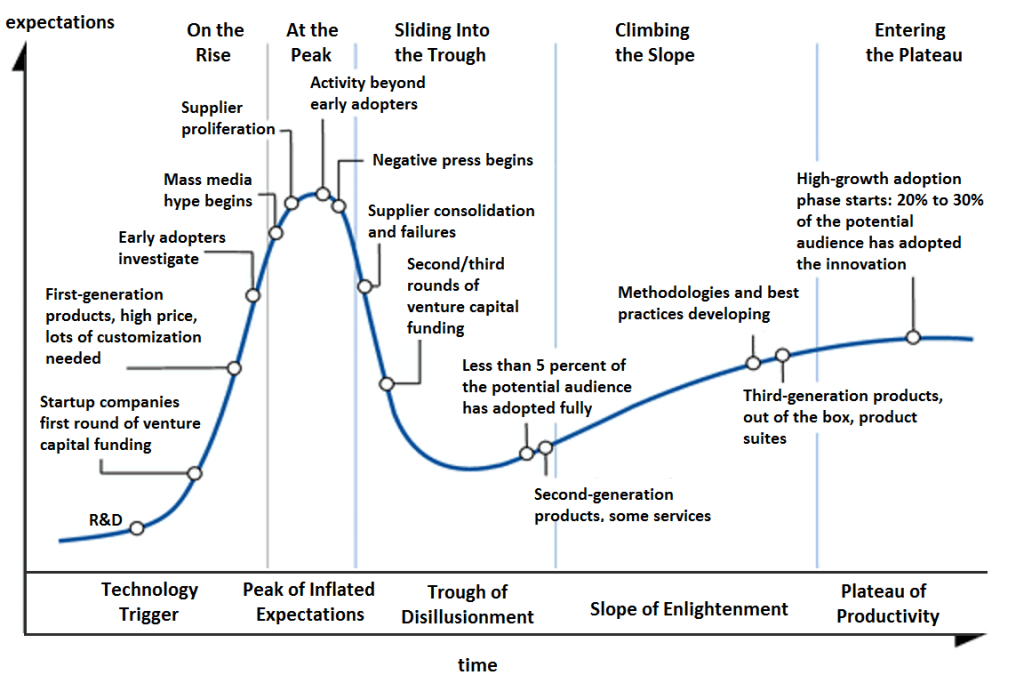
During the hype cycle of an emerging technology, ‘society tends to overestimate the impact of a development in the short run and underestimate the impact in the long run.’ This pattern has been seen in many technologies overtime. Within the last decade, this pattern has been recognized not only in blockchain technology, but also in Ai, VR, and other forms of augmented reality.
The hype cycle is outlined in five stages. The first stage is known as a technology trigger in which there are early proof-of-concept examples and forerunner public interest.
The second stage is referred to as the peak of inflated expectations. During this time the media produces a number of success stories and the potential of the technology is realized. This creates an investing peak and public euphoria surrounding the asset. Toward the end of the peak of inflated expectations, diminishing returns begin to emerge which transitions the technology into the third phase: trough of disillusionment.
The third phase is a result of negative media, mild technological failures, and societal recognition that the technology is in a substantially infantile stage. During this stage, less than 5% of the potential user base has adopted the technology.
Next, the innovation enters a stage called the slope of enlightenment. At this point, second and third generation technologies are created. User methodologies are improving and many successful use cases are applied.
The final step of the hype cycle is the plateau of productivity. This stage consists of adoption percentages of around 20-30% of the potential user base. The technology experiences positive and steady growth for years to come.
So what phase of the hype cycle is bitcoin and blockchain technology currently in? From a highly simplistic perspective, the price chart of bitcoin would indicate the innovation is somewhere in the trough of disillusionment phase. Although powerful institutional figures such as Lloyd Blankfein, CEO of Goldman Sachs, recently spoke positively about the future of bitcoin, there are still many skeptics who always doubt the future success of a particular technology, typically dismissing the asset as merely a subject of the ‘greater fools theory.’
According to the statistics company Statica, there are about 24,000,000 cryptocurrency wallets worldwide (Q1 2018). With a global population of 6.3 billion people, roughly 65% of which are adults ages 15-61. This demographic symbolizes a potential cryptocurrency user base. Therefore, (6.3B)(.65)/24M = 0.0048(100) = 0.48%. This equation would indicate the potential user base of cryptocurrencies is less than 1% globally. Therefore, total cryptocurrency and blockchain technology may still be early in the trough of disillusionment phase of the hype cycle.
Another indication is the potential to expand the user base and make it easier for newcomers to enter the space. For cryptocurrencies, technologies such as the lightning network may still be far away from mass implementation. Aside from the potential problems of centrality within the lightning network. Off-chain layering such as lightning and sharding have the potential to aid bitcoin and ethereum scaling issues.
Atomic swaps are another improvement feature of blockchain technology which aid in transactions through cross-chain communication. Swaps make it easier to exchange Altcoins. For example, Litecoin and Vertcoin can execute atomic swaps between chains. Unfortunately, it may take time before these swaps are implemented into the majority of Altcoins. This is because a cryptocurrency must successfully implement the lightning network before they can use cross-chain atomic swaps.
It is difficult to determine where exactly bitcoin is on the hype cycle. However, there has been speculation that the cryptocurrency bear market may be dying. This optimism is derived from the comparison between the cryptocurrency bear market of 2014 vs. 2018. “From December 4th, 2013, to January 4th, 2015 (a 400-day period), the bitcoin price dropped by over 80 percent. Recently, in a 200 day period it took BTC less than 200 days to decline by over 72 percent.” This model comparison is somewhat simplistic and it is often difficult to predict future trends with past data when it comes to emerging technologies. Yet, prominent figures in the field agree with this opinion for similar reasons.
For example, the CEO of cryptocurrency exchange BitMEX, Arthur Hayes, recently said in an interview with CNBC,
“Absolutely BTC can reach $50,000 by the end of 2018. I think something that goes up to $20,000 in one year can have a correction down to $6,000. I think we can find a bottom in the $3,000 to $5,000 range, but we are one positive regulatory decision away, maybe an ETF approved by the SEC, to climbing through $20,000 and even to $50,000 by the end of 2018,”
Although there are many people who want to be hopeful about the future of bitcoin, it is still uncertain which stage of the hype cycle bitcoin is currently in. Still with bitcoin’s dominance in the blockchain space, it it plausible that the only thing bitcoin needs to do to win is survive.
Disclaimer: This is not financial advice. Please do your own research and make objective decisions. This article is intended to educate readers about bitcoin’s relation to the Gartner Hype Cycle. The author of the article owns cryptocurrency.