
Cryptocurrency
Bitcoin Inflation Hedge Mantra Put to Test as Momentum Falters
Bitcoin Inflation Hedge Mantra Put to Test as Momentum Falters: (Bloomberg) Bitcoin’s stayed quiet so far this month, even as inflation prints show up hotter than expected. Chartists are now keying in on technical indicators to see where it could be headed. The price of Bitcoin is nearing the lower band of its Trading Envelope indicator […]

Bitcoin Inflation Hedge Mantra Put to Test as Momentum Falters:
(Bloomberg)
Bitcoin’s stayed quiet so far this month, even as inflation prints show up hotter than expected. Chartists are now keying in on technical indicators to see where it could be headed.
The price of Bitcoin is nearing the lower band of its Trading Envelope indicator — which smooths moving averages to map out higher and lower limits — suggesting it’s near a critical inflection point. If the lower level of the band is breached, the price could test its major support level of $30,000, which chartists say it needs to hold in order to sustain the current trading range. If it were to drop below and rally back, it could retest the upper trading band, which currently sits near $36,000.
“Bitcoin, I think, is too speculative of a market still, even though it has some institutional adoption,” said Brian Walsh, Jr., senior financial adviser at Walsh & Nicholson Financial Group. “There’s still a lot that has to be proven.”
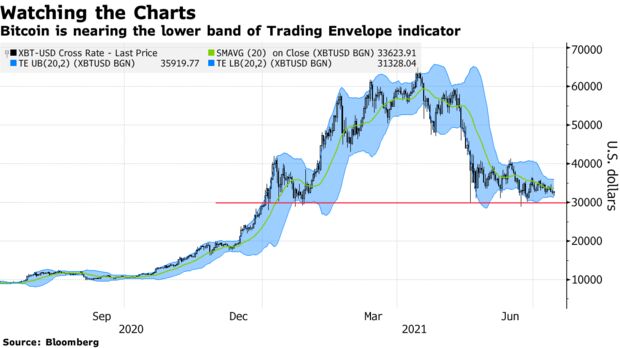
Bitcoin has remained relatively range-bound since the start of the month, hovering between $32,000 and $34,000, recently trading up about 1% at $32,841. But its appeal as an inflation hedge is being put to the test amid a slew of data showing higher costs associated with the reopening from the pandemic. Prices paid by U.S. consumers spiked in June by the most since 2008, while those paid to producers also rose by more than expected.
Hardcore enthusiasts have argued Bitcoin and some other cryptocurrencies are a hedge against rising consumer prices and excessive money printing from global central banks. The logic goes like this: Unlike U.S. dollars or any other traditional currency, it’s designed to have a limited supply, so it can’t be devalued by a government or a central bank distributing too much of it.
“It’s just so early and speculative that markets don’t really consider it an inflation hedge,” said Walsh. “Yes, there’s a finite supply — but that’s not everything.”