
Cryptocurrency
Bitcoin’s Wild Weekends Turn Efficient Market Theory Inside Out
Bitcoin’s Wild Weekends Turn Efficient Market Theory Inside Out: (Bloomberg) Bitcoin just notched one of its best weeks on record, surging about 40% over the seven days through Friday. Anyone expecting the notoriously volatile digital currency to take a breather this weekend had better buckle up. It’s on Saturdays and Sundays, when most other assets […]

Bitcoin’s Wild Weekends Turn Efficient Market Theory Inside Out:
(Bloomberg) Bitcoin just notched one of its best weeks on record, surging about 40% over the seven days through Friday. Anyone expecting the notoriously volatile digital currency to take a breather this weekend had better buckle up.
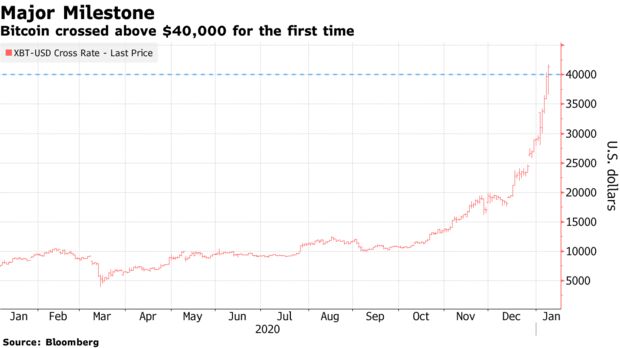
It’s on Saturdays and Sundays, when most other assets barely budge, that Bitcoin tends to go particularly nuts. Take the first weekend of 2021. Coming off a 300% gain last year, the world’s largest digital coin rose as much as 14% Jan. 2 and another 10% Jan. 3, a period when most of Wall Street was still in holiday mode. The swings were bigger than on any weekday in the prior two weeks and the biggest intraday moves since the weekend before, when it jumped 10% on Dec. 26, according to Bloomberg data.
Bitcoin’s not alone in trading all day, every day. What sets the coin apart is how big its price swings are outside of established business hours. It’s tough to find pricing for the dollar, for example, with currency-market participants usually in agreement to take weekends off. Bitcoin’s average swing on Saturdays and Sundays during the fourth quarter, on the other hand, was 1.5%.
The cryptocurrency’s weekend volatility spikes owe to a couple of factors. One is that it’s held by relatively few people — about 2% of accounts control 95% of all available Bitcoin supply. If these whales trade when volumes are thin, price swings will be magnified. Another is its market structure, which consists of hundreds of disconnected exchanges that in effect are their own islands of liquidity.
“People always tout Bitcoin as 24/7, 365 liquidity, but what that actually means is you have periods of very thin liquidity,” said Nic Carter, a partner at crypto-focused venture firm Castle Island Ventures. “If you want to deploy $500 million of Bitcoin, you probably want to do it during core banking hours.”
The crypto market is relatively nascent. Bitcoin, the original crypto, brought forth the movement a little more than 10 years ago. According to Greg Bunn, chief strategy officer at digital-asset firm CrossTower, the market remains hugely fragmented from an infrastructure standpoint.
Many platforms operate under different standards and with “different philosophies,” said Bunn, who spent decades with firms including Citadel and Deutsche Bank. Yet it lacks a centralized market structure akin to that of traditional assets, which tend to have common means of custody and settlement, for instance.
“If you think about the structure, that makes it conducive to things that are going to be very volatile and where you’re going to have big moves,” he said. “That’s obviously going to be impacted by when people are trading, when people are awake, when people are watching the markets.”
To Binance.US’s Catherine Coley, Bitcoin’s wild weekend patterns are reminiscent of her time trading currencies in Hong Kong in the early 2010s. Volatility sometimes became subdued during lunchtime lulls and around holidays. Professional traders, she says, tend to keep Monday-through-Friday schedules, so it makes sense that liquidity — or how easily an asset can be traded — would wane on weekends.