
Cryptocurrency
Blockstream’s Bitcoin Satellites Hope to Increase Global Adoption
Many have claimed the only way to shut down bitcoin would be to disable the entire internet. However, this is no longer the case. The Blockstream Satellite system is designed to broadcast the bitcoin blockchain all around the world without having to rely on an internet connection. After launching their fifth satellite into orbit on […]
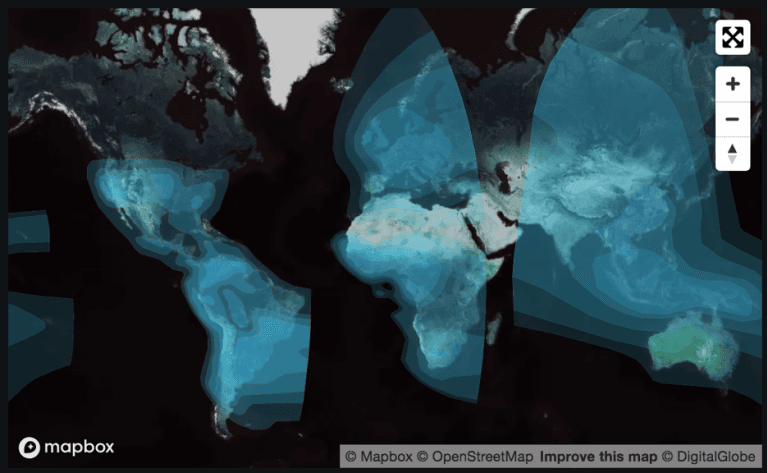
Many have claimed the only way to shut down bitcoin would be to disable the entire internet. However, this is no longer the case. The Blockstream Satellite system is designed to broadcast the bitcoin blockchain all around the world without having to rely on an internet connection. After launching their fifth satellite into orbit on December 18th, 2018, Blockstream’s satellites now cover the majority of Earth’s surface. These five satellites are currently located above five continents: North America, South America, Africa, Europe, and Asia. Below is a representation of satellite coverage from Blockstream’s website.
Blockstream’s satellite network saves users baseline costs by eliminating the need for a traditional internet service provider. Additionally, receiving information from Blockstream satellites is free, further increasing the economic incentive to switch. The cost to entry is low as Adam Back, CEO of Blockstream, explained the necessary requirements to interact with Blockstream’s satellites.
“With a perpetual generator out back with a satellite dish, a Raspberry Pi by the generator, a local wi-fi hot spot, and the necessary software set up, you could be transacting globally with bitcoin.”
Blockstream’s head of satellite, Chris Cook, said the cost to entry is roughly $100. The process of connecting to one of Blockstream’s satellites may sound expensive and complex, but in theory, an entire village could set up a shared node in which anyone in the village would have access to bitcoin transactions.
One of the most dangerous threats to the bitcoin network is a broad network blackout perpetuated by war, natural disaster, or other emergency situations. Blockstream satellites safe guard against these kind of attack vectors by providing the ability to send and receive bitcoin transactions as well as private encrypted information without reliance on the internet.This satellite development eliminates the need for a traditional ADSL connection and fibre optic network.
Samson Mow, CSO of Blockstream, expanded on this concept in a Coindesk article:
“For anyone relying on bitcoin for buying or selling goods and services, it would be a major problem if they were completely cut off from the network due to say an undersea internet cable being severed. It would cause a network partition where nodes would go out of sync – so users there could potentially accept a transaction that’s later invalidated. With Blockstream Satellite, as long as someone in a country is receiving, it would keep themselves and others in that region in sync with the rest of the bitcoin network.”
When viewing transmissions, Blockstream’s satellite API is still executing transactions using the Lightning testnet. According to Blockstream’s website:
“The Blockstream Satellite API is currently operating in Beta mode utilizing Lightning Testnet for payment. We will transition the API to mainnet in late January 2019.”
As Blockstream satellite development continues, bitcoin will become more accessible for citizens of the world. With additional users now able to access the network that were not previously possible, the continual adoption and economic incentive to operate a full node will bring more diversity to the bitcoin network.
Although these developments have not impacted price directly, they serve as a stepping stone for the long term vision of making bitcoin more decentralized as well as providing everyone in the world with access to the network. When extrapolating bitcoin’s timeline 10-15 years into the future, it may be possible to use bitcoin on Mars.
Disclaimer: I am not a financial advisor. This is not financial advice. Please do your research independently and make objective decisions. This article is intended to educate readers on the recent state of the cryptocurrency market. The author of the article trades cryptocurrency.