
Cryptocurrency
ETH 2.0, What it is and Why You Should Care
ETH 2.0, What it is and why you should care The most significant change yet is coming to the world’s #2 largest cryptocurrency Ethereum is one of the oldest and most battle-tested blockchains in existence, second only to the Bitcoin blockchain. A major selling-point of the Ethereum chain is its flexibility, which is about to […]
ETH 2.0, What it is and why you should care
The most significant change yet is coming to the world’s #2 largest cryptocurrency
Ethereum is one of the oldest and most battle-tested blockchains in existence, second only to the Bitcoin blockchain. A major selling-point of the Ethereum chain is its flexibility, which is about to be put to the ultimate test with the implementation of Eth 2.0. Where Bitcoin is hailed for its ability to serve as a store-of-value, Ethereum has historically been seen as a chain that is meant to be built upon: apps, contracts, and the creation of non-fungible tokens are just a few of the many applications of Ethereum.
As a result of the utility of Ethereum, price tends to fluctuate around demand for these various use cases. When certain apps gain traction, it can serve as a positive catalyst to drive up price. It’s all going to change with ETH 2.0: new tokenomics, new consensus, and new catalysts for price. Let’s take an in depth look at ETH 2.0 and what this historic upgrade means for crypto at large.
The History of Ethereum 2.0
Ethereum 2.0 is not necessarily a new idea among the Ethereum community. Since the very beginning of the Ethereum chain, there has been talk of shifting consensus away from Proof of Work due to its inherent limitations. Ethereum 2.0 arrives on the back of several successful upgrades to the Ethereum mainnet, namely:
Homestead, March 2016
Metropolis: Byzantium, October 2017
Metropolis: Constantinople, February 2019
Istanbul, December 2019
London Fork, August 2021
The launch of Ethereum 2.0 is especially significant compared to past upgrades because of the implementation of a Proof of Stake consensus mechanism, moving the network away from its existing Proof of Work architecture.
This upgrade is undoubtedly the most significant in the network’s history given the fact that the way the chain works will fundamentally change. This is the ultimate test of what makes Ethereum unique.
Proof of Stake
Shifting the consensus mechanism is the biggest test of Ethereum’s flexibility to date. This change to Proof of Stake (PoS) entirely changes the incentive structure used to validate transactions on chain. Currently, Ethereum is maintained by Proof of Work (PoW) which recently came under fire for the energy consumption required to validate the network.
Miners spend their time and money on hardware and electricity in exchange for block rewards, which are distributed to those who successfully mine a block into existence. PoW chains are extremely secure given the amount of computational energy and time required to validate the chain. However, this extreme security comes at the expense of scalability and accessibility issues. To better understand these issues, let’s take a look at how they are described by the Ethereum Foundation:
Scalability: Because each block is mined sequentially, and there is a finite amount of data that can be recorded in each block (a measurement known as block size), Ethereum can only process a limited amount of information in a given amount of time. If the number of pending transactions surpasses what a block can fit, then the remaining transactions have to wait for the following block, and so on. This scalability issue will be fixed by the implementation of sharding on the PoS network.
Accessibility: PoW miners have been fundamental to the creation and maintenance of the surge in decentralized technologies we have witnessed in the past decade. Though PoW blockchains are functional, the barriers to entry to be a miner are quite high. An individual must purchase and set up all the necessary hardware. To earn considerable returns from block rewards, that individual also likely must live in a region with lower electricity costs.
Further, due to the high cost associated with being a PoW validator, the average individual is cut out of participation. Several of the largest mining conglomerates, like $MARA or $RIOT, have utilized capital from investors and tax credits to set up massive mining farms and gain a significant share of the mining market. In Ethereum 2.0, one of the goals is for PoS to level the playing field for more individual validators to participate, earning a shared return on maintaining the truth of the network.
The Merge
Ethereum’s main chain (PoW) will eventually merge with Ethereum’s beacon chain (PoS). The beacon chain is already running on Proof of Stake and has roughly $35B of Ethereum staked in preparation for the merge. Once the merge occurs, investors who have staked assets on the beacon chain will be able to gradually withdraw and take profit. That being said, staking rewards on the beacon chain are estimated to increase from 4-5% to 9-12% apy since validation rewards previously distributed to miners will now be given to stakers.
Overall, it’s hard to predict what long-term stakers will do once they have the ability to unstake and take profit, but there’s a decent chance institutional demand for Ethereum’s yield will likely mask any sell pressure from long-term stakers.
Ethereum Becoming Ultrasound Money
In 2021, EIP-1559 was implemented, which added a mechanism to burn a portion of each Ethereum transaction fee. Furthermore, a continual reduction is intended to limit supply in the long run and lead Ethereum one step closer to the path of deflation. Since EIP-1559’s implementation, over 2.1m ETH has been burned. You can watch the burn live at ultrasound.money.
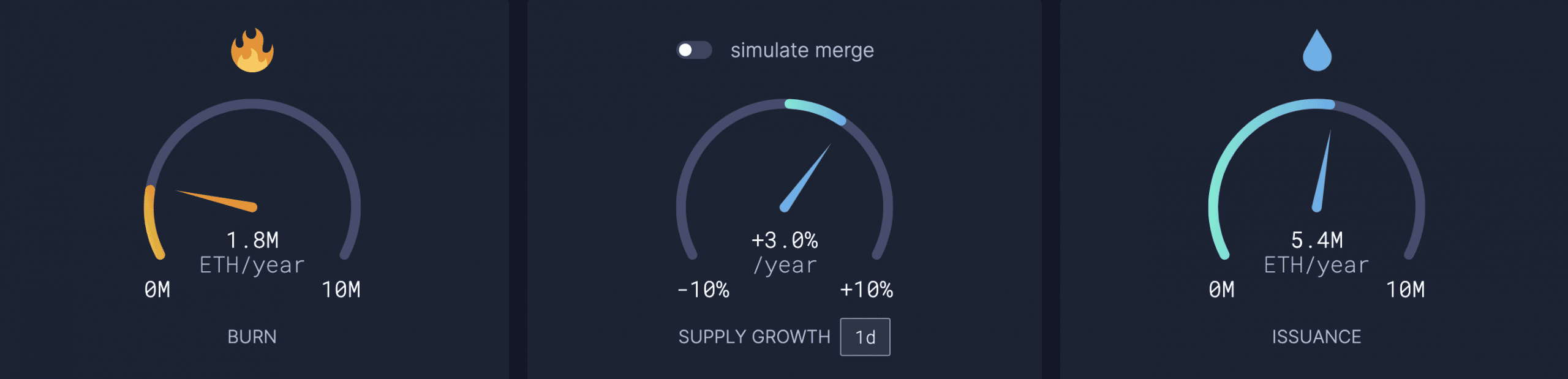
Current Statistics
The second step in the path to becoming ultra-sound money is the move from Proof of Work to Proof of Stake. Previously, a portion of gas fees were given to miners, however, once the transition to Proof of Stake is complete, stakers will receive this portion of the gas fee as an incentive to secure the network. As a result, Ethereum staking rewards are estimated to double after the merge.
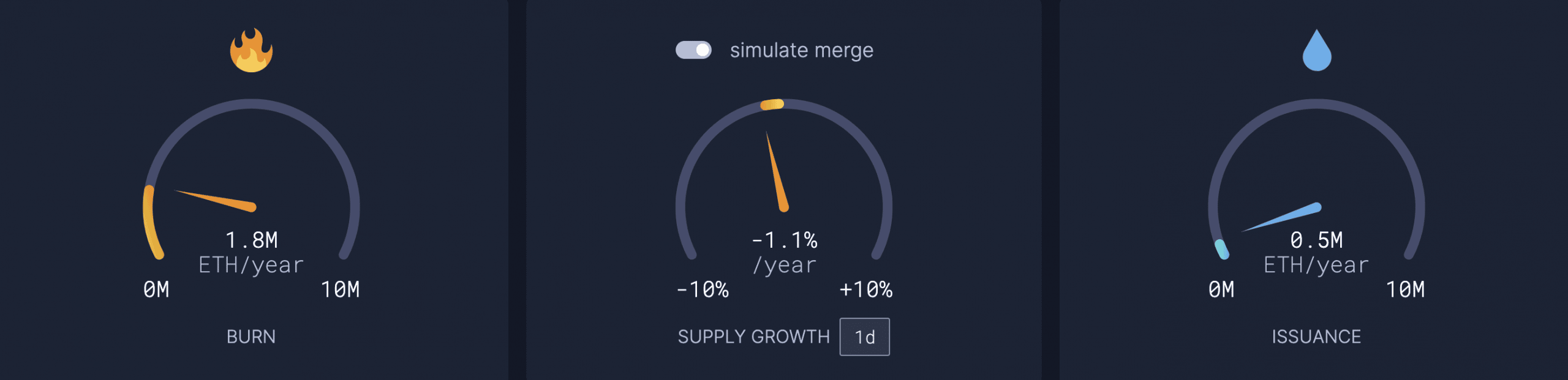
Post-Merge Estimates
According to Ethereum Foundation’s site, Ethereum is estimated to have deflation of roughly -1.1% following the merge to Proof of Stake. Additionally, yearly issuance of new tokens is estimated to decrease from 5.4m ETH to just 0.5M ETH. The more Ethereum applications are used, the more ETH will be burned. As activity spikes on the network, the tokenomics will automatically create scarcity. Here are the top applications currently burning the most ETH.
Source: Ultrasound.money
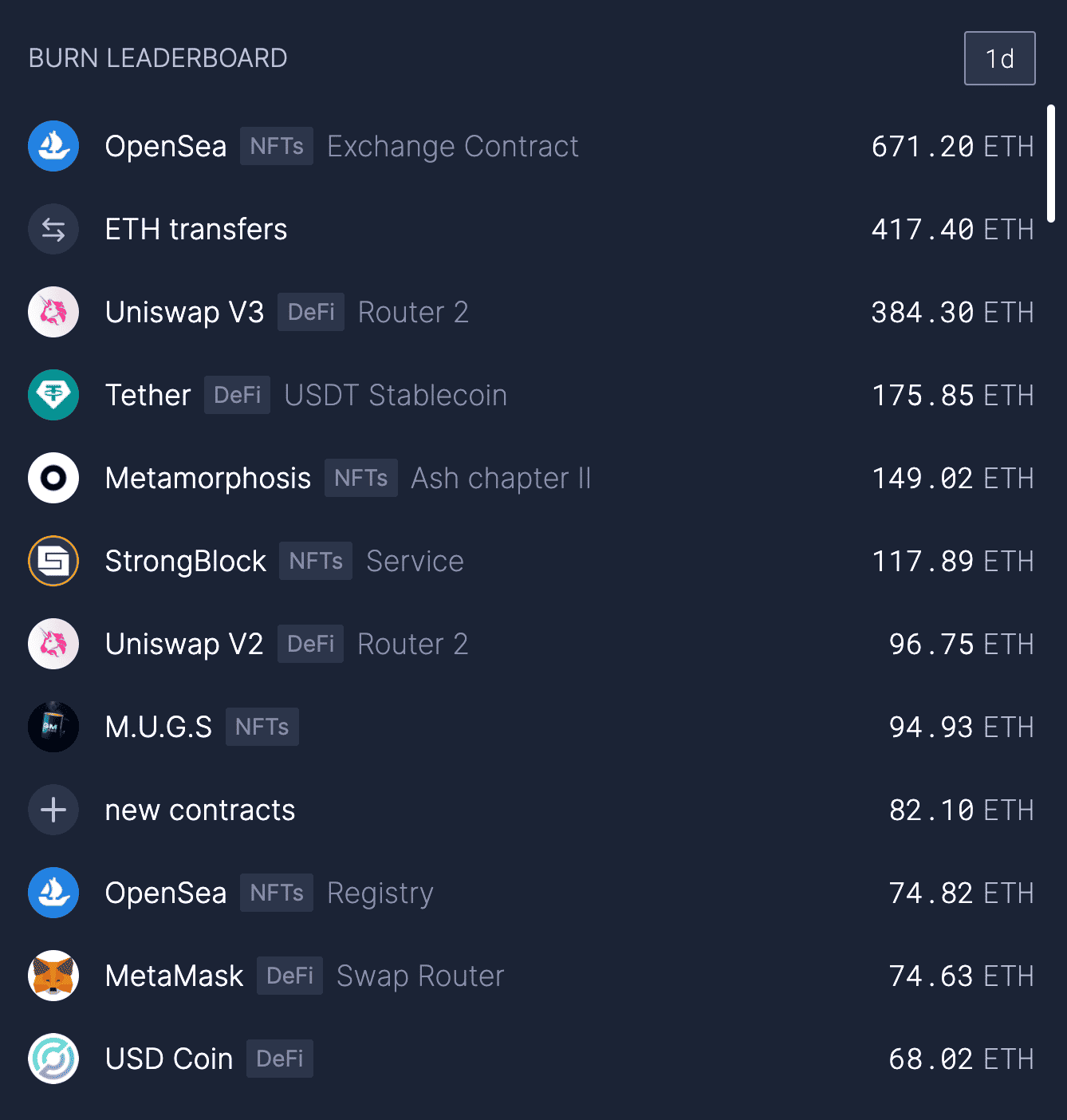
As you can see, most of the burn fees are a result of NFT sales/purchases on OpenSea, followed by volume on decentralized exchanges such as Uniswap. It will be interesting to watch this leaderboard evolve over time to highlight some of the most dominant applications on Ethereum.
Institutional Adoption of Proof of Stake Technologies Beginning with ETH 2.0 Staking
While Ethereum has been viewed as a speculative asset by broader market participants, the adoption of institutional stakers could change the tone of the cryptocurrency market – very similar to how MicroStrategy, Square, and Tesla changed the tone of the market after announcing their BTC purchases in 2020. These actions ultimately legitimized the industry from the viewpoint of the everyday person. The same could be true of Ethereum if institutions announce multi-million dollar buys following a successful launch of ETH 2.0.
What’s Keeping Institutions on the Sidelines?
Currently, anyone who stakes ETH for Ethereum 2.0 has locked their coins in a staking contract. However, users can’t withdraw or unstake these coins until the merge is complete – which has already been delayed and is ultimately up to the developers to determine a future launch date.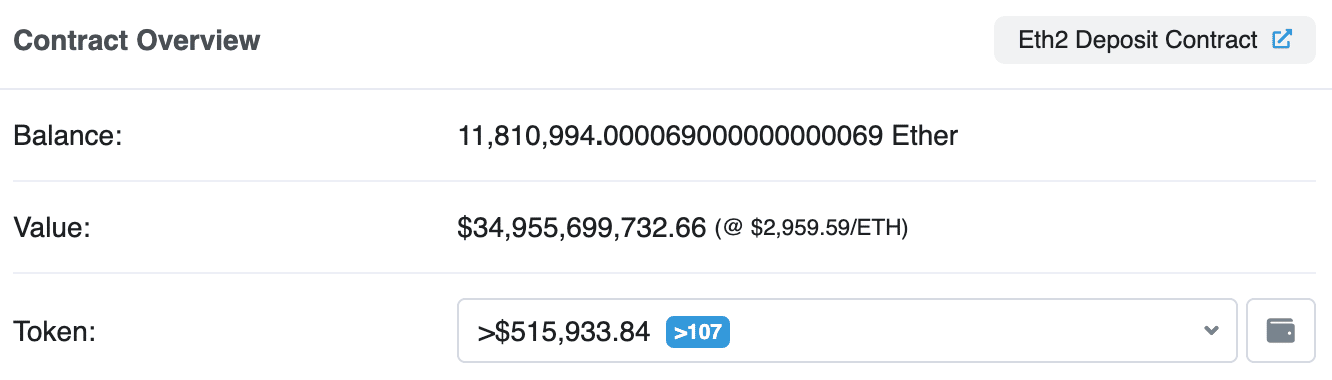
Not being able to unstake assets and having them locked for an undetermined period of time would deter any rational investor from participating – especially risk averse institutions. If the transition to Proof of Stake goes smoothly, institutions looking for yield on an emerging asset will undoubtedly feel better about the prospects of staking their ETH for the long haul.
ESG Concerns Will No Longer Apply
Many fund managers can’t invest in assets which are harmful to the environment or generally in opposition to humanitarian causes. Potential institutional capital has been sidelined because of concerns around the energy consumption involved in Proof of Work mining. Once Ethereum migrates from Proof of Work to Proof of Stake, it will require 99.5% less energy to secure the network. Therefore, ESG concerns will no longer be a barrier for any institutional fund seeking exposure to Ethereum.
Will the Unlock be a Bearish Catalyst?
There is about $35B worth of Ethereum staked on the beacon chain smart contract until the merge. So $35B in assets will essentially remain trapped/ locked until Vitalik and team completes the merge. So will these market participants sell once their coins are unlocked? Many have been staking ETH at prices below $2,500. We must assume some of the stakers will realize profit, but since staking rewards are estimated to double, long-term ETH bulls will likely continue to stake unless another crypto winter resumes. Additionally, institutions who are waiting for the merge to be successful may begin staking once the update is complete.
Will the Ethereum Merge Lead to Lower Gas Fees?
Like most Layer 1 platforms, Ethereum requires a gas fee for an action to be executed on the network. Despite the increased popularity of Layer 2 applications such as DYDX and Loopring, Ethereum still faces a lot of criticism for being a ‘whale chain’, by effectively pricing out the everyday user who can’t afford to pay a gas fee of roughly $50-200 per transaction.
The initial steps of Ethereum’s merge are focused on the implementation of ultra-sound money, not necessarily scaling gas fees for the everyday user. While the Ethereum foundation has a plan for sharding and continual scaling, it is scheduled in the roadmap for a later date.
What Will Happen To Other Layer 1 Networks Post Merge?
Crypto Twitter likes to debate market outcomes in absolutes. But the reality is usually more nuanced. We’ve seen ideologies morph throughout time and fade. Whether it’s maximalism around BTC or ETH, there have always been opportunities in the speculative competing alternatives.
At least for the time being, high gas fees will continue to price the average user out of Ethereum. The door is open for alternative Layer 1s which prioritize high throughput and low gas fees. Many of these projects already utilize the Ethereum virtual machine, therefore, developers can easily migrate Ethereum-based projects onto competing layer 1s.
We’ve already seen the impacts of project migration. For instance, AAVE and DeFi Kingdoms both migrated to Avalanche and have added significant total value to the ecosystem. This will likely continue, plus once those users are lost, there’s no guarantee that they’ll automatically return to Ethereum once scaling solutions are implemented.
Final Thoughts – Themes and Possible Chain Reactions Post Merge
Obviously, the migration of ETH from Proof of Work to Proof of Stake is expected to be a bullish catalyst for the entire cryptocurrency market. However, Bitcoin and Ethereum have recently recorded their highest ever 90-day correlation to the Nasdaq and S&P 500. Therefore, crypto is still at the mercy of traditional markets for the time being. Nevertheless, if market conditions return to being macro bullish, there will likely be many opportunities to take advantage of.
Here are a few themes that could play out once the merge is complete:
First – Liquid Staking for Institutions
Nexo
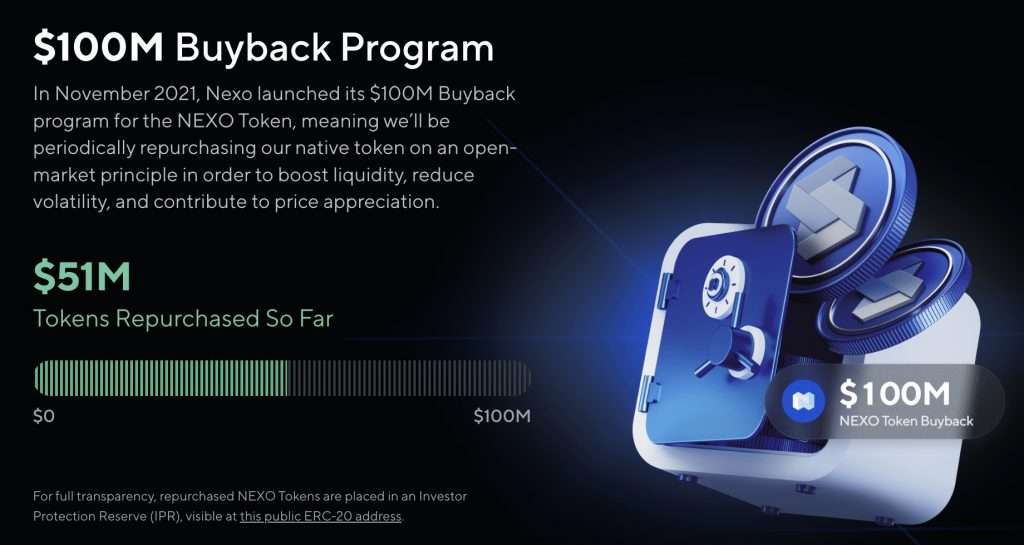
As institutions enter the crypto market, they want to work with reliable custodians and limit counterparty risk in any way possible. One company gaining prominence in the institutional crypto space is Nexo. If you’re a large fund looking to stake assets, Nexo will provide you with everything you need to take advantage of Ethereum yields post-merge. Additionally, $NEXO is a traded token which provides a boost in interest for holders of $NEXO token through its loyalty program. Furthermore, the firm participated in a $100M token buy back program, so Nexo is putting its money where its mouth is. If Nexo wants to change the incentives of its loyalty program due to an opportunity from increased institutional demand, keep an eye out for institutional accumulation after the merge.
Quick Link – Nexo’s public address, currently filled with $100M worth of $NEXO
Lido
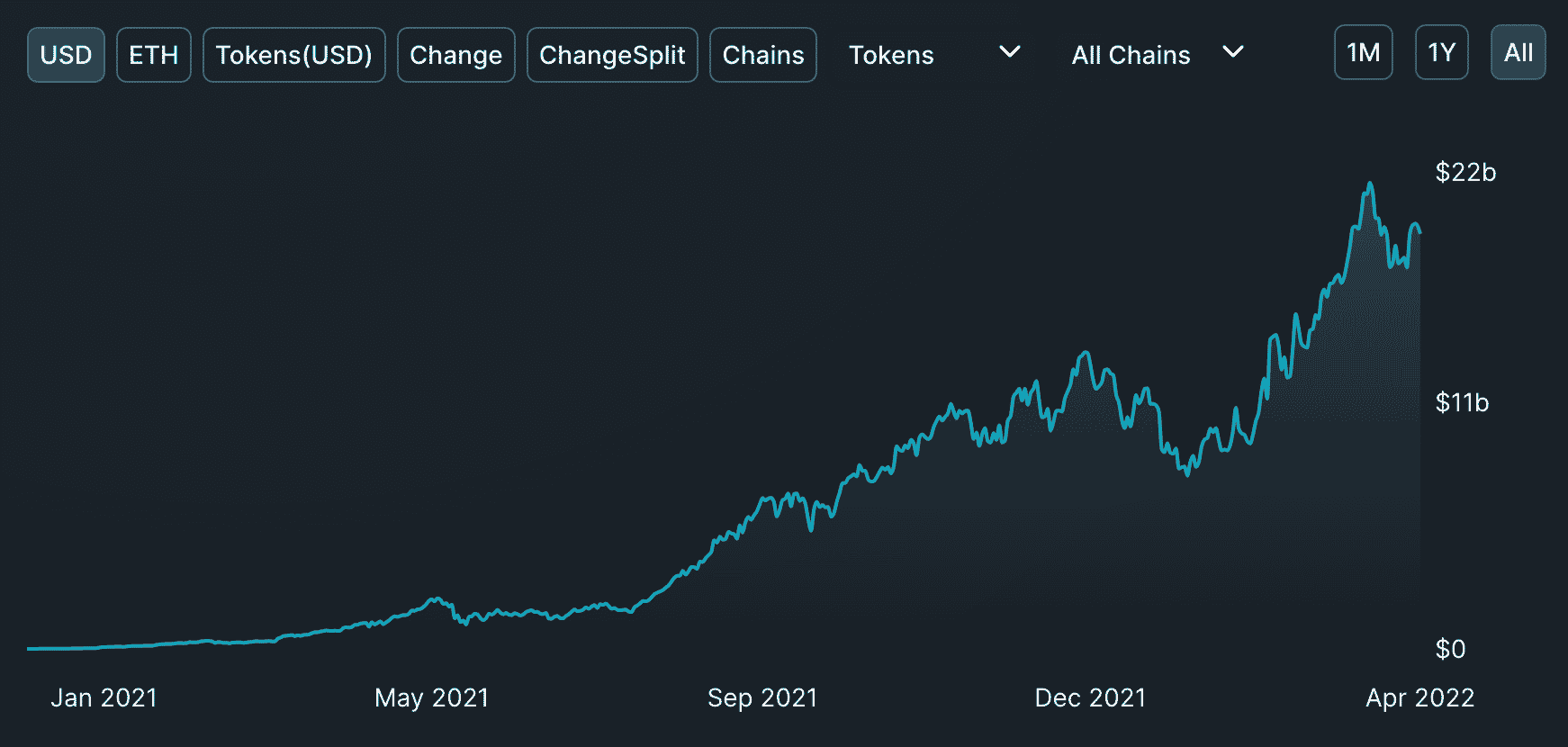
Lido is a DeFi staking protocol which allows users to stake and unstake assets of various networks without lockups. For example, the Terra ecosystem provides roughly 5% to stakers of Luna. However, it takes 21 days to unstake Luna. With Lido, users pay a small management fee so they can stake/unstake whenever they want. We’ve already seen a surge in the price of Lido Dao Token as total value locked within its ecosystem continues to skyrocket. When viewing the chart above, Lido has reached a high of roughly $22B in total value locked on the platform. As retail and institutional investors look to take advantage of the yield provided by Proof of Stake networks, Lido Dao Token could be an interesting asset to monitor for potential exponential growth.
Second – Layer 2 Applications
Loopring and DYDX have emerged as the most prominent layer 2 Ethereum applications. While layer 2 applications have underperformed alternative layer 1 protocols, we still believe layer 2 applications with optimal tokenomics will likely play a large role in the future of the Ethereum ecosystem.
Third – Alternative Layer 1s
2021 was the year of the alternative layer 1. With Sol, Luna, Avax, Near and many others leading the charge, DeFi users will continue to be priced out of Ethereum DeFi because of high gas fees. The merge update estimated for Q3-4 of 2022 will not improve gas fees drastically, so we predict alternative layer 1s will still play a large role in the crypto ethos.
Summing Up…
ETH 2.0 will be the ultimate test of Ethereum’s flexibility and is the most significant upgrade in the chain’s history. Not only will ETH 2.0 fundamentally change the way Ethereum operates, but it will also have a ripple effect throughout the entire market. Understanding what exactly the upgrade entails is the best way to prepare to capture potential upside in price following the implementation.
At the time of writing, authors of the article are long BTC, ETH, SOL, LUNA, AVAX, LDO, NEAR, FTM, RUNE, DOT
Interested in learning more about crypto trading? Get the first week for just $7 at marketrebellion.com/trycrypto.