Trading Insights
Fed Doves Get Hawkish on Rate Hikes
QUICK LOOK: On Tuesday, Fed Governor Lael Brainard and Fed President Mary Daly have signaled that they see higher rates and an “aggressive drawdown” of the central bank’s balance sheet. “Inflation running at a 40-year high is as harmful as not having a job”, said Daly. “The FOMC will continue tightening monetary policy through a […]

QUICK LOOK:
- On Tuesday, Fed Governor Lael Brainard and Fed President Mary Daly have signaled that they see higher rates and an “aggressive drawdown” of the central bank’s balance sheet.
- “Inflation running at a 40-year high is as harmful as not having a job”, said Daly.
- “The FOMC will continue tightening monetary policy through a series of interest rate increases” said Brainard, “and by starting to reduce the balance sheet at a rapid pace as soon as our May meeting.”
- These sentiments were bolstered by Fed President Harker, who said “I’m also worried that inflation expectations could become unmoored.”
- Harker said he expects, “A series of deliberate, methodical rate hikes”
- All three major indices are down for the second day in a row.
- Interest rates, defined: The cost that someone must pay in order to use someone else’s money.
Rate hikes are not a new talking point from the Fed, so why is the market falling?
On Tuesday, Fed Governor Lael Brainard expressed concern about growing inflation, vowing to do everything in her power to fight it, including raising rates. This sentiment was echoed by Fed President Mary Daly, who said on CNBC that raising rates is necessary to ensure the economic security of the American consumer.
The following day, Philadelphia Fed President Patrick Harker would come out with a similar tone. He expressed “acute concern” over inflation and a need for “deliberate, methodical rate hikes”. Hawkish comments from these three influential Fed officials have roiled the market over the past two days.
Why is This News?
This isn’t the first time Fed officials have talked tough about impending rate hikes. Last Month, St. Louis Fed’s President Bullard said the central bank should raise rates 12 times this year, to a target federal funds rate of over 3%. To put it into perspective, the current plan forecast by the last FOMC meeting is 7 hikes this year, and a target federal funds rate of 1.7%. Bullard’s target is roughly twice as Hawkish. And yet, the market didn’t have a problem with Bullard’s dissent or his hawkish comments. In fact, the day this happened (last month’s FOMC meeting) the market roared.
The catch? Bullard is a known hawk. He’s been hawkish the whole time. He was the only Fed President to dissent last month’s rate hike (in favor of a larger one), in what was the first dissented decision since 2020. The market already knew how he felt, and he made no bones about expressing it frequently.
But Lael Brainard? Mary Daly? The market thought they were doves — in favor of a softer landing and a slower ease of accomodative monetary policy. Finding out that they’ve changed their opinion to one that is decidedly more hawkish represents a potential shift in the trajectory of future rate hikes. And hearing that opinion confirmed by Fed President Harker is a sign that Fed officials are setting the stage for a decidedly more hawkish approach at May’s meeting.
How the Market Reacted
In short: Not well.
When the news came out at last month’s FOMC meeting that the Fed was planning 7 rate hikes this year, it was met with some market relief. Seven was more hikes than the Fed had previously forecast, but it was seen as tolerable to the market. The result was a rapid, “everything rally”, where all of the major indices finished the day up over 1%, with the Nasdaq up nearly 3%. Many growth stocks rose even more.
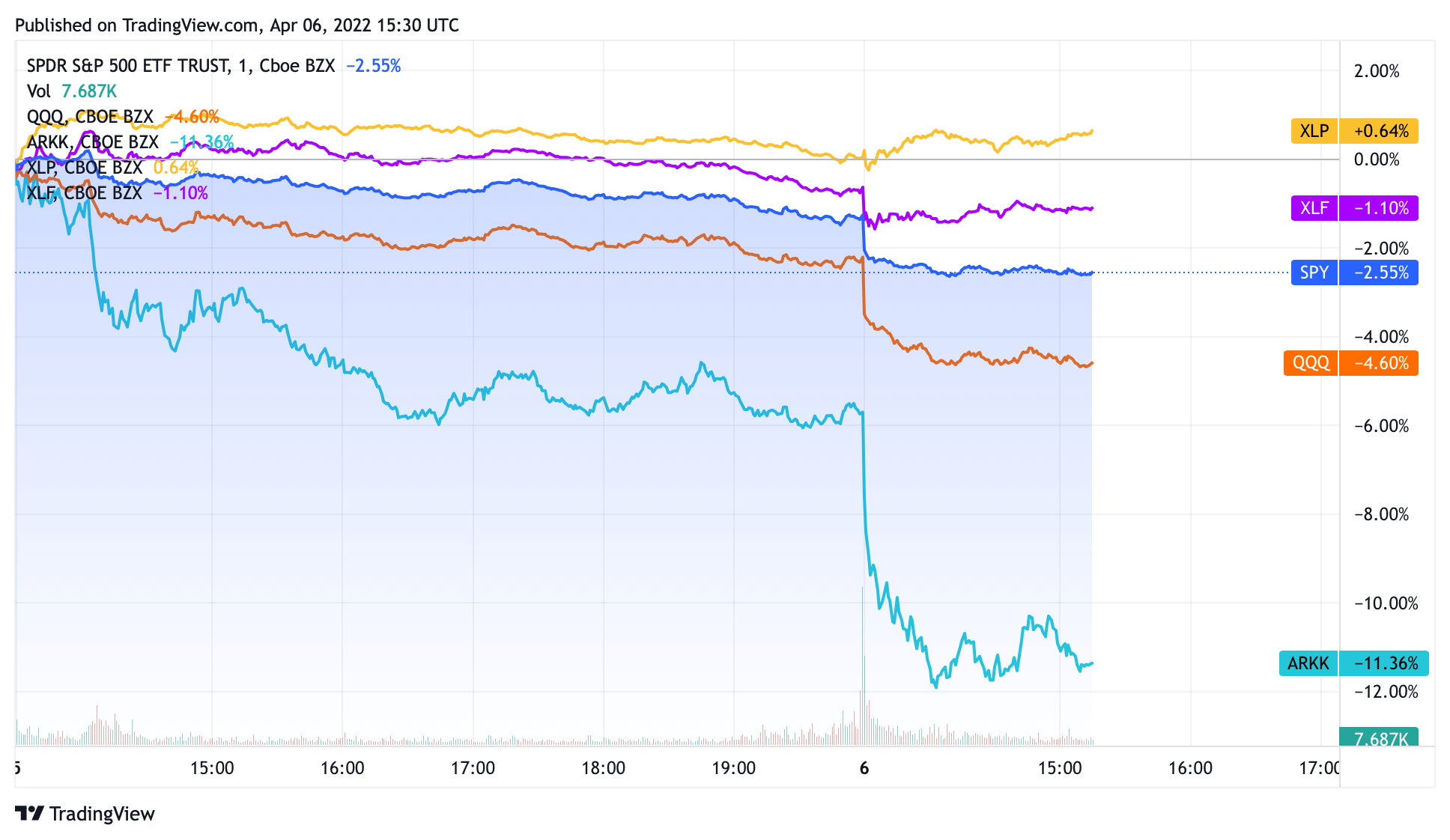
Today, the opposite is happening. Over the past two days, the S&P 500 is down more than 2.5%, the Nasdaq is down more than 4.5%, and the growth-heavy ARK Innovation Fund ($ARKK) is down more than 11%. But if you squint hard enough, you can still find some green. Investors looking for a safe haven often flock to defensive sectors, like the consumer staples ($XLP) and the financial sector ($XLF), when the market gets fearful.
Why Traders Should Care
Traders need to keep a close eye on rate hike-related news. By using charts like the one above, they can determine the flow of momentum into and out of sectors, trading accordingly. But charting isn’t the only way traders could have exploited this move.
For instance, if you were using an unusual options activity strategy, you could have followed the “smart money” into the $ARKK puts they bought on March 31st and April 5th, before the massive decline.

Or, if you were trading on technical indicators, you could have watched the daily RSI on the $QQQ, which tracks the Nasdaq Composite Index. If you did, you might have seen that it was overbought, with an RSI of more than 80 on April 4th — the day before the drop. Stocks with an RSI higher than 70 are considered “overbought”.
Regardless of the strategy you could have used to trade this move, it’s clear that there were plenty of trading opportunities. What’s important is that you have the discipline and knowledge to take advantage of those opportunities when they present themselves.
If you’re interested in becoming a better equipped trader, or finding a new strategy that fits your trading style, check out Market Rebellion’s many unique trading services.