
Cryptocurrency
How Would a Stock Market Crash Impact Bitcoin?
Currently, the US Stock Market is in one of the most prosperous bull markets ever seen. Some commentators enthusiastically claim we are experiencing the longest and strongest economic expansion in the history of the Stock Market. By observing the chart below you can see that our current bull market has not been the strongest rally […]

Currently, the US Stock Market is in one of the most prosperous bull markets ever seen. Some commentators enthusiastically claim we are experiencing the longest and strongest economic expansion in the history of the Stock Market. By observing the chart below you can see that our current bull market has not been the strongest rally to occur in history. The bull market from 1921-1929 was the strongest rally, increasing 500% in just seven years. This is vastly different from our current bull market (2009 – 2018) which has only increased by 300%.
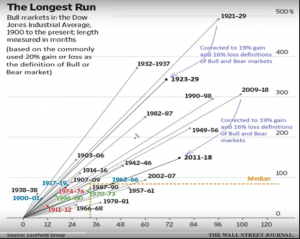
According to the standard definition given by the Wall Street Journal, a movement of 20% or more in either direction defines a market condition being either bullish or bearish. According to this metric, the current bull run has been the longest in history. Consequently, not all analysts agree on this percentage. Many analysts argue that the 20% metric is false and therefore the proper metric is between 16-19%. This would indicate that the current bull market began in 2011, not 2009.
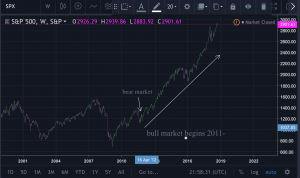
Although there is strong evidence to suggest the bull market did not begin until 2011, a seven year bull market is still very long relative to most expansions. It could also be possible that the market is being temporarily propped up by corporate stock buy backs. According to CNBC, “Companies have set a record for share buybacks in the second quarter.” This factor is not new, however it has recently been compounded by the fact that Wall Street CEOs are selling off their personal shares at a record rate. According to an article from CBSnews.com,
“Stock sales by company executives reached $5.7 billion, according to data from TrimTabs Investment Research — the highest September in a decade.”
Taking profit during all-time highs is a totally logical decision. What is concerning is the rate in which executives are issuing these selling offs. This does not indicate a market crash is immediate, but there will inevitably be a correction most likely occurring within the next 1-2 years. Interestingly enough, many analysts have been predicting a stock market crash for years and as legendary investor Jim Rogers once said, “Markets can remain irrational for longer than you can remain solvent.”
Many individuals in crypto are of the mentality that Bitcoin and crypto is a hedge against society, inflation, and US Stocks. Also, Bitcoin is often referred to as digital gold and a store of value in time of crisis and uncertainty. Therefore, Bitcoin would thrive in a US Market crash. However, Bitcoin has never been put to this test before. It emerged out of the ruble of the 2008 crisis and has existed along side a thriving US Stock Market for the past 9 years. But if a crash/correction occurs within the next 12 to 14 months, investors will likely embrace tactics of risk aversion. This includes investing in stable commodities and precious metals such as gold and silver. After the 2008 financial crisis, the value of gold more than doubled from 2009 to 2011.
In the event of a recession, the mindset of fund managers changes from ‘risk-on’ to ‘risk-off.’ Currently, we are still in ‘risk-on’ mode, but if a correction occurs fund managers will be interested in ‘risk-off’ assets. Up until now, Bitcoin has been a ‘risk-on’ investment which leads one to believe investors won’t be as enthusiastic to immediately jump on board. This may also be true for small business owners and the middle class. If individuals are losing money in their equity-based retirement funds, and in effect, spending & consuming less, they may be more reluctant to invest in cryptocurrencies which are currently the most speculative asset class in modern existence.
In the short term, it is very difficult to speculate if bitcoin would thrive or burn in a US Stock Market crash. However, the long term impact on our society and culture could be much more profound. If a US Stock Market crash were to occur, and the effects were worse than the catastrophe of 2008, that event would further instill a negative sentiment millennials have about banks. Millennials already witnessed many of their parents lose millions in the crash of 2008, if a similar event were to occur, their confidence in banking and the financial sector would further disintegrate. In addition, buying Bitcoin has been a favorable investment for millennials as opposed to owning traditional stocks. This could ultimately push their generation toward a global financial world centered around a blockchain ledger. The short term impact of a US recession on the price of Bitcoin is uncertain, or at the very least highly speculative. But long term, another great recession could shape the minds of an entire generation, thus pushing them toward cryptocurrencies and decentralized systems, ultimately leading to the greatest currency shift in the history of civilization.
Disclaimer: I am not a financial advisor, this is not financial advice. Please do your own research and make objective decisions. This article is intended to educate readers on the possible US Market Crash and its effects on the cryptocurrency market. Disclosure: the author of the article owns cryptocurrency.
Additional Sources:
Image sources are from tradingview.com WSJ, and Alessio Rastani leadingtrader.com