
Cryptocurrency
If You Like Gold, You’ll Love Bitcoin
Both Bitcoin and gold holders rejoiced this week as their assets rapidly reached price highs. Interestingly, price is not the only thing reaching highs this week among these two assets; the realized correlation between the two assets has hit an all-time high. Data from Skew has been beautifully visualized to demonstrate just how significant this […]

Both Bitcoin and gold holders rejoiced this week as their assets rapidly reached price highs. Interestingly, price is not the only thing reaching highs this week among these two assets; the realized correlation between the two assets has hit an all-time high. Data from Skew has been beautifully visualized to demonstrate just how significant this correlation has become in recent weeks:
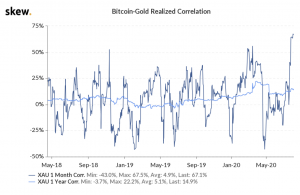
The one month realized correlation between the two assets is now at 67.1%, an all-time high. The timing of this spike in correlation is no coincidence, as people are begin to doubt the future parity of the dollar as government stimulus is also at an all time high. Historically, in times of massive economic uncertainty, people look for safety in hard assets like gold to maintain wealth regardless what happens to the value of their native currency. This is the very same reason people are buying Bitcoin today; it is an asset with a truly finite supply. In every commodity market in the world, greater demand leads to higher prices, which leads to increased production of the commodity. Gold’s supply increases yearly at a small rate due to the arduous process of mining and the lack of rich gold deposits, but the production rate has historically fluctuated and altered the price. Because of Bitcoin’s truly finite supply, the community can speculate on other metrics in order to predict the direction of price. I think Mike McGlone of Bloomberg summed it up nicely;
Restricted supply means adoption is the metric that matters, and most indications remain positive in an unprecedented environment where virtually every central bank is aggressively adding liquidity.”