
Cryptocurrency
Legendary Trader Launches Healthcare Revolution at the Inaugural Market Rebellion Conference
By Cj Reichel and Matt Montemayor Intro: The Indicium Group (“Indicium”) Mark Fisher, one of the most well-known traders on Wall Street, has launched a revolutionary healthcare solution that utilizes initial coupon offerings and blockchain technology to put more power in the hands of the consumer. Many Americans believe healthcare reform is something that is […]

By Cj Reichel and Matt Montemayor
Intro: The Indicium Group (“Indicium”)
Mark Fisher, one of the most well-known traders on Wall Street, has launched a revolutionary healthcare solution that utilizes initial coupon offerings and blockchain technology to put more power in the hands of the consumer. Many Americans believe healthcare reform is something that is long overdue, and Mark Fisher’s solution may be exactly what people are looking for. Here’s how he plans to change the role consumers play in the healthcare system:
First, it’s important to understand Indicium connects drug companies that have successfully completed Phase 1 and are attempting to fund research and development of new drugs with the very patients that need them. They accomplish this by using decentralized contributions and the issuance of Digital Prescription Coupons (“DPC”) utilizing blockchain technology. Partners of Indicium have the exclusive rights to fulfill prescriptions for patients using the secure Indicium environment.
The Problem:
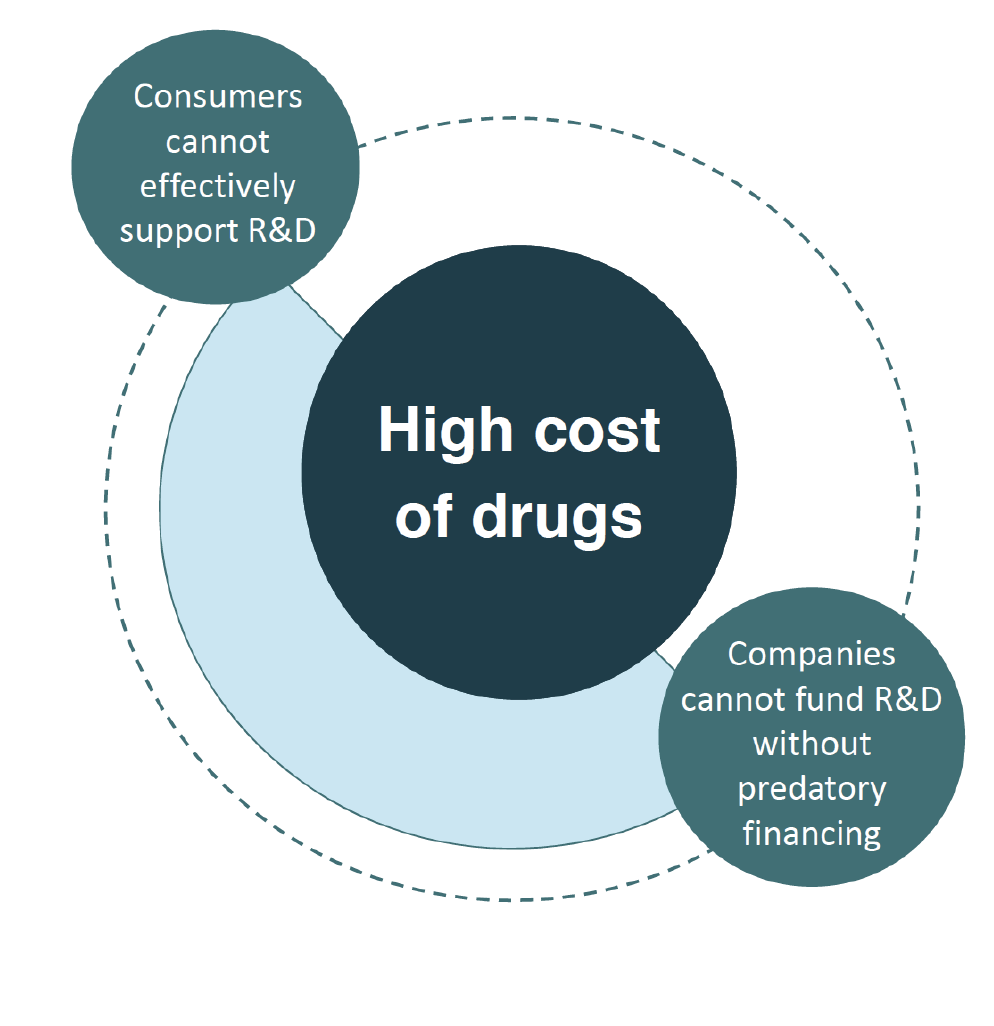
Drug manufacturers spend significant time and resources raising funds, while the expensive cost of capital drives the cost of successful drugs to profoundly high prices. Additionally, consumers are forced to pay extremely high costs for their prescription medications. To make matters worse, patients suffering from rare and neglected diseases have little chance drugs will be developed to meet their needs. As a result, patients affected by diseases have few ways to meaningfully impact what new treatments are developed, leaving it up to drug companies to decide their fate.
Why Does this Occur?
Teaching hospitals lack “a currency” to develop drugs and compete for talent against Big Pharma. For instance, the annual Health-Related Charitable Donations total at $38 billion, which have huge overhead expenses. Contributors, besides receiving a feeling of well-doing and a 1099 write-off, do not receive any tangible benefit. Consumers, Health plans, Physicians, Pharmacies, Generic drug manufacturers & PBMs are all affected by this problem.
Deficiencies in the Drug Development Process:
The Solution:
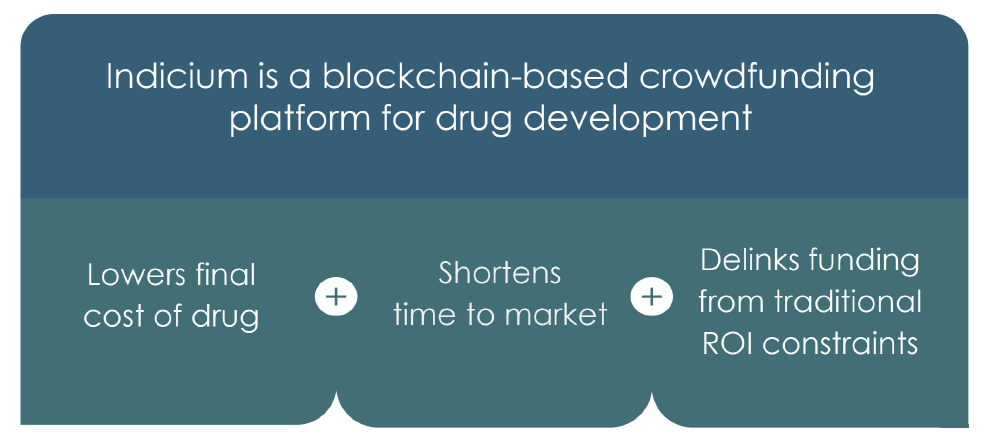
Through an Initial Coupon Offering (“ICO”) model, the Indicium Group provides a Blockchain solution which will enable public and private partnership involving Drug Coupons. This crowdfunding model allows consumers to have a larger say in the commercial drug development process. Additionally, having a federal government fund a portion of the drug coupon also allows for the mandating of price caps on these drugs. Furthermore, consumer psychology and patient compliance increases when patients feel they have an attachment and input to the drug development process.
What is a Drug Coupon?
A drug coupon is a voucher which entitles a holder to a set amount of free doses of a particular drug as well as the ability to buy and sell.
Potential Obstacles:
While the concept of digital drug coupons is extremely promising, these coupons require FDA and SEC approval for exempt status from Accredited Investor regulations. Also, there is limited government participation in the funding of drug coupons.
Process:
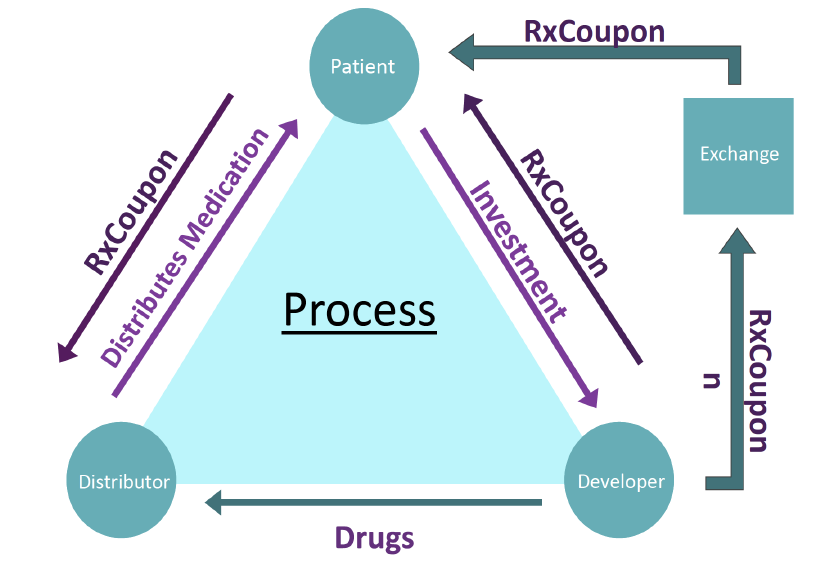
A panel of medical experts determine the viability of each drug. Then patients, foundations, and insurance companies crowdfund to raise 85-95% of a drug company’s Phase II and Phase III development costs. The Federal government funds the remaining 10-15% through grants and other contributions. Coupons are then dosage based similar to the Hoffman-La Roche model during the 1980s. Price caps are instituted on all new prescription drugs involved in this program for a set period of time domestically. Coupons become tax deductible for consumers (need IRS private letter ruling) and patients don’t need a financial return on their investment because all they want is free medicine.
Helping People Contribute to Their Drug’s Development:
Indicium has developed a patent-pending, technology-driven and socially responsible instrument that allows people to contribute towards the research and development of drugs that have already successfully completed Phase I trials and have initiated Phase II trials.
Benefits:
The self-funding relationship lowers the ultimate cost of drugs and significantly shortens the amount of time it takes for a new drug to enter the market. The RxCoupon uses distributed ledger technology to track and trace drugs in their development, while the RxWallet ensures that only those who are qualified to have RxCoupon can access it. This combination ensures that people can contribute to the research and development of the drugs that they desperately need. Overall, Indicium is finding a way to lower the cost of prescriptions for new drugs using the ICO model as a method to raise funds.
Product: RxCoupon
With Indicium’s distributed decentralized ledger technology, the RxCoupon is transferable, divisible, and traceable which seamlessly integrates into the pharmacy experience that people trust.
The RxCoupon can be transferred between different classes of contributors and split into smaller increments or be recombined into larger lots. The RxCoupon will also be composed of a portfolio of drugs under development, and hard forked as development progresses. Distributed ledger technology allows the RxCoupon to be tracked and traced throughout its lifespan while uniquely identifying holders of the RxCoupon & RxWallet. This lifespan includes tracking through development, mergers and bankruptcy, and gives contributors real value while also being HIPAA compliant.
Revolution Through Direct Participation:
Social media, GoFundMe, and Kickstarter have all created an atmosphere where people take control and become their own activist. The RxCoupon is based off the same crowd-funding model and patients have the ability to contribute to the creation of the drug through purchase of the RxCoupon. Future demand can also be estimated by the frequency of pre-orders through the RxCoupon. This shifts the balance of power from traditional expensive mechanisms to a crowd-funded tech-forward solution.
And remember, no one else has done this…
- The federal government continues to face public concern over high costs and more cost-effective policies surrounding the development of new drugs.
- Previous efforts to directly intervene in the negotiation of drug prices has only resulted in drug companies and its affiliates arguing that in order to incentivize future development of these new drugs, high prices are essential.
- Lack of data to concisely prove the relationship between price and non-price innovation drivers has only made it more challenging to do so.
- Other government policies that provide incentives such as speedier drug approvals, generous tax breaks and extended patent protections have also failed because lawmakers have not tied such incentives to any price controls and insurance may not cover all or any of the cost.
Conclusion:
Indicium lowers the cost of drugs for everyone by incentivizing prospective patients to contribute to research and development. Furthermore, Indicium provides companies with an alternative source of funding unconstrained by traditional ROI considerations. Prior awareness from the distribution of RxCoupon reduces normally high initial marketing costs and altruistically increases the number of competitive drugs on the market. Most importantly, when the federal government funds a portion of the drug coupon, it also allows for the mandate of price caps on these drugs, a crucial benefit to anyone in need of essential prescription medications.