
Trade Ideas/Updates
NEW ALERT: Cashflow from a company “Making Life Multiplanetary” (SPCX)
WAIT! New to Instant Cashflow? If you’re a new student here and you have not gone through our Quick Start or Masterclass series, we do not suggest taking action on the information below. Click here and review our educational material first. Then, review our alerts like the one below, start paper trading, and…
|
WAIT! New to Instant Cashflow? If you’re a new student here and you have not gone through our Quick Start or Masterclass series, we do not suggest taking action on the information below. Click here and review our educational material first. Then, review our alerts like the one below, start paper trading, and attend our live Q&A to gain confidence and knowledge first. This is a marathon not a sprint. Take the time to learn and build confidence before taking action. The Instant Cashflow strategy requires knowledge of selling options. Don’t be lazy or take shortcuts. Use the resources we’re providing each week to learn before you do. Also, remember that we do NOT give personalized investment advice and these are NOT recommendations. If that’s all clear to you, then read on… |
Cashflow from “Making Life Multiplanetary”
Company Profile: SpaceX
Company Overview
SpaceX (Space Exploration Technologies Corp.) is an American aerospace manufacturer, launch service provider, and satellite communications company founded in 2002 by Elon Musk. The company’s mission is to make humanity multiplanetary by dramatically reducing the cost of access to space through reusable rocket technology.
Company Information
· Company Name: Space Exploration Technologies Corp. (SpaceX)
· Founded: 2002
· Founder: Elon Musk
· Headquarters: Hawthorne, California, USA
· Industry: Aerospace, Space Transportation, Satellite Communications
· Type: Private Company
Mission
To revolutionize space technology with the ultimate goal of enabling people to live on other planets.
Core Business Areas
· Orbital launch services for commercial, government, and military customers
· Human spaceflight missions
· Cargo transportation to the International Space Station
· Satellite deployment
· Satellite internet services through Starlink
· Development of next-generation spacecraft for lunar and Mars missions
Key Products and Technologies
· Falcon 9 reusable orbital launch vehicle
· Falcon Heavy heavy-lift launch vehicle
· Dragon spacecraft for cargo and crew transportation
· Starship fully reusable deep-space transportation system
· Starlink global satellite broadband network
· Raptor methane-fueled rocket engine
Competitive Advantages
· Industry-leading reusable rocket technology
· Lower launch costs than many competitors
· Vertically integrated manufacturing
· Rapid development and testing approach
· Strong commercial and government customer base
· Leadership in commercial satellite launches
Major Customers
· NASA
· U.S. Department of Defense
· Commercial satellite operators
· International space organizations
· Enterprise and consumer Starlink subscribers
Achievements
· First privately developed spacecraft to reach orbit and return safely
· First private company to transport astronauts to the International Space Station
· Pioneer of routine first-stage rocket landings and reuse
· Built one of the world’s largest satellite constellations through Starlink
· Developing Starship for future lunar and Mars missions
Vision
SpaceX aims to lower the cost of space transportation, expand access to space, support scientific exploration, and establish a sustainable human presence beyond Earth.
Below are the four main types of transactions we use in Instant Cashflow. You can review each transaction type within our Masterclass Series.
1) Credit Spreads
2) Covered Calls
3) Naked Puts
4) Stock Replacement
Here’s a summary of the trade ideas, and then keep scrolling down for a breakdown of each and a tutorial video on how to place the trade:
|
SUMMARY OF THIS WEEK’S TRADE IDEAS: Underlying Stock: Space Exploration Technologies (SPCX) #1 Credit Spread Trade: Sell to open (STO) 1 SPCX July 31 115/105 vertical put spread (15 days to expiration) at a limit of $1.05. Good for the Day. (*Only place this trade if the stock is $134 or higher*) We suggest you do not sell the put spread unless you’re willing and able to buy the shares for the short strike price in the event of assignment. #2 Covered Call Trade: Buy 100 shares SPCX and simultaneously sell to open (STO) 1 July 31 $128 call (15 days to expiration) at a net debit of $123. Good for the Day. (*Only place this trade if the stock is $134 or higher*) #3 Naked Put Trade: Sell to open (STO) 1 SPCX July 31 $116 put (15 days to expiration) at a limit of $1.70. Good for the Day. (*Only place this trade if the stock is $134 or higher*) We suggest you do not sell the put unless you’re willing and able to buy the shares for the short strike price in the event of assignment. #4 Stock Replacement Trade: Buy to open (BTO) 1 SPCX July 31 $105 call (64 days to expiration) at a limit of $36. Good for the Day. (*Only place this trade if the stock is $134 or higher*) |
|
|
Read on for the different trade plans and tutorials on the different ways you can generate cash flow from this opportunity…
Four Instant Cashflow Trade Plans
Each one of these four has a different level of risk and reward. And each one has different steps to conduct the transaction within a brokerage account.
We suggest only trading one of the following depending on your goals and risk tolerance. The instructions and videos for each are broken down in detail, below.
Also, remember, the following trades are listed as one contract, but you can always increase the quantity if you’re comfortable.
However, be sure you’re not investing more money than you can afford to lose.
No matter how confident you are in a trade, it’s best to keep the position sizes small relative to the total account size.
As a general rule, don’t put more than 1% to 2% of your total account value into any one trade.
Remember when trading: More things can happen than will happen. Managing risk is the most important thing. And the market doesn’t care what you think. So be disciplined and manage your risk.
If you’re uncertain about anything, don’t take action. Bring your questions to our team’s weekly Q&A calls and level-up your confidence.
We suggest you do not sell the put spread unless you’re willing and able to buy the shares for the short strike price in the event of assignment.
Let’s dive in…
|
STRATEGY #1: CREDIT SPREAD
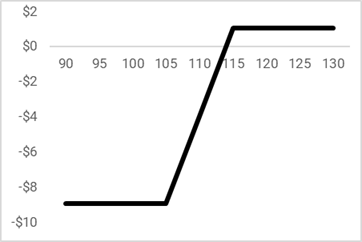
Why Use This Strategy? We suggest you do not sell the naked put unless you’re willing and able to buy the shares for the strike price in the event of assignment. The main reason for a put credit spread is it’s a safer version of the naked put. A naked put has unlimited downside risk, at least to a stock price of zero. Credit spreads are always limited risk and limited reward. How Do You Place This Trade? If you choose the credit spread, just place the following order: (*Only place this trade if the stock is $134 or higher*) What’s the Risk? The credit spread has the following risk graph:
Max gain = $1.05 (for all stock prices above $115 at expiration). Max loss = $8.95 (for all stock prices below $105 (at expiration). Expiration breakeven = $113.95 |
Credit Spread Video Tutorial
|
STRATEGY #2: COVERED CALL
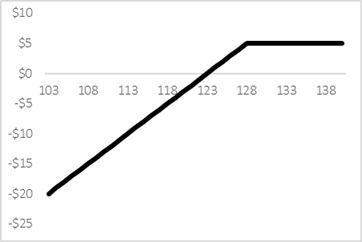
Why Use This Strategy? The main reason for using the covered call is to provide a relatively small hedge to the downside risk in the strategy. By selling calls, you’ll collect premiums over time, which reduces the effective amount you’ve invested. The covered call strategy is expected to have lower risk–and lower returns–over time. How Do You Place This Trade? To use the covered call strategy, you must own 100 shares for every call you sell. If you choose to use the covered call but don’t currently own shares, you can buy shares and sell the call in one trade (your broker’s platform may also call this “covered stock” or a “buy write”). Just place the following order: Buy 100 shares SPCX and simultaneously sell to open (STO) 1 July 31 $128 call (15 days to expiration) at a net debit of $123. Good for the Day. (*Only place this trade if the stock is $134 or higher*) What’s the Risk? The covered call has the following risk graph:
Max gain = $5 (for all stock prices above $128 at expiration) Max loss = $123 (unlimited to a stock price of zero) Expiration breakeven = $123 The risk profile for the covered call has the same shape as the naked put (see strategy below). Whether using the covered call or naked put, always be sure you’re willing to assume the full downside risk. We expect to write new calls to continue to cashflow this position over time. |
Covered Call Video Tutorial
|
STRATEGY #3: NAKED PUT
Why Use This Strategy? We suggest you do not sell the naked put unless you’re willing and able to buy the shares for the strike price in the event of assignment. There are many reasons for using naked puts. First, you can sell to generate cashflow. If the stock price sits still or rises, you’ll collect the put premiums over time without owning the shares. However, it only works if the stock price remains above the strike at expiration. If the stock price falls below the breakeven price, you’ll end up with losses. A longer-term approach is to use naked puts to acquire shares. In other words, if the share price falls below the strike at expiration, you can take the assignment and buy shares. Once you own the shares, you can sell calls (covered calls) to continue to cashflow over time.
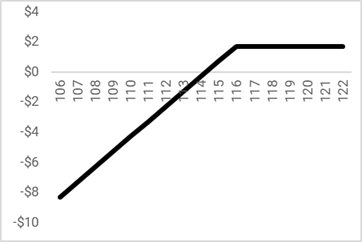
How Do You Place This Trade? If you choose the naked put, just place the following trade: (*Only place this trade if the stock is $134 or higher*) What’s the Risk? The naked put has the following risk graph:
Because of the large downside risk, the broker will have a margin requirement, which is an amount of cash set aside in the event the stock price falls. While brokers are allowed to set their own requirements, most will require about 25% of the strike’s price, so $116 * 100 shares * 25%, or $2,900.
However, if you’re not approved for naked options, you may still be able to do the trade with a “cash secured” put, which means you must post the full assignment value. Another alternative is to use the previously mentioned credit spread.
Potential margin calls: For any naked option position, you’re subject to “margin calls” or “maintenance calls.” These are additional cash requirements should the stock price fall below a certain level. Before you sell any naked put, it’s a good practice to have additional money over and above the initial margin requirement. The maximum you could ever need would be to assume you got assigned on the naked put and buy 100 shares at the $116 strike, or $11,600. However, if you’re using a cash-secured put, you’ll never have a margin call.
Max gain = $1.70 (for all stock prices above $116 (at expiration).
Max loss = $114.30 (unlimited to a stock price of zero).
Expiration breakeven = $114.30
The risk profile for the naked put has the same shape as the covered call (see strategy above). Whether using the covered call or naked put, be sure you’re willing to assume the full downside risk–because you are.
|
Naked Put Video Tutorial
|
STRATEGY #4: STOCK REPLACEMENT
Why Use This Strategy?
The stock replacement strategy is used to create a cheaper way to buy shares. The current price for a share of SPCX is $135. But when you buy options using the stock replacement strategy, you’re only paying $37. That’s just 27% of the stock’s price.
This gives you roughly 3.6:1 leverage while ensuring a $37 maximum loss if the stock falls below $105 at expiration.
You could use this strategy to take a position in the underlying with a longer-term view. Remember, for longer-term positions, it’s a big advantage to scale in over time. If possible, leave room for additional purchases in the future.
How Do You Place This Trade?
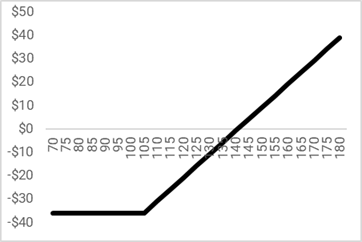
If you choose the stock replacement strategy, just place the following order: Buy to open (BTO) 1 SPCX July 31 $105 call (64 days to expiration) at a limit of $36. Good for the Day. (*Only place this trade if the stock is $134 or higher*) What’s the Risk? The risk graph for this stock replacement call is shown below. The strategy has limited risk and unlimited potential reward:
Max gain = unlimited
Max loss = $36 (price paid)
Expiration breakeven = $141
We’re initiating a position at this level for a longer-term hold. However, we may decide to sell calls against it or roll to a higher strike in the future. |
Stock Replacement Video Tutorial
If you’re confused by ANYTHING above, wait for our live Q&A zoom call next week and ask your questions live.
Remember, this is a learning process.
So don’t be hasty, just write down your questions and use our calls to learn before you take any actions. So, read this multiple times. List your questions.
We highly recommend attending—and participating—in our weekly Q&A discussions. You’ll find them invaluable during your awesome cashflow journey!
– Pete Najarian, Bill Johnson & Stu Dorfman

IMPORTANT DISCLAIMERS
THIS PRESENTATION IS FOR EDUCATIONAL AND INFORMATIONAL PURPOSES ONLY AND DOES NOT CONSTITUTE INVESTMENT ADVICE, NOR THE RECOMMENDATION OF ANY SECURITY, TRADING STRATEGY OR FINANCIAL INSTRUMENT OF ANY KIND. THE INFORMATION IN THIS PRESENTATION DOES NOT CONSTITUTE TAX ADVICE, LEGAL ADVICE, OR OTHER PROFESSIONAL ADVICE OF ANY KIND.
ALL INVESTMENTS INVOLVE A DEGREE OF RISK, AND THE PAST PERFORMANCE OF A SECURITY, INDUSTRY, SECTOR, MARKET, FINANCIAL PRODUCT, TRADING STRATEGY, OR INDIVIDUAL’S TRADING DOES NOT GUARANTEE FUTURE RESULTS OR RETURNS. OPTIONS AND FUTURES HAVE UNIQUE RISKS THAT INVESTORS MUST FAMILIARIZE THEMSELVES WITH BEFORE TRADING THESE INSTRUMENTS.
REFERENCE TO SPECIFIC SECURITIES SHOULD NOT BE CONSTRUED AS A RECOMMENDATION TO BUY, SELL OR HOLD THAT SECURITY. SPECIFIC SECURITIES ARE MENTIONED FOR EDUCATIONAL AND INFORMATIONAL PURPOSES ONLY. THE PRESENTATION SHALL NOT CONSTITUTE AN OFFER TO BUY OR SELL ANY SECURITIES NOR SHALL IT CONSTITUTE A RECOMMENDATION OF ANY SECURITY.
THIS PRESENTATION AND INFORMATION CONTAINED THEREIN IS DISTRIBUTED AS EDUCATIONAL MATERIAL AND DOES NOT CONSTITUTE “INVESTMENT ADVICE” UNDER APPLICABLE EXEMPTION FROM INVESTMENT ADVISOR REGISTRATION INCLUDING BUT NOT LIMITED TO SECTION 202(A)(11)(D) OF THE INVESTMENT ADVISERS ACT OF 1940 (ADVISERS ACT) THE “PUBLISHERS’ EXEMPTION).
WHILE THE INFORMATION IN THIS PRESENTATION IS BELIEVED TO BE ACCURATE, NO REPRESENTATION OR WARRANTY, EXPRESS OR IMPLIED, IS MADE AS TO ITS ACCURACY OR COMPLETENESS OR FITNESS FOR ANY PURPOSE.
INVESTORS ARE FULLY RESPONSIBLE FOR ANY INVESTMENT DECISIONS THEY MAKE. SUCH DECISIONS SHOULD BE BASED SOLELY ON AN EVALUATION OF THEIR FINANCIAL CIRCUMSTANCES, INVESTMENT OBJECTIVES, RISK TOLERANCE, AND LIQUIDITY NEEDS.
LIVE TRAINING AND EDUCATION REFERRED TO IN THE CONTENT IS PROVIDED BY MARKET REBELLION. VIEWPOINTS AND OPINIONS SHARED IN THIS PRESENTATION ARE FOR EDUCATIONAL AND INFORMATIONAL PURPOSES ONLY. THE VIEWS EXPRESSED BY US ARE OUR OWN, AND NOT NECESSARILY THAT OF MARKET REBELLION. ALL INVESTMENTS INVOLVE RISK, AND THE PAST PERFORMANCE OF ANY ASSET, INDUSTRY, SECTOR, MARKET, FINANCIAL PRODUCT, TRADING STRATEGY, OR INDIVIDUAL’S TRADING DOES NOT GUARANTEE FUTURE RESULTS OR RETURNS. YOU ARE FULLY RESPONSIBLE FOR YOUR OWN INVESTMENT DECISIONS, AND THEY SHOULD BE BASED SOLELY ON AN EVALUATION OF YOUR FINANCIAL CIRCUMSTANCES, INVESTMENT OBJECTIVES, RISK TOLERANCE, AND LIQUIDITY NEEDS.
REFERENCES BY THE PRESENTERS TO THE PERFORMANCE OF ANY PARTICULAR SECURITY OR TRADE ARE SOLEY FOR THE PURPOSE OF ILLUSTRATION. NO GUARANTEE OR ASSURANCE CAN BE MADE THAT TRADING RESULTS EXPERIENCED BY VIEWERS OF THIS PRESENTATION WILL BE THE SAME OR SIMILAR TO THE REFERENCED EXAMPLES. THE PRESENTERS ARE HIGHLY EXPERIENCED INVESTORS AND MARKET PROFESSIONALS.