Newsletters
Rebel Roundup Newsletter For 7/20/26: Semis Recover. Stocks Remain Range Bound.
By Geoff Garbacz | Market Rebellion · July 20, 2026
TODAY, WRAPPED:
S&P 500 closed 7,443.28 (-14.41, -0.19%), Dow -307.16 (-0.59%), Nasdaq Composite -12.17
(-0.05%), Nasdaq 100 +11.58 (+0.04%), Russell 2000 -19.79 (-0.67%). VIX fell to 18.65
(-0.64%). 10-year yield rose to 4.60% (+1.21%), 30-year to 5.12% (+1.07%). WTI crude $83.47
(+0.89%), Brent held near $90. Gold slipped to $4,008.52 (-0.25%) despite the escalating war
— real yields, not geopolitics, are setting gold’s price today. Bitcoin $65,229 (+0.85%). Bonds
sold off. Gold fell. Chips rallied. The index still closed lower. The market is pricing several
different stories at once rather than one coherent narrative.
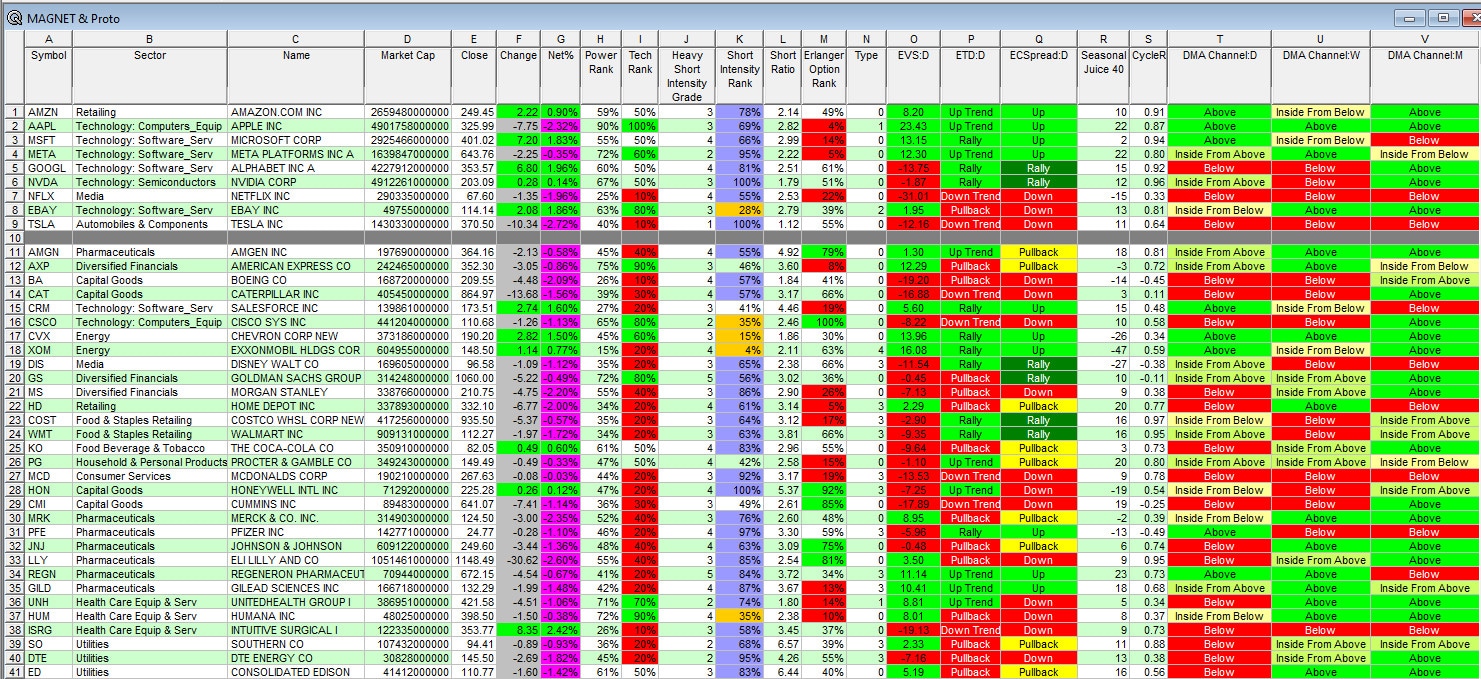
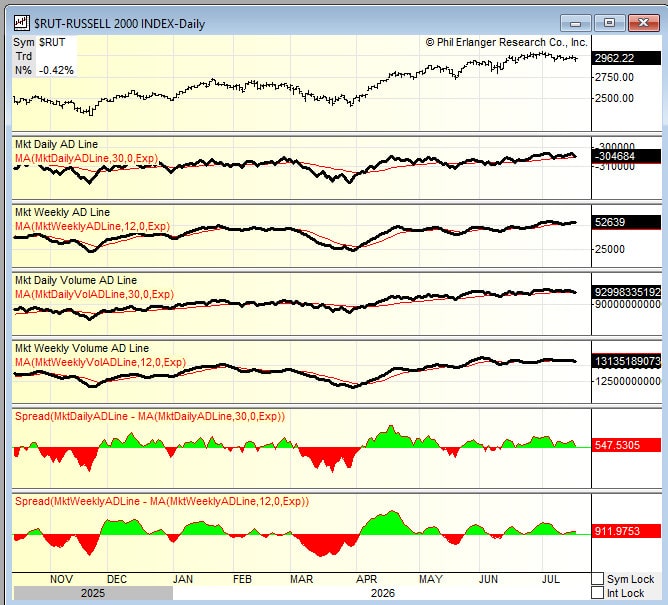
Breadth told the real story beneath the surface: only 32.5% of stocks advanced against 220 new
lows versus just 108 new highs. Stocks above their 50-day moving average slipped to 48.6%
and above the 200-day to 49.7% — both below half, a meaningful deterioration from Friday’s
70% reading above the 200-day. An index closing near flat despite breadth this weak is the tell:
today’s winners were a handful of names, and everyone else lost ground quietly.
Fear & Greed sits at 38 (Fear), barely changed from last week’s 40 but a world away from a
year ago’s 73 (Greed) — the market has spent a year re-learning what fear feels like.
THE BIG FIVE EVENTS FOR MONDAY:
1. Trump Escalates the Threat Level as US Deaths Hit 17
Headline: Trump warns Iran will “pay many times over” for every American soldier killed, as
strikes enter their tenth night.
Narrative: Today’s directive — issued not as a tweet but as a formal order relayed to Hegseth
and the Joint Chiefs — reframes retaliation as automatic policy rather than a case-by-case
decision, and it lands as both the death toll (17 US troops) and the strike count (10 consecutive
nights) cross thresholds the market hasn’t fully priced. Hormuz traffic has collapsed to about 10
ships a day, down from a pre-war pace that supported 20 million barrels daily; this isn’t a
disrupted route anymore — it’s a closed one in all but name. Oil near $90 still reads as a
shipping-disruption price, not a closure price, which means the gap between what’s happening
on the water and what’s priced into the barrel is widening.
Expect the next Iranian-caused US casualty to trigger a sharper oil spike than prior ones, now
that the market knows retaliation is automatic rather than discretionary.
Playbook
Watch: Brent’s reaction to the next confirmed US casualty, and whether the Qatar-brokered
10-day ceasefire proposal gains traction this week.
Confirm: Hormuz vessel counts stay in the single digits and oil holds above $88 into
Wednesday.
Invalidate: A ceasefire is announced and vessel traffic through Hormuz visibly resumes.
2. Chips Rally Individually, But the Index Falls Anyway
Headline: Micron reclaims $1 trillion market cap, Intel and AMD both rally, and the S&P 500
closes lower anyway.
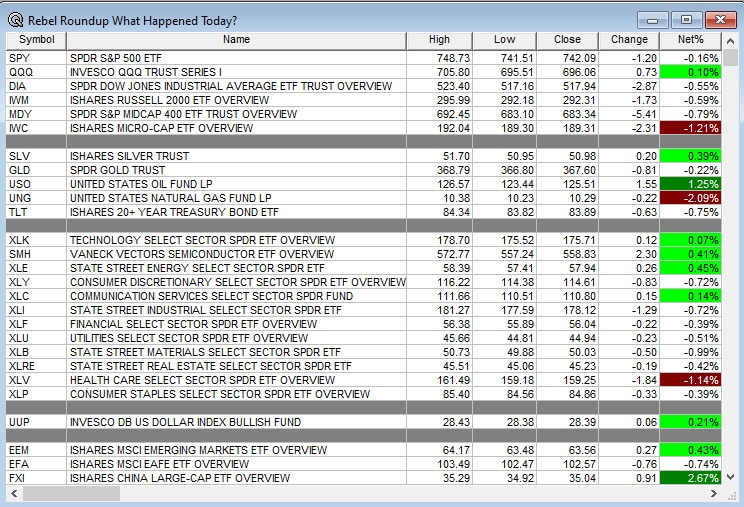
Narrative: Micron (+2.04%), Intel (+2.16%), AMD (+1.57%), and Broadcom (+1.97%) all rallied
today, clawing back some of last week’s SOX bear market losses. But Apple (-2.11%) and Tesla
(-2.96%) did enough damage to the cap-weighted index to erase the gains. The S&P’s 6-month
implied correlation sits at a record-low 0.14-0.15, against a 0.43 long-term average and 0.35
during last month’s selloff; stocks are moving more independently of each other than at almost
any point on record. Hedge funds have sold technology in 6 of the last 8 weeks, the largest
8-week liquidation on Goldman’s 10-year dataset, even as tech remains the best-performing US
sector for seven straight years.
This is a stock-picker’s market pretending to be an index market — single-stock volatility
(VIXEQ above 50, a 15-month high) should keep outrunning index volatility (VIX 18.65) as long
as earnings season forces investors to separate AI winners from AI also-rans.
Playbook
Watch: Whether GOOGL and TXN earnings this Wednesday and Thursday widen or narrow the
correlation gap.
Confirm: Individual semiconductor names keep diverging from mega-cap tech on earnings
reactions.
Invalidate: A macro shock forces correlation back toward the historical average as everything
sells together.
3. The Memory Chip Cycle Debate Splits the Smart Money
Headline: SK Hynix put buyers bet the memory rally is due for a reset, even as suppliers insist
the chips are sold out into 2027.
Narrative: Michael Burry says memory remains cyclical; industry sources on the other side say
Micron is sold out for 2026 with a chunk of 2027 already gone, because hyperscalers are now
locking up an entire company’s HBM output regardless of price — the dynamic that historically
made memory cyclical. Options flow shows real money hedging the bull case anyway: 3,670 SK
Hynix August $120 puts were bought today for $8.19 against zero prior open interest, a
directional bet against a stock still trading at a one-third discount to Micron on forward earnings.
DRAM prices are up as much as 300% this year even as the stocks themselves get hit; the
commodity and the equities are telling different stories.
If this were purely a supply story, spot prices and equities wouldn’t be diverging this hard — the
gap says positioning and leverage, not fundamentals, are driving the memory-stock selloff, and
Thursday’s Intel and Texas Instruments earnings will be the first real test of which side is right.
Playbook
Watch: China’s memory-heavy margin-debt unwind (-$36.9B over four sessions) for signs it’s
spilling into US names.
Confirm: SK Hynix and Micron both hold recent lows into Thursday’s earnings.
Invalidate: Memory names decouple from the broader chip selloff and grind higher on confirmed
2027 sellout commentary.
4. China Is Quietly Closing the AI Gap
Headline: FXI outpaces SMH for a second straight session as Beijing intervenes and Moonshot
AI’s valuation triples in five months.
Narrative: A month ago, the Asia AI trade meant buying Korea and avoiding China; that’s now
inverted. FXI is up 11% since the second half began versus Taiwan’s -11% and Korea’s -18%,
and Beijing has deployed nearly $8.9 billion in state-fund purchases to stem its own equity slide
even as margin debt on the Shanghai and Shenzhen exchanges fell by the most since January
2016. Moonshot AI’s Kimi K3 — the model that triggered last week’s chip rout — is now
finalizing a funding round above $30 billion, up from $4.3 billion in December, with ARR tripling
from $100 million in March to $300 million in June. Kai-Fu Lee’s framing is useful here: closed
US labs become the iPhone, Chinese open-weight models become Android, and the gap
between them is about six months and closing.
The Trump administration’s reported plan to restrict Chinese AI models arrives at exactly the
moment Chinese models are proving competitive on merit, not just price.
Playbook
Watch: Any formal announcement of US restrictions on hosting or distributing Chinese AI
models this week.
Confirm: FXI continues outperforming SMH and Chinese AI valuations keep climbing.
Invalidate: Beijing’s state-fund support fades and margin-debt liquidation resumes, dragging
Chinese tech back down with it.
5. AI Financing Is Getting More Expensive Even As AI Capital Keeps Flowing
Headline: Oracle’s credit risk hits a record high and Big Tech bond cover ratios collapse — but
BlackRock still just led $12 billion in fresh data-center financing.
Narrative: Two things are true about AI financing at once. Cover ratios on Big Tech bond deals
(Amazon, Apple, Meta, Microsoft, Oracle) have fallen to about 1.7x from 4.7x in February — the
lowest since at least September 2025 — as bond investors grow warier of financing the
buildout. At the same time, BlackRock is leading a $12 billion debt sale for a new Meta-backed
data center in El Paso, and Fluidstack just raised $830 million, backed by BlackRock, Google,
and Jane Street, specifically to build out Anthropic’s $50 billion compute network. Last week’s
30-year Treasury sold at 5.06%, the highest since 2007; AI infrastructure debt is now competing
directly with government debt for the same capital, and both are getting more expensive
together.
Watch whether this week’s hyperscaler earnings show capex guidance holding or trimming — a
cut would confirm the credit market’s skepticism, while a raise would suggest the equity selloff in
chips has outrun the actual spending story.
Playbook
Watch: GOOGL’s capex guidance Wednesday as the read-through for the entire AI
infrastructure complex.
Confirm: Bond cover ratios stabilize and data-center financing deals keep closing at this pace.
Invalidate: A major AI-linked bond deal fails to find demand, forcing repricing across the sector.
Market ANALYTICS:
TRACKING TODAY’S ACTION
TOP DOGS
BREADTH
UOA AND TOA:
1. SKHY (SK Hynix ADR) — Bearish Put Buying
21Aug $120 puts, 3,670 contracts against zero prior open interest, bought for $8.19. Stock
$161.60.
Something to consider: SK Hynix trades at a one-third discount to Micron on forward earnings,
and Micron just reclaimed $1 trillion market cap today — yet this trade bets the “cheap winner”
narrative breaks down. The buyer takes on directional risk that memory’s cyclicality reasserts
itself broadly; the seller (likely a dealer) picks up upside gamma exposure into a stock still riding
the HBM story. If Thursday’s chip earnings confirm sold-out 2027 capacity, this put expires
worthless; if Burry’s cyclical thesis is right, it pays off precisely when the “safe” memory trade
breaks first. Is SK Hynix actually insulated from the memory cycle, or just late to fall?
2. IREN — Bullish Call Buying
24Jul $50 calls, 7,500 contracts, bought for $0.09-$0.20. Stock $37.52-$39.00.
Something to consider: Bought hours after IREN’s $2.8B contract announcement, this is a
lottery-ticket bet on roughly a 28% four-day move — cheap enough that the buyer accepts
near-certain expiration worthless in exchange for asymmetric upside if AI infrastructure
enthusiasm reignites this week. The dealer selling this absorbs real gamma risk if the stock
actually runs. A strong GOOGL capex number Wednesday could validate this bet; a weak one
leaves it dead on arrival.
3. IBIT — Bullish Call Buying
31Jul $40.50 calls, 11,700 contracts, bought for $0.06-$0.08. Stock $36.49-$36.82.
Something to consider: This trade lands the same week Bitcoin ETFs posted a second straight
week of inflows after nearly two months of outflows — a tentative return of the “bitcoin as
uncorrelated hedge” thesis amid record equity dispersion. If risk-off spreads from Iran headlines
to broader markets, bitcoin’s independence gets tested for real; in the 2020 pandemic crash,
correlations across risk assets converged toward 1, and bitcoin was no exception.
4. CSCO — Bullish Call Buying (stock-replacement structure)
18Sep $97.50 calls, 3,000 contracts, bought for $18.70-$18.75 — nearly all intrinsic value.
Stock $112.64.
Something to consider: This isn’t speculation; it’s a leveraged stock-replacement position in an
AI-networking name, placed the same day optics names (Lumentum, Coherent) rallied on “picks
and shovels beyond chips” enthusiasm. It reflects money rotating toward AI infrastructure
plumbing rather than the chips themselves — a bet that survives even if the
semiconductor-specific dispersion story continues.
5. VSH (Vishay Intertechnology) — Bearish Put Buying
16Oct $20 puts, 7,300 contracts, bought for $1.00-$1.15. Stock $37.67-$38.25.
Something to consider: A put this far out of the money (about 47%) and this large reads as
tail-risk insurance on the weakest link in the semiconductor supply chain, not a near-term
directional call. Passive components like Vishay’s sit downstream of AI capex decisions with
little of the upside and most of the downside if hyperscaler spending disappoints. This is what
THE DAILY DASHBOARD: LEADERS AND LOSERS
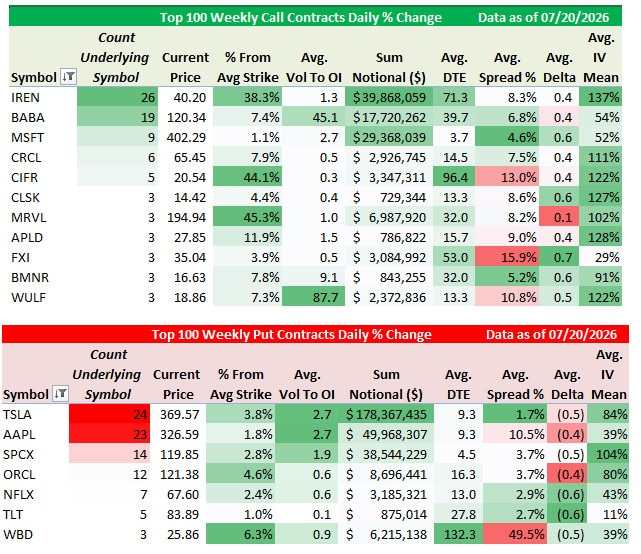
We now track where option players made the most money today on both the Call and Put side. 0DTE are not part of the calculation.
AFTER THE CLOSE
Notable Earnings Out After The Close:
- Beats: ZION +1.48, CCK +0.33, WRB +0.19, WTFC +0.16, MCRI +0.11, CALX +0.07, STLD +0.06 of note.
- Misses: BOKF -0.09 of note.
- Flat: None of note.
Winners From Monday: PKE +8%, TPC +4.3%, NBIS +4.2%, CBRL +4.1%, VVX +3.9%, CCK +3%,
Losers From Monday: CALX -13.5%, MGY -4.8%, GTLB -4.5%.
After The Close:
- Ross Stores (ROST) opens 47 new locations in June and July, keeps pace for about 110 openings this year.
- Cracker Barrel (CBRL) completes 26-store sale-leaseback, exits Maple Street Biscuit; raises FY26 profitability outlook.
- FedEx (FDX) expects its MD-11 fleet to be fully returned to service by the end of calendar year 2026.
- Planet Fitness (PLNT) exits minority stake as Franchise Equity Partners buys Australian franchisee Bravo Fit.
- President Trump to impose additional 50% tariffs on certain goods of Canada.
- RTX awarded a $1.8 bln modification to previously awarded Navy contract.
- Krystal Biotech (KRYS) to join S&P MidCap 400; Tutor Perini (TPC) and V2X (VVX) added to S&P SmallCap 600.
- 10Q Delays – None of note.
Executive, Corporate Changes:
- HNVR appointed Kevin O’Connor as president, effective July 27, 2026.
- STIM names Axogen’s Nir Naor CFO; legal chief to step down.
- GTLB names former New Relic executive Thomas Lloyd chief business and legal officer.
Buybacks of Note:
- VALU renews $2 million stock repurchase program
Dividend Info:
- goes Ex-Div Tuesday.
- goes Ex-Div Wednesday.
- MCB raises quarterly dividend to $0.35/share from $0.25/share.
QUESTIONS FROM THE ROWDY REBELS
Q: Are we still optimistic about GLD — do we still have conviction in that trade? — Kevin
C.
A: Gold’s 2026 relationship with real rates has flipped from its 2024-2025 pattern — it’s now
moving more in line with what higher real yields should do to a non-yielding asset, which is why
gold fell today (-0.25%) even as the Iran war escalated. Historically gold rallies on geopolitical
fear; today it didn’t, because the market is pricing rate-hike risk (odds near 55% on Kalshi)
above war risk. The conviction case for gold right now depends less on Iran and more on
whether the Fed’s blackout-period silence gets broken by incoming inflation data — watch the
1-year inflation swap, not the headlines out of Hormuz.
Q: Do you use the VWAP upper/lower bands as support and resistance for 0DTE trades,
or just the centerline? — Craig C.
A: The centerline matters most, and today explains why: with only 32.5% of stocks advancing
and the index chopping without a clear trend, mean-reversion around VWAP works better than
trend-following breakouts in this kind of breadth. That’s a direct byproduct of today’s Real Story
— when implied correlation collapses, the index itself stops trending cleanly, because it’s really
dozens of unrelated single-stock stories fighting for the tape. In a market like today’s, fading
extension away from VWAP has been a better statistical bet than chasing it.
Q: Is today’s AMC options volume real institutional demand, or just existing open interest
turning over as sellers close positions into strength? — Allen F.
A: Both, and that’s the important distinction. Much of the volume at the $2, $2.50, and $3
August strikes built up gradually over weeks rather than arriving today, meaning today’s spike is
largely small retail flow layering onto existing positions — not a single large “smart money” print.
What makes it worth watching anyway is the dealer side: if that open interest is mostly short
calls, a continued rally forces market makers to buy stock to stay hedged, which can accelerate
the move regardless of whether the original buyers were institutions or retail.
Q: Is there a certain threshold of open interest you target when picking strikes for
spreads, or is it based on historical price levels? — Vinnie C.
A: Liquidity matters more than usual right now, not less. In a market where implied correlation
just hit a record low of 0.14-0.15, single-stock options can gap on name-specific news without
the broader index confirming or denying the move — a strike with thin open interest can trap
you with no clean exit if the catalyst doesn’t play out. Today’s SK Hynix trade (3,670 contracts
against zero prior open interest) worked because it was a single large order, not because the
strike was inherently liquid; that’s a different risk profile than working into an already-active strike
like AMC’s August $3 calls.
Q: If your account isn’t approved for spreads, is there a conversion to a longer-dated call,
or an alternative put strategy, that gets similar exposure? — Andrew B.
A: A single-leg long call further out in time is the closest substitute, but you give up the
defined-risk, lower-cost structure that makes spreads attractive in exactly the kind of choppy,
low-correlation tape we saw today — paying full premium for a directional bet when the index
itself can’t hold a trend is expensive. The better single-leg alternative here is sizing down and
going further out in time (September/Q4, where today’s more consistent bullish paper has
concentrated), giving the position room to be right without needing this week’s chop to resolve
immediately.
WATCHLIST
Theme: AI Infrastructure Momentum
Bull: This week’s earnings (GOOGL Wednesday, INTC/TXN Thursday) confirm capex guidance
holding or rising, memory demand stays sold-out into 2027, and the private-market frenzy
(Moonshot’s $30B+ valuation, Fluidstack’s $830M raise, Databricks at $188B) proves the
public-market chip selloff overshot. A GOOGL capex raise would likely trigger a sharp unwind of
recent dispersion as correlation snaps back higher across the whole complex.
Bear: Cover ratios on Big Tech bonds have collapsed to 1.7x from 4.7x in five months, Oracle’s
credit risk sits at a record high, and Goldman’s own trading desk says a bottom is still “a couple
of weeks away.” If this week’s capex guidance disappoints even slightly, the credit market’s
skepticism gets validated first, and equities follow with a lag.
Theme: Memory Chips — Structural Shortage or Cyclical Peak
Bull: Hyperscalers are reportedly locking up entire HBM production runs regardless of price,
removing the leftover-inventory dynamic that made memory cyclical in prior cycles; Micron says
it’s sold out into 2027 with no imbalance resolution expected before 2028.
Bear: Burry’s cyclical thesis hasn’t been disproven, only delayed — DRAM prices up 300%
while equities sell off is the kind of divergence that eventually resolves one way or the other, and
today’s SK Hynix put buying (3,670 contracts, zero prior open interest) says at least one large
trader is betting on the bear case.
Theme: China vs. US in AI
Bull: FXI’s outperformance over SMH, Beijing’s direct market intervention, and Moonshot’s
tripling valuation all point to China closing the AI gap faster than expected — cheaper
open-weight competition should expand the total AI market rather than just cannibalize US labs’
share.
Bear: China’s own leverage unwind (-$36.9B in margin debt over four sessions, the fastest
since 2016) shows this rally is itself built on borrowed money, and a Trump administration
crackdown on Chinese AI model distribution — reportedly under active consideration — could
cut off the US revenue and hosting access Chinese labs need to fund their scaling.
Rebel’s Edge From 7/20 (from You Tube link – RebelsEdgeOfficial):