Newsletters
Rebel Roundup Newsletter For 7/16/26: AI Infrastructure Unwind Accelerates While Traditional Safe Havens Fail to Provide Shelter
By Geoff Garbacz | Market Rebellion · July 16, 2026
TODAY, WRAPPED: THE AI INFRASTRUCTURE COMPLEX SOLD OFF SHARPLY WHILE GOLD, SILVER, AND BITCOIN
FELL ALONGSIDE IT — BROAD DE-RISKING ACROSS ASSET CLASSES RATHER THAN A CLASSIC SHIFT INTO
TRADITIONAL SAFE HAVENS. IRAN ENTERED A SIXTH CONSECUTIVE NIGHT OF STRIKES by the us. NETFLIX GUIDED LIGHT
AFTER THE CLOSE.
The S&P 500 fell -0.51% to 7,533.77. The Nasdaq Composite dropped -1.47% to 25,881.9, and
the Nasdaq 100 lost -1.62% to 29,025.77. The Dow slipped -0.20% (-105.67 points) to roughly
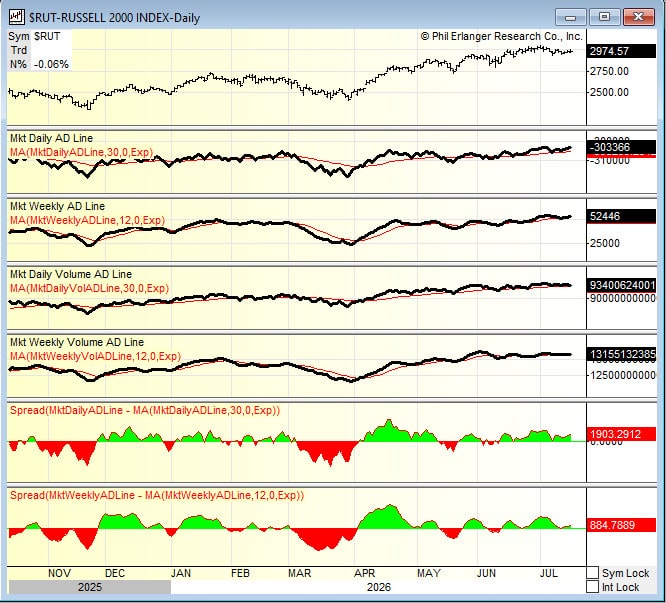
52,553. The Russell 2000 was essentially flat at -0.06%, closing at 2,974.57 — small caps once
again shrugging off the mega-cap unwind.
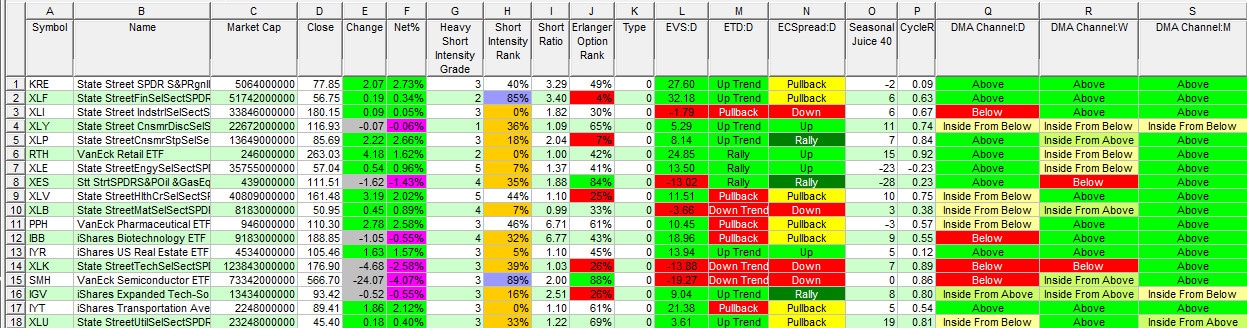
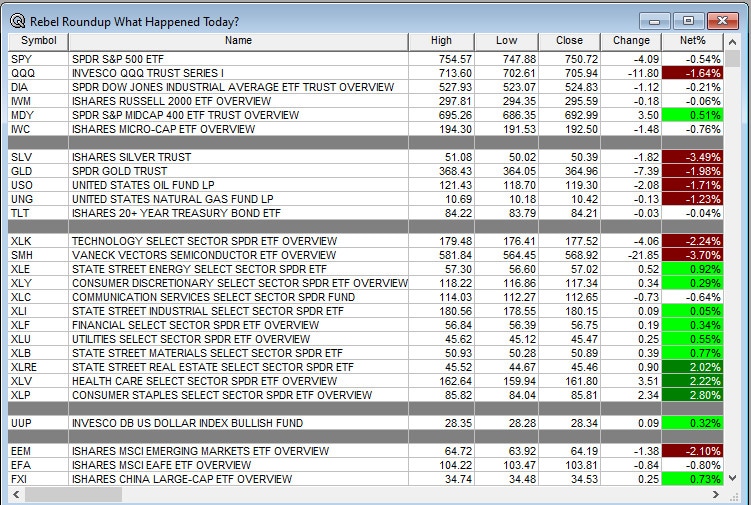
VIX jumped +6.70% to 16.72. SMH (VanEck Semiconductor ETF) fell -3.70%. XLK (Technology)
dropped -2.24%. On the other side: XLP (Consumer Staples) +2.80%, XLV (Healthcare)
+2.22%, XLRE (Real Estate) +2.02%, XLE (Energy) +0.92%. CNN Fear & Greed ticked up
slightly to 42 (Fear) from yesterday’s 41. The Erlanger Big Barf held at 5.91.3 This divergence shows the damage stayed
concentrated rather than turning systemic.
Breadth was close to even — 47.3% advancing versus 49.2% declining — but new highs (342)
still beat new lows (192), roughly 64% to 36%. Gold fell -2.16% to $3,973.09, silver dropped
-3.97% to $55.54, and Bitcoin slipped -0.81% to $64,187. Equity weakness itself remained
highly concentrated inside AI infrastructure. WTI crude fell -1.63% to $79.48 as Iran’s war
entered its sixth consecutive day of strikes.
The 10-year yield rose to 4.57%.Philadelphia Fed’s manufacturing index blew past expectations
at 41.4 versus an 11.0 consensus — a signal the underlying economy has more cushion than today’s
price action suggests. June retail sales missed headline estimates at +0.2%, but the shortfall was driven
almost entirely by gasoline station sales (-5.3%); excluding gas, retail sales rose a solid +0.7%.
QUOTE OF THE DAY
“We are still at the beginning of the cycle.”
— Jensen Huang, Nvidia CEO, July 16, 202
— Jensen Huang, Nvidia CEO, July 16, 202
THE BIG FIVE EVENTS FOR THURSDAY:
1. Iran Enters a Sixth Consecutive Night of Strikes — And Oil Fell Anyway
U.S. Central Command confirmed a sixth day of strikes on Iran, this round hitting targets around
Tehran for the first time and firing on a tanker accused of breaking the naval blockade. Iranian
officials claim more than 35 killed and 300 wounded. The White House confirmed the Hormuz
blockade is “in full force” while saying Iran “continues to talk” and “wants to make a deal.” Yet
WTI fell -1.63% today — the market had already priced most of this into the +9.6% one-day
Brent spike on July 13. Iran has now also threatened to close a second chokepoint, the Bab
el-Mandeb Strait, if the U.S. strikes its power grid.
2. Korea’s Leverage Unwind Becomes the Template for How Fast Crowded Trades Break
Roughly 1.2 million Korean retail accounts have been margin-called over the past week —
about 1 in 30 working-age adults — with 320,000 to 360,000 accounts fully liquidated, per
Goldman Sachs. South Korea’s regulator suspended new single-stock leveraged ETF listings
and banned marketing of existing ones, while the Bank of Korea hiked rates for the first time in
three years. SK Hynix fell more than 9% in Seoul this week; SKHY (its U.S. ticker) fell -13.48%
today alone. The same leveraged-ETF mania — 700 U.S.-listed leveraged funds now
outstanding, more than double the count at the end of 2024 — is running domestically too. The
U.S. has built the same leverage. It simply hasn’t faced its liquidation event yet.
3. Netflix Guides Light After the Bell
NFLX reported Q2 revenue of $12.56 billion (slightly below the $12.59 billion estimate) and EPS
of $0.80 (slightly ahead of $0.79), but guided Q3 revenue to $12.86 billion versus a $13.01
billion estimate and EPS to $0.82 versus $0.84 expected. The stock traded down roughly -8% in
after-hours action. Netflix is also cutting its viewing-hours disclosure from twice yearly to once,
starting 2027 AND it did not give earnings or revenue guidance.
4. Healthcare Rotation Gains a New Anchor
UNH beat badly — EPS of $6.04 well above the roughly $4.85 consensus estimate, on revenue
of $112 billion versus $110.7 billion expected — sending the stock up more than 8%. But the
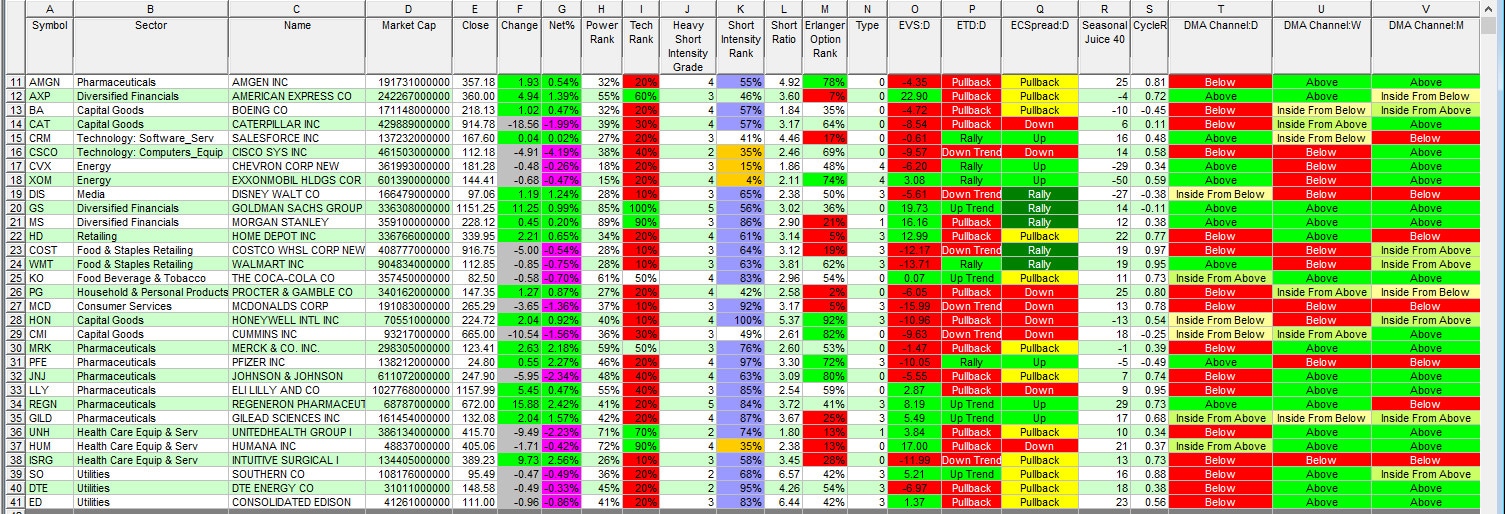
more important story is what happened around it: XLV closed +2.22%, with JNJ +1.19%, ABBV
+4.21%, MRK +3.25%, GILD +3.47%, and AMGN +3.70% all participating. This wasn’t a
single-stock pop — it was sector-wide participation on a day the rest of the tape needed
somewhere to hide.
5. Gold, Silver, and Bitcoin Sold Off Together
Gold fell -2.16%, silver dropped -3.97%, and Bitcoin slipped -0.81% — all on the same day the
VIX jumped +6.70% and equities sold off. In a classic risk-off environment, at least one of these
should have caught a bid. None did, suggesting this was balance-sheet de-risking rather than a
traditional flight to safety.
HEATMAP, SECTORS, BREADTH:
TRACKING TODAY’S ACTION
TOP DOGS
BREADTH
UOA AND TOA:
SKHY (SK Hynix) — Bullish Call Buying (3:25 p.m.)
35,000 September 18 $200 calls bought in one print for $16.20, above open interest of 683
contracts. Stock at $155.88.
Something to consider: This trade landed the same session SKHY fell -13.48% and the same
week 1.2 million Korean retail accounts got margin-called. If forced liquidation begins to fade
over the next several sessions, today’s block likely marks early accumulation. If liquidation
instead accelerates, this buyer is simply early into a downtrend that hasn’t finished.
AVGO (Broadcom) — Bullish Call Roll (12:05 p.m.)
26,000 October 16 $440 calls bought for $22.12, above open interest of 627 contracts; 26,000
October 16 $410 calls sold for $30.67, below open interest of 27,118 contracts. Rolls a trade
from the 6/29 log. Stock at $383.10.
Something to consider: Rolling up in strike into a sector down -17.8% from its recent high, while
extending duration to October, is continued conviction, not a hedge. Watch whether this position
gets rolled again on the next leg down — that would confirm genuine conviction. If it gets
trimmed instead, this was paper-loss management wearing a bullish label.
TSM (Taiwan Semiconductor) — Bullish Call Spread (10:22 a.m.)
22,500 August 21 $450/$510 call spread bought for $12.28 on the long leg, above open interest
of 4,801 contracts. Follows a 17,000-contract September $450/$530 vertical from the 7/14 log.
Stock at $410.88.
Something to consider: TSM beat on every metric this morning and still closed -2.32%. Watch
whether the stock starts following the options market over the next few sessions. If price keeps
diverging despite this much bullish positioning stacking up, conviction alone isn’t enough to
move it.
CCJ (Cameco) — Bullish Call Buying (11:08 a.m.)
5,000 September 18 $100 calls bought in one print for $3.50, above open interest of 1,169
contracts. Stock at $87.48.
Something to consider: This sits at the intersection of AI’s power-consumption problem and
today’s memory-chip capacity crunch. If uranium keeps outperforming semis through this
unwind, the market is separating AI power demand from AI hardware demand — two different
trades with two different risk profiles going forward.
XOM (Exxon Mobil) — Bullish Call Roll (2:58 p.m.)
10,000 July 17 $155 calls bought for $0.04, above open interest of 5,986 contracts; 10,000 July
17 $149 calls sold for $0.31, below open interest of 10,770 contracts. Rolls a trade from the
7/10 log. Stock at $146.32.
Something to consider: Energy is the only sector leading on both a 1-day and 1-week basis,
even as WTI itself fell today. If crude starts confirming this equity strength over the next few
sessions, energy is leading a genuine repricing. If it doesn’t, this rolls off as tactical positioning
that unwinds once the market fully digests that Iran headlines are already priced.
THE DAILY DASHBOARD: LEADERS AND LOSERS
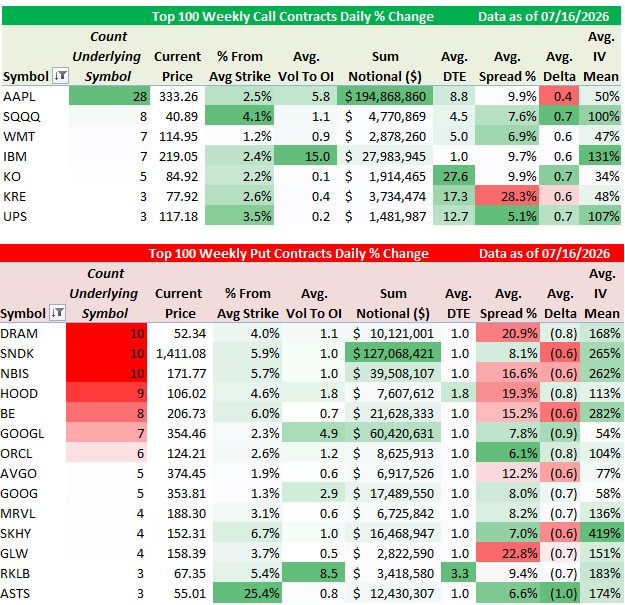
We now track where option players made the most money today on both the Call and Put side. 0DTE are not part of the calculation.
AFTER THE CLOSE
Notable Earnings Out After The Close:
- Beats: ISRG +0.29, WAFD +0.03, NFLX +0.01 of note.
- Misses: AA -0.13, SFNC -0.02 of note.
- Flat: CNS FNB FFIN of note.
Winners From Thursday:, VNDA +5.3%, ROAD +4.5%, ASPI +3.7%,
Losers From Thursday: STAA -12.5%, ISRG -11%, NFLX -8.2%, AA -2.9% EVC
- Netflix (NFLX) beats but gives poor guidance. The company did not provide EPS or revenue guidance on the call.
- LMT awarded a $101.8 mln US Air Force contract.
- Molina Healthcare (MOH) to join S&P MidCap 400; Construction Partners (ROAD) to join S&P SmallCap 600.
- 10Q Delays –
Executive, Corporate Changes:
- UPWK announces Chief Financial Officer and principal financial officer, Erica Gessert, will take a temporary medical leave, effective July 14, 2026.
- EVC names Michael Christenson as Chair of the Board on July 16, 2026. Mr. Christenson will continue to serve as CEO.
Buybacks of Note:
- Valero (VLO) increases its share repurchase authorization by $5 bln; total authorization now stands at $6.4 bln
Dividend Info:
- EGO WSM UDR SNX RVTY AYI WDFC MGRC KWR DCOM KARO CYD CBRL go Ex-Div today.
- go Ex-Div Monday.
- SND declares special cash dividend of $0.10/share.
THE REAL STORY
Today’s Selloff Wasn’t About Technology. It Was About One Part of Technology.
AI infrastructure. Apple made new highs. Oracle made new lows.
That pairing — AAPL closing +1.76% at a fresh all-time high while ORCL closed -6.25% at a
fresh 52-week low, on the same day — is the cleanest single data point for what’s actually
happening beneath the index-level noise. Apple represents companies monetizing AI today;
Oracle sits much closer to the infrastructure spending cycle. This was never a broad “tech
selloff.” MSFT finished green, AAPL finished green, and NFLX closed positive ahead of its own
post-bell miss. What sold off was the AI-infrastructure-capex complex specifically: NVDA,
AVGO, MU, AMD, INTC, MRVL, SNDK, WDC, and GOOGL.
The market is drawing a line between companies that consume AI compute profitably today and
companies whose valuations depend on continued, uninterrupted capex spending by others.
The divide is no longer showing up only in equities. Big Tech CDS spreads sit near 7-year highs,
and hyperscaler bond cover ratios have collapsed from 5x in February to under 2x in July.
Equity investors are now pricing the same skepticism credit investors have been pricing for
weeks.
Markets spent two years treating AI as a single trade. Today may have been the first session
that investors decided it isn’t.
Question to Sit With: If today’s split persists, the AI trade may increasingly reward companies
monetizing AI today over those still dependent on infrastructure spending. That’s the distinction
worth trading
QUESTIONS FROM THE ROWDY REBELS
Q: There were multiple huge DRAM and SKHY option blocks this week — one apparently
opened and closed intraday in the exact same size. What’s going on there? (Chris S.)
A: That’s most likely a large institutional player using options to express or hedge a very
specific, short-term view on memory-sector volatility rather than a directional stock bet. An
intraday round-trip of that size in a single block is unusual — it suggests either a market maker
unwinding facilitation risk, or a fund testing conviction and immediately exiting. When size like
that clusters in the exact names at the center of a sector-wide selloff, institutional attention is
fully focused there — consistent with today’s SKHY 35,000-contract call buy.
Q: A major bank got hammered on language from its earnings call rather than the
numbers themselves. Is that a short-term overreaction? (Jason G.)
A: The distinction that matters is whether the market reacted to numbers or to guidance
language. A sharp move driven by phrasing on a call, rather than a revenue or EPS miss, is
more often a sentiment overreaction that mean-reverts faster once the next data point confirms
or denies the concern. Watch whether other banks with similar exposure move in sympathy over
the next few sessions — if the selling stays isolated, it was about the words.
Q: With this many stocks getting crushed day after day, should we be hedging with index
puts instead of picking spots? (Donna R.)
A: Today’s tape argues against it. Advancing stocks nearly matched decliners even as the
Nasdaq fell -1.47%, and new highs (342) beat new lows (192) by nearly 2-to-1. Index puts make
sense when weakness is systemic; reducing exposure to the specific names under pressure is
the more efficient tool when pain is this concentrated.
Q: How should we think about position sizing when a stock can swing from a strong
bounce to a heavy loss inside the same week? (multiple members)
A: The volatility itself is the signal to reduce position size, not to tighten stops after the fact.
Position sizing should assume uncertainty — not hope it disappears.
Q: Does tonight’s presidential address matter for markets, even though it’s billed as
being about elections? (Tom H.)
A: Directly, probably not — the stated topic doesn’t have market mechanics attached to it. But
the White House has left the door open to Iran commentary given the ongoing escalation, and
after-hours positioning already reflects some expectation of event risk heading into tomorrow’s
session. Speeches like this rarely move markets on their own content, but they can if an
unexpected Iran-related headline lands on top of an already-fragile chip complex.
WATCHLIST
AI Infrastructure: The Cycle’s First Real Test
Bull: TSM and ASML both beat and raised guidance this week, and Goldman forecasts AI-agent
token consumption rising 24-fold by 2030 — the demand story isn’t broken, it’s being repriced
around who actually captures it.
Bear: Semiconductors are roughly 20% of the S&P 500 today, versus just over 8% at the 2000
dot-com peak. The selloff has gone fully global — Korea, Japan, Taiwan all showing losses this
week — and Goldman has already cut PC shipment forecasts citing the memory crunch hitting
demand, not just supply.
Gold, Silver, and Bitcoin: Broken Safe Havens or a Temporary De-Grossing Event?
Bull: GLD outflows have decelerated sharply in July (-$46 million month-to-date versus -$8.5
billion in March alone). BlackRock’s CEO remains “very bullish” on Bitcoin over 12 months.
Bear: All three sold off together today, exactly the scenario safe havens are supposed to work
in, and didn’t. Rising real yields make non-yielding assets structurally less attractive.
Iran/Hormuz: Priced In or Underpriced?
Bull: WTI fell -1.63% today despite the sixth consecutive night of strikes — the market has
already absorbed the blockade and toll into pricing since July 13.
Bear: Iran has now threatened a second global chokepoint if the U.S. strikes its power grid, and
Trump’s April promise that objectives would be met “very shortly” has clearly failed.
Defensive/Healthcare Rotation: How Long Does This Kind of Leadership Actually Last?
Bull: Defensive leadership often lasts longer than traders expect — once capital rotates into a
sector on real earnings delivery rather than pure fear, it tends to stay until the next catalyst
forces a re-rating.
Bear: Crowded defensives can become just as vulnerable once positioning becomes
consensus. Healthcare has now led on both a 1-day and 1-week basis for multiple sessions
running.
Rebel’s Edge For July 16th (from You Tube link – RebelsEdgeOfficial):