Newsletters
Rebel Roundup Newsletter For 7/23: S&P 500 Begins To Cluster With Second Loss in July of More Than -1%. VIX Rising Into Next Full Moon On The 29th
By Geoff Garbacz | Market Rebellion · July 23, 2026
TODAY, WRAPPED:
The day’s dominant market belief: AI infrastructure spending and a real energy shock can no
longer be told as two separate stories, because both now compete for the same capital.
AI’S TWO BIGGEST SPENDERS MISSED ON THE SAME DAY OIL CROSSED $100.
NEITHER STORY WAS ABOUT TO WAIT FOR THE OTHER.
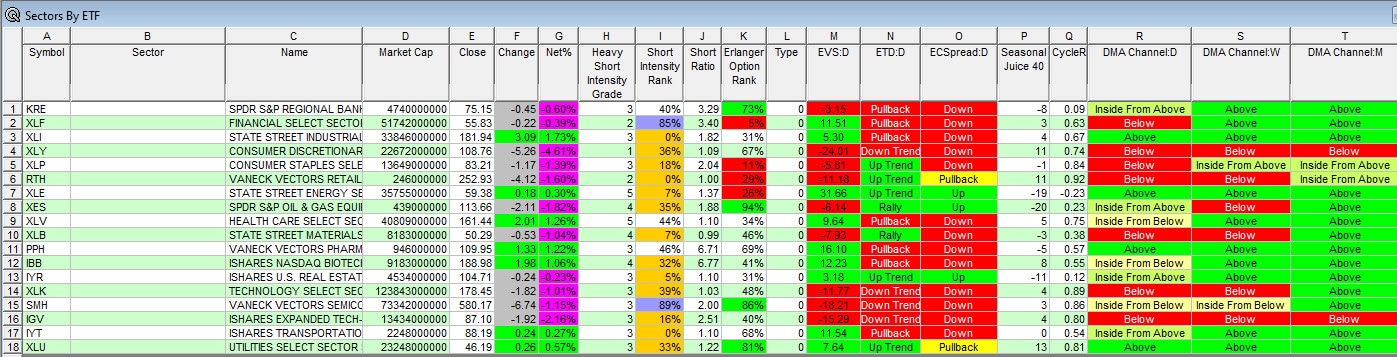
● S&P 500: 7,407.50, -91.46 (-1.22%)
● Nasdaq Composite: 25,137.7, -553.21 (-2.15%)
● Dow: 51,711.6, -507 (-0.97%)
● Russell 2000: -17.99 (-0.61%)
● VIX: 18.78, +2.14 (+12.86%)
● 10-Year Treasury: 4.703%, +4.6bps; 2-Year: ~4.32%
● WTI: $92.82, +6.23%; Brent: touched $102 intraday before settling near $100
● Gold: $4,048.74, -1.93%; Silver: $57.60, -3.56%
● Bitcoin: $65,088, -1.50%
● Fear & Greed Index: 40 (Fear), down only 2 points from yesterday’s 42. EBB is at -3.54.
That last number is the tell. The index barely moved even as the Nasdaq dropped 2.15% and
the Mag 7 shed nearly $800 billion in market cap (per Mike Z intraday tracking) —
sentiment was already braced for this before the open, which means today didn’t break anything
new in positioning. It confirmed what was already priced.
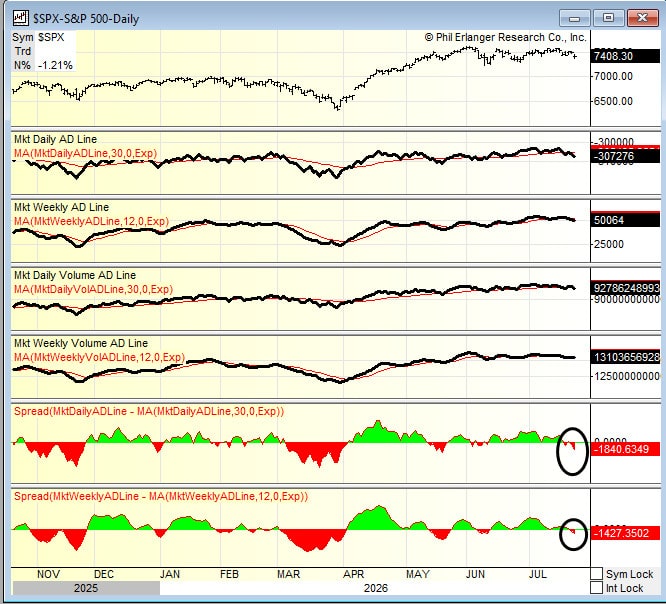
● Breadth: 1,786 advancers vs. 3,601 decliners (31.8% / 64.1%)
● New highs/lows: 92 new highs vs. 241 new lows
● Above 50-day SMA: 46.8%; Above 200-day SMA: 49.1%
Breadth held up better than the headline losses suggest — nearly half the index is still above its
200-day average. This wasn’t a systemic flush. It was concentration risk, sitting in exactly two
names.
● Initial Jobless Claims (week of 7/18): 187K vs. 212K expected, 209K prior — lowest
since 1969
● Chicago Fed National Activity Index (Jun): -0.02 vs. -0.19 prior
The claims number is the kind of print that should have been the day’s headline on any other
Thursday. Instead it got buried, because a labor market this tight into an oil shock is exactly the
combination that makes the Fed’s job harder, not easier — strong claims data removes the
argument for patience just as energy prices are handing Warsh a reason to act.
QUOTE OF THE DAY
“Hyperscalers don’t generate any cash; buy the chip companies.” — Ben Reitzes, Melius
Research, July 23, 2026
THE BIG FIVE EVENTS FOR THURSDAY:
1. Alphabet’s Capex Guidance Beat the Business It Was Meant to Fund
Headline: Alphabet Raises Capex to $205 Billion.
The Market Prices In the Bill, Not the Cloud
Beat.
Narrative: Cloud revenue grew 82% and blew past every estimate. Search still grew 17% to
$63.3 billion. None of it mattered next to one number: Alphabet raised full-year capex guidance
to $195–205 billion, up from $180–190 billion, and reported negative free cash flow for the first
time in company history. A $98 billion unrealized gain on its SpaceX stake added $6.26 to EPS
— strip that out and the $9.11 headline number is closer to $2.85. The stock fell 7.13%, its worst
session in 14 months, on a quarter where the actual operating business outperformed. That
guidance is itself below the $325–375 billion range buy-side desks (UBS, JPMorgan) had been
modeling — the market isn’t punishing Alphabet for spending more than expected. It’s punishing
the fact that spending more, even less than feared, still produced a negative cash flow print.
This is an earnings-quality problem as much as a spending problem.
Watch: Whether analyst price-target cuts (six of seven major desks today) stabilize into next
week.
Confirm: Backlog execution outpaces capex growth in the next quarter’s numbers.
2. Tesla’s Record Revenue Came With a Record-Small Operating Margin
Headline: Tesla Posts $28.24 Billion in Revenue. Operating Income Fell 57%.
Narrative: Tesla delivered a record quarter by revenue — $28.24 billion, +26%, trailing
12-month revenue above $100 billion for the first time ever. Operating margin compressed to
1.4% as opex rose 47% on AI and R&D spend. Non-GAAP EPS, which strips out Tesla’s own
SpaceX stake gain, came in at $0.33 against a roughly $0.51 estimate — a clean miss. The
$1.0 billion unrealized SpaceX gain accounted for roughly two-thirds of the quarter’s GAAP net
income. The stock fell 14.57%, its worst day in 13 months, erasing more than the entire
quarter’s revenue beat in market cap. Where Alphabet’s story was about earnings quality,
Tesla’s is about operating profitability — record demand, and the thinnest margin the company
has posted in years, arriving in the same quarter.
That’s the trade to watch next quarter: whether FSD attach rates and robotaxi mile growth start
showing up in the numbers Tesla actually reports, not just the ones it highlights in a slide deck.
Watch: FSD attach rate and robotaxi mile growth in next quarter’s report.
Confirm: Battery pack capacity — Tesla’s stated bottleneck — expands enough to lift deliveries
without further margin compression.
3. Iran Escalation Crossed From Rhetoric Into Violence
Headline: Trump Says He’s “Close” to a “Massive Attack” on Iran. Oil Doesn’t Wait to Find Out.
Narrative: Explosions were reported on Iran’s Qeshm Island overnight, alongside Trump telling
Axios he’s weighing a “massive attack… bigger than ever before.” Iran’s navy says the Strait of
Hormuz remains closed; Tehran warned it won’t let “deceptive ceasefires” be used to resupply.
Brent touched $102 intraday for the first time since May before settling back near $100. This
marks a shift from rhetorical escalation to reports of strikes on both sides, and the House
passed a second Iran War Powers resolution today with four Republicans crossing the aisle. Oil
options still aren’t pricing a full-blown nuclear-facility strike — Kalshi has only a 48% chance of
WTI touching $115 by year-end — meaning the market is trading a shipping-disruption book, not
a war-widening book.
That gap is the story to track into the weekend, because a strike anywhere near Natanz turns
this from a shipping premium into a supply-shock repricing overnight.
Watch: Whether VLCC transits through Hormuz continue at pace or start slowing.
Confirm: Brent holds above $100 into next week without a fresh escalation headline.
4. Yields Hit Fresh 2026 Highs as Rate-Hike Odds Spike With Oil
Headline: The 10-Year Crosses 4.70%. The Fed’s Next Move Just Got Harder to Predict.
Narrative: The 10-year yield hit 4.703% today, its highest close of the year, up 75bps since the
Iran war began. The 30-year is on pace for its longest stretch above 5% since 2007. CME
FedWatch now prices close to a 50% chance of a July 29 hike, up from under 40% Monday and
under 12% a week ago; September hike odds sit near 82%. Fed Chair Kevin Warsh has
scheduled a press conference for next week’s meeting — a break from precedent that traders
are reading as a signal something is being prepared to explain. Today’s jobless claims print, the
lowest since 1969, would normally argue for patience. Instead it removes the labor-market
excuse to hold, leaving oil-driven inflation as the only variable left for Warsh to weigh.
Next week’s FOMC decision is now the single most important catalyst on the calendar, and
Warsh’s unscheduled press conference suggests even the Fed isn’t fully certain how it lands.
Watch: Whether Friday’s PMI data shifts CME-implied hike probability in either direction.
Confirm: Oil holds above $95 into the July 28–29 meeting, keeping the inflation argument
alive.
5. Hyperscaler Credit Spreads Are Blowing Out While Equity Ignores It
Headline: Tech Bond Spreads Are Now Wider Than the Broader IG Market.
Narrative: Goldman flagged today that tech sector credit spreads now trade wide to the broader
investment-grade market — a sector that used to be one of credit’s safest corners. This isn’t a
new development; it’s the credit market’s weeks-long warning finally catching up to equity
prices. More on the mechanics below in The Real Story.
Watch: Whether Friday’s flows show the widening stabilizing or continuing.
Confirm: Coverage ratios on the next jumbo hyperscaler bond deal stay below 2x.
Market ANALYTICS:
TRACKING TODAY’S ACTION
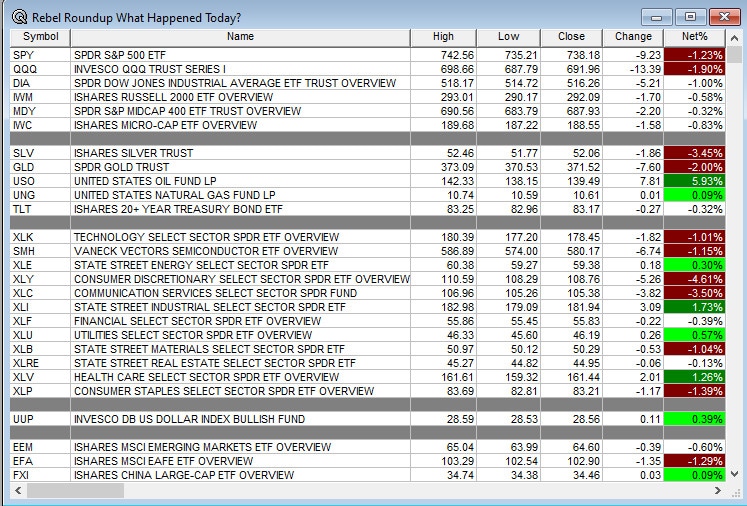
TOP DOG
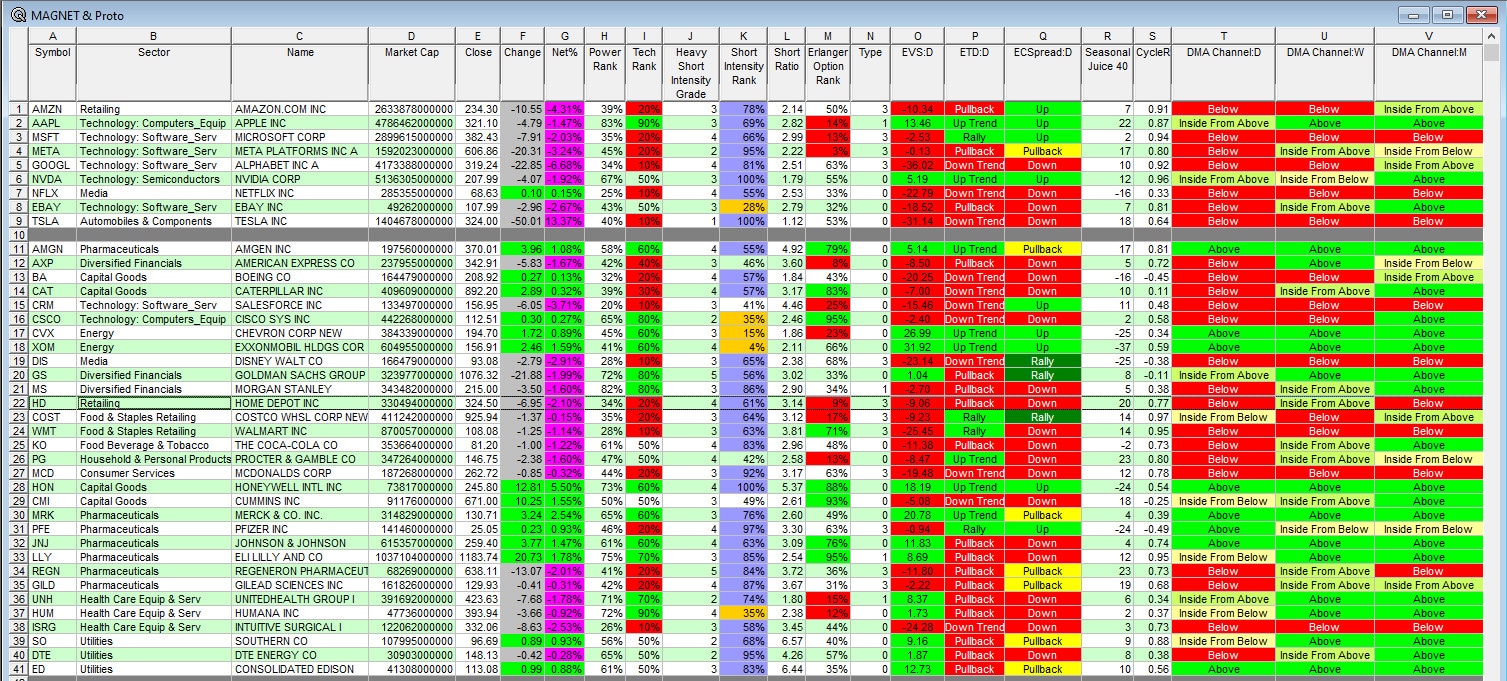
BREADTH
UOA AND TOA:
1. VIX — Bullish Call Spread
100,000 September 16 45-calls bought for 0.69–0.71 against 200,000 September 16 65-calls
sold for 0.39, rolled from an identically-sized position in the August 19 expiration. Spot VIX
19.46.
Something to consider: This is a continuation trade, not a fresh bet — the same size and strike
ratio was rolled further out rather than closed. If VIX gets anywhere near 45 by mid-September,
this becomes enormously profitable; if it doesn’t, it decays to worthless. The size suggests an
institutional tail hedge tied to the Fed meeting and Iran timeline. 22 is next stop or it goes back to 16.
2. IWM — Bearish Put Spread
110,000 July 28 285-puts bought for 0.94–1.22 against 110,000 July 28 280-puts sold for
0.40–0.31, against essentially no prior open interest. Stock 290.19–291.11.
Something to consider: Brand new position, five days to expiration, enormous size. The seller of
the 280-puts is being compensated for underwriting the risk that small caps break below 280 by
next Friday. If rate-hike odds keep climbing into next week’s meeting, small caps are the most
rate-sensitive place to express that view. IMO, this is a stupid trade. IWM beat SPY, QQQ and DIA.
The others drop first.
3. XLE — Bearish Put Buying
15,000 August 7 60-puts bought for 1.58, above open interest of just 32 contracts. Stock 59.66
— while Brent traded near $100.
Something to consider: A contrarian trade against today’s own tape — energy was one of the
day’s stronger sectors, and someone bought fresh downside protection anyway. Goldman’s own
Q4 Brent forecast is still $80, assuming de-escalation; this reads as skepticism that today’s
spike holds.
4. SPY — Bearish Put Spread
11,200 August 5 733-puts bought for 6.58–6.59 against no prior open interest, against 11,200
August 5 710-puts sold for 2.33, above open interest of 17 contracts. Stock 738.61–738.63.
Something to consider: Fresh, short-dated protection put on during today’s selloff itself — a
reaction to the tape, not a pre-positioned hedge. The spread’s width suggests it’s sized for
continuation of today’s move rather than a tail hedge.
5. MSFT — Bullish Call Buying
8,500 July 31 435-calls bought for 3.00–3.20, above open interest of 2,715 contracts. Stock
388.69–388.96 — a strike more than 11% above spot.
Something to consider: On a day when Alphabet and Tesla both got punished for their AI
spending, someone bought a large, short-dated, far-out-of-the-money bullish bet on Microsoft
ahead of its own earnings — a low-cost bet the market treats Microsoft differently than it treated
Google today.
THE DAILY DASHBOARD: LEADERS AND LOSERS
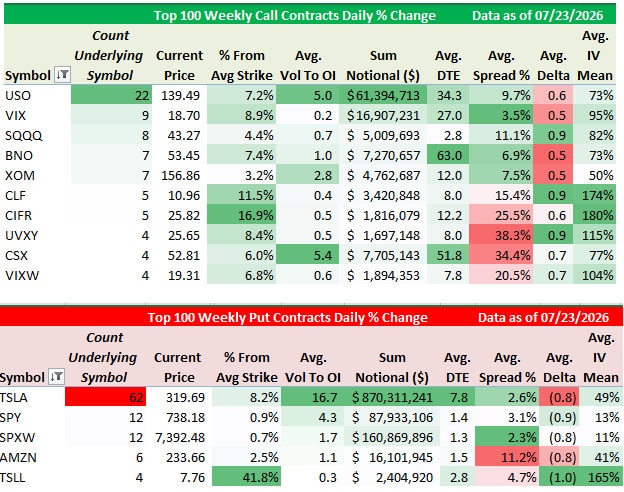
We now track where option players made the most money today on both the Call and Put side. 0DTE are not part of the calculation.
AFTER THE CLOSE
Notable Earnings Out After The Close:
- Beats: FIX +2.08, THC+1.86, DLRI +0.58, WKC+0.54, KNSL+0.43, ENVA +0.36, SIGI +0.29, HIG +0.26, INTC +0.20 of note.
- Misses: SAP -0.40, OVV -0.32, SLM -0.15, ABCB -0.06, VRSN -0.04, MRTN -0.01 of note.
- Flat: EGP GTY of note.
Winners From Thursday: SAFT +34.3%, AMKR +16.3% ,INTC +5.6%, THC +12.6%, EW +4.6%, KN +2.9%
Losers From Thursday: CDXS -21.1%, MXL -9.8%, DECK -7.5%, SLM -6.1%.
- Intel (INTC) crushed it with prelim Q2 $0.42 vs $0.22 FactSet Consensus; revs $16.1 bln vs $14.43 bln FactSet Consensus.
- Newmont (NEM) produced 1.3 mln attributable gold ounces; On track to meet FY26 production guidance.
- OKLO receives DOE startup authorization for Groves reactor.
- Summit Therapeutics (SMMT) discloses there is substantial doubt about its ability to continue as a “going concern”.
- Amkor (AMKR) and NVIDIA (NVDA) strike $1.5 bln multi-year advanced packaging pact.
- Oracle (ORCL) was awarded a 10-year IDIQ contract under the U.S. Department of War’s Enterprise Software Initiative, with a base value of $3.31 bln for the first five years and up to $6.99 bln if options are exercised.
- President Trump to impose broad new tariffs on 60 trading partners as existing duties expire. (CNBC)
- Stripe and Advent continue to consider their options regarding PayPal. (WSJ)
- 10Q Delays – None of note.
Executive, Corporate Changes:
- GEHC said CFO Jay Saccaro will step down for a role outside medtech, with Controller and Chief Accounting Officer George Newcomb appointed interim CFO while a permanent search begins.
- LSTR names Bill Clement chief commercial officer effective Aug. 1.
Buybacks of Note:
- VRSN announces additional $884.2 mln share repurchase authorization.
Dividend Info:
- DHR MDT CP HUM KDP RL ELS VMI FLS TRNO IRT TOWN CTS PSEC goes Ex-Div Friday.
- goes Ex-Div Monday.
- FIX increases quarterly dividend to $0.90/share from $0.80/share.
- HTH increases quarterly dividend 10% to $0.22/share.
QUESTIONS FROM THE ROWDY REBELS
Q: NYSE-wide short interest hit a record 9.0% of shares outstanding in late June — above the
5.0% peak during the 2008 financial crisis and the 6.0% peak during the 2020 pandemic. Does
this look like positioning ahead of a bigger slump? — Allen F.
A: Short interest is genuinely at an all-time high — that part checks out. But treating record
short interest as a warning sign on its own gets the mechanism backwards. Today’s data shows
why: hedge fund exposure to the Mag 7 is already sitting near a multi-year low, and VIX call
skew is at the 96th percentile, meaning a large share of the market has already de-risked or
hedged heading into this selloff. Record short interest in a market that’s already this defensively
positioned isn’t necessarily fuel for a crash — it can just as easily be fuel for a short squeeze
once the news flow clears. The direction it breaks depends entirely on which piece of news
arrives first. — Geoff Garbacz.
Q: On the EVS intraday signal discussion — if you’re using 3-minute candles as the primary
trigger, why does the 5MA/15MA relationship still matter? — Ben B.
A: The candle pattern and the moving averages aren’t doing the same job. The 5MA/15MA
relationship sets the underlying trend context — it tells you whether you’re looking for a
continuation setup or a genuine reversal. The four-candle-then-reversal pattern is the execution
trigger within that context. Today was a clean example: the reversal pattern never showed up in the
first 18 minutes of trading, and because the broader trend read supported it, that signal was
tradeable for a real move to the downside into a bottom at 11:30 a.m. EDT. — Geoff Garbacz.
WATCHLIST
Theme: AI Capex and Memory Demand
Bull: SK Hynix’s own numbers show the DRAM business has structurally flipped — server and
graphics memory, including HBM, now makes up 69% of DRAM revenue, up from 30% in 2013,
with the dividing line sitting almost exactly at ChatGPT’s November 2022 launch. Micron traded
as today’s safe haven inside a battered chip sector, up 3.20% while Nvidia, AMD, and
Broadcom all fell.
Bear: That structural story only holds if the customers funding it can keep paying — and the
same capex fueling memory demand is exactly what got Alphabet punished today. If equity’s
new skepticism about capex ROI spreads from spenders to suppliers, Micron’s safe-haven
status won’t survive next week’s hyperscaler earnings.
Theme: Iran and Oil
Bull: Three VLCCs carrying 6 million barrels transited the Strait of Hormuz in the past 24 hours
despite the threats, and companies like DP World are already building infrastructure to route
around the strait entirely. Options markets aren’t pricing a full nuclear-escalation scenario either
— Kalshi puts only a 48% chance on WTI reaching $115 by year-end. If today’s spike proves to
be a fear premium, oil has room to give back a meaningful chunk of this move.
Bear: Strikes were reported on Iran’s Qeshm Island overnight, and Trump told Axios he’s close
to authorizing an attack “bigger than anything before.” Iran’s navy says Hormuz remains closed.
If the next headline is a strike near Natanz rather than continued shipping harassment, the
market’s current shipping-disruption pricing gets torn up overnight for a genuine supply-shock
repricing.
Theme: The Fed’s Widening Path
Bull: Jobless claims just hit their lowest level since 1969, and Goldman itself argued today that
the economy isn’t showing signs of overheating — the strongest rationale the Fed would need to
hold. If oil prices stabilize into next week’s meeting, Warsh has every reason to let the strong
labor data speak for a soft landing.
Bear: Rate-hike odds have moved from under 12% a week ago to nearly 50% for July and 82%
for September, moving in lockstep with oil prices, not economic data. Warsh’s unscheduled
press conference is being read as preparation to explain a move the market wasn’t fully pricing
until this week. If oil holds above $95 into the FOMC meeting, the inflation argument may simply
override the strong labor print.
Rebel’s Edge For July 23 (from You Tube link – RebelsEdgeOfficial):