Newsletters
Rebel Roundup Newsletter For 7/29: The Fed Didn’t Hike. The Bond Market Did Though As Yields On 10-Year Move to 4.689%
Today, Wrapped:
The day’s dominant market belief: the Fed held the line, but nobody believes it was free. The S&P 500 closed at 7,316.15, down 112.63 points, or 1.52%; the Dow fell 1,153.18 points, or 2.19%, its worst one-day drop since April 2025; the Nasdaq Composite dropped 1.74% while the Nasdaq 100 gave up 2.06%, confirming a technical correction roughly 11% off its June record. The Russell 2000 slid 1.64%.
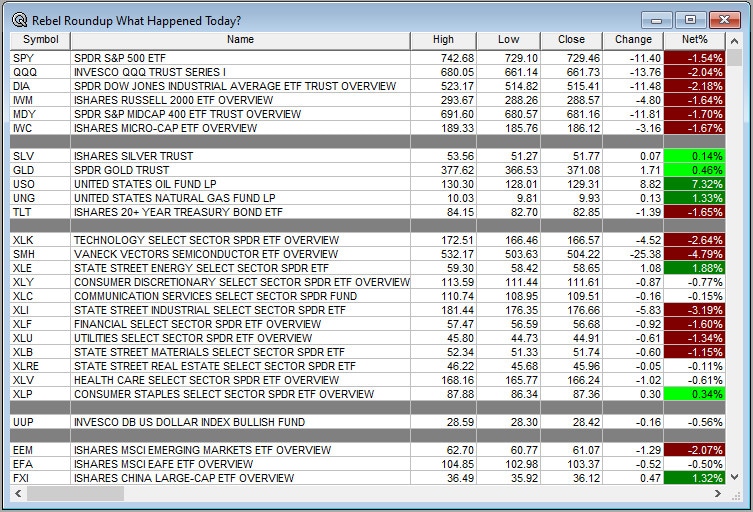
Under the surface it was uglier still — decliners outnumbered advancers by better than two-to-one, and the CBOE Volatility Index jumped roughly 13% to 20.66. The trigger wasn’t the rate decision itself, which came in almost exactly as expected. It was everything that happened around it: a 9-3 Fed vote with three dissents demanding a hike, a 30-year Treasury yield pushing toward multi-year highs last seen around 2007-08, oil spiking 7% on fresh Iran-U.S. hostilities, and a Meta Platforms stumble that reopened the AI-spending debate right as investors were still digesting a week of semiconductor carnage. That’s the story.
THE LEAD
The market did the hiking the Fed wouldn’t.
Kevin Warsh’s Fed held its benchmark rate at 3.50%-3.75% for a fifth straight meeting, with Cleveland’s Hammack, Minneapolis’s Kashkari and Dallas’s Logan all dissenting in favor of a hike — the first time since 2016 that three officials have pushed the same direction. On paper, that’s a dovish outcome relative to the roughly one-in-three odds of a surprise hike priced into futures beforehand. In practice, it didn’t feel dovish at all, and the reason is worth sitting with.
Long-end yields did the Fed’s job for it. The 30-year Treasury pushed toward its highest level in nearly two decades even as the policy rate stayed put, and Warsh all but confirmed that’s by design: as the Wall Street Journal’s Nick Timiraos reported from the press conference, the chairman noted the Fed “hasn’t done much in 42 days” while “the markets have done quite a bit” — framing the collapse of forward guidance as a feature, not a bug. With no roadmap to lean on, bond markets are setting financial conditions themselves, and right now they’re setting them tighter, not looser. Warsh also repeated, according to reporting from Gunjan Banerji, that there’s “no soft inflation target,” aiming to kill any lingering market assumption that the Fed would quietly tolerate inflation running above 2%.
Institutional money had been positioning for exactly this kind of volatility for days — as the UOA & TOA section details below.
The closest historical parallel isn’t a hike or a cut at all. Bloomberg’s Lisa Abramowicz noted Wednesday that U.S. investment-grade bond yields, measured against the S&P 500’s earnings yield, are the richest they’ve been since 2002 — bond vigilantes reasserting themselves even as corporate profits keep climbing. The rhyme is real: then as now, credit markets are demanding a bigger premium against equities. The difference is what’s underneath it. In 2002, that gap reflected a market still digesting the dot-com bust and a genuine earnings collapse. Today, S&P 500 earnings are still growing at a roughly 38.5% blended clip this quarter with an 88% beat rate, per FactSet and Fundstrat data. Today’s tighter financial conditions may themselves be an early sign of credit markets pricing a leverage risk building beneath otherwise strong earnings — not bad numbers, but debt they aren’t yet sure those numbers can carry.
Goldman’s Take. Goldman’s Delta 1 desk offered a different lens on the mechanics: this looks “much more a deleveraging and de-grossing event than a macro one” — pointing to violently correlated single-stock swings without matching index moves as a signature of a crowded trade unwinding, suggesting positioning rather than a fundamental macro shift (more on how this plays into the credit story below).
Chart Room’s Take. In Market Rebellion’s live chat mid-session, Geoff Garbacz floated a contrarian view — a decent chance of a complete reversal once the FOMC noise cleared. That call reflected real-time uncertainty rather than a wrong prediction: the session did stage a sharp intraday rally between roughly 12:15 and 2:55 p.m. before fresh Iran headlines and the closing hour reasserted the selloff.
So what happens now: tonight’s earnings gave the market its cleanest test yet of whether AI spending is paying off, and the split verdict — Microsoft clean, Meta messier — didn’t settle the debate either way. That divergence sets up the real story below.
THE MARKETS
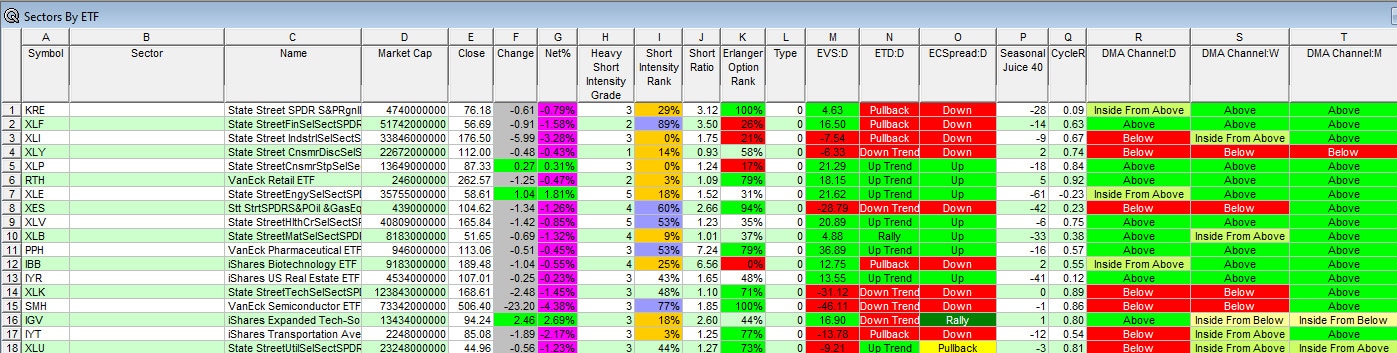
Energy was the only S&P sector positive on the day (+2.05%); Industrials (-3.40%) and Technology (-2.49%) led losses. Zoom out a week, though, and the rotation looks less like a one-day panic and more like a slow bleed: Technology is down 7.19% over five sessions while Consumer Defensive (+3.67%) and Healthcare (+3.49%) have been the market’s shelter.
THE BUZZ
-
GE HealthCare (GEHC) posted a record 11.1% organic orders quarter and beat on both revenue and EPS
-
Garmin (GRMN) raised full-year guidance after a blowout quarter, pushing its market cap toward $50 billion
-
Starbucks (SBUX) beat badly on EPS ($0.85 vs. $0.66 expected) with North America comps up 8.1%
-
Chipotle (CMG) and Fortinet (FTNT) both beat and raised full-year guidance
-
Qualcomm (QCOM) beat on revenue but gave a weak Q4 profit outlook, flagging an accelerating Apple revenue step-down and roughly 20% Android handset revenue decline this fiscal year
-
ARM Holdings’ sales forecast failed to reassure an already-nervous chip-stock audience
-
Robinhood (HOOD) posted a record quarter with event-contract (prediction market) revenue up more than tenfold year over year
-
Disney is reportedly planning to drop Microsoft’s GitHub Copilot in favor of OpenAI’s Codex
-
South Korea’s finance ministry moved to cap retail exposure to leveraged ETFs after a second straight circuit-breaker day; Citi estimates Korean retail investors have lost roughly $38.7 billion on leveraged products this month
-
The FTC is reportedly suing Hims & Hers over billing and cancellation practices
AFTER THE CLOSE
Microsoft (MSFT) beat cleanly across the board — EPS of $4.74 versus $4.25 expected, revenue of $90.01 billion versus $87.72 billion, and Azure growth of 43% ex-FX versus roughly 39.6% expected. Microsoft 365 Copilot crossed 30 million paid seats. CEO Satya Nadella noted on the call that “this year, Azure revenue surpassed $100 billion for the first time.” Shares rose roughly 1-2% in after-hours trading — a clean, unambiguous market verdict on a clean quarter.
Meta Platforms (META) missed on EPS despite beating revenue ($6.18 vs. $7.18 expected on EPS; $60.8 billion vs. $60.2 billion on revenue), with net income down 14% year over year as operating margin compressed to 31% from 43%. Q3 revenue guidance of $61-64 billion came in below the Street’s roughly $63.2 billion midpoint, and full-year capex guidance was narrowed to $130-145 billion. Shares fell roughly 8% in after-hours trading. What that miss actually means — and whether it’s really an AI-spending story — gets unpacked in THE REAL STORY below.
Robinhood (HOOD) delivered a record quarter, with EPS of $0.62 against $0.41 expected and revenue of $1.31 billion, up 32% year over year. Event-contract revenue — Robinhood’s prediction-markets business — came in at $156 million, up more than tenfold from a year ago, now exceeding both crypto and equities revenue. CEO Vlad Tenev said the company’s product push, from the Robinhood Chain to Trump Accounts, is “focused on one goal: making everyone an owner.”
Notable Earnings Out After The Close:
- Beats: CSL +0.68, BOOT +0.60, MSFT +0.50, EQIX +0.43, FICO +0.42, LHX +O.33, FORM +0.21, HOOD +0.19, SBUX +0.19, AEM +0.16 (>0.15)
- Misses: TREE -0.73, ALKT -0.23, PSA -0.08, PPC -0.06, GLF -0.04, QCOM -0.02, PTEN -0.01.
- Flat: None of note.
Winners From After The Close: CORT +20.2%, PRCH +20.4%, CORT +20.2%, SMHI +17.2%, FORM +12.4%, FTNT +11%, SBUX +6%, CMG +5.9%, LRCX +4.7%, GKOS +9.5%, MSFT +8.3%, EFOR +8.3%, NPKI +7.9%, CNMD +7.2%, SBUX +6%, GFL +5.9%, CMG +5.9%, CVI +5.1%, MAX +5.1%, SIMO +5.1%, SFM +4.8%, PBI +4.8%, LRCX +4.7%, CHDN +4.5%, ARXS +4.3%, PI +4.2%, FLS +4.1% of note.
Losers From After The Close: FTAI -18.4%, TDOC -16.2%, TREE -11.3%, FICO -9.3%, WWD -8.9%, META -8.7%, CWH -6.9%, MDXG -6.6% of note.
News after the close:
- Xencor (XNCR) to receive $105 mln from Alexion to settle Ultomiris U.S. royalty dispute.
- MIMEDX (MDXG) to acquire Sanara MedTech (SMTI) for $35/share in cash and stock.
- META missed on earnings $6.18 versus $7.19 but beat on revenues $60,88 billion versus $60.22 billion.
- Qualcomm (QCOM) missed on earnings, $2.21 versus $2.23 but beat on revenues.
- Procore (PCOR) entered a definitive agreement to buy private DroneDeploy for approximately $845 mln in cash, subject to customary purchase price adjustments.
- Microsoft (MSFT) beat firmly on revenues and earnings.
- Chipotle (CMG) raised FY 26 Comp guidance even though earnings were so so.
- Saudi Arabia wants to guide a coalition to protect the Red Sea.
- TransAlta (TAC) declares a quarterly dividend of $0.05.
- 10Q Delays – None of note.
Executive, Corporate Changes:
- KMT names Joseph Alvarado incoming chairman; William Lambert to retire in October.
- WRB names Christopher Moede president of Berkley Risk.
Buybacks of Note:
- CMG to buy back $1.3 billion.
Dividend Info:
- UNP increases quarterly dividend 3% to $1.42/share from $1.38/share.
UOA & TOA
SPY (ETF) — Bearish Put Spread (7/29)
24,500 Aug. 7 $720 puts bought for $3.46, financed by selling 24,500 Aug. 7 $700 puts, rolled up from a July 31 $740/$720 spread.
Why it matters: Someone kept rolling their crash hedge higher and later into the calendar all week — into a Fed decision that ultimately resolved as a hold. That’s not a one-day trade.
Bloom Energy (BE) — Bearish Put Buying (7/29, 3:58pm)
34,500 July 31 $125 puts bought for $0.93, well above open interest of 2,902 contracts.
Our read: This landed the same afternoon Chart Room traders were locking in gains on BE calls bought into Tuesday’s earnings beat — a clean signal that the post-earnings pop was seen as a fade, not a new trend.
Nebius (NBIS) — Bearish Put Buying (7/29, 3:40pm)
64,000 July 31 $120 puts bought in mostly one order, well above open interest.
Risk: This is a large fresh bet against a stock already down more than 50% from its June high and sitting at one of its most oversold readings on record — either a capitulation signal or a bet that oversold can get more oversold.
Alphabet (GOOGL) — Bullish Call Roll-Down (7/29, 11:13am)
54,000 Oct. 16 $375 calls bought, financed by selling the same size in $410 calls.
What we’re watching: Still bullish, but at a meaningfully lower conviction strike — a de-risking move mid-session on Fed day, not a reversal of view.
IWM (ETF) — Bearish Put Spreads (recurring, 7/23, 7/27, 7/29)
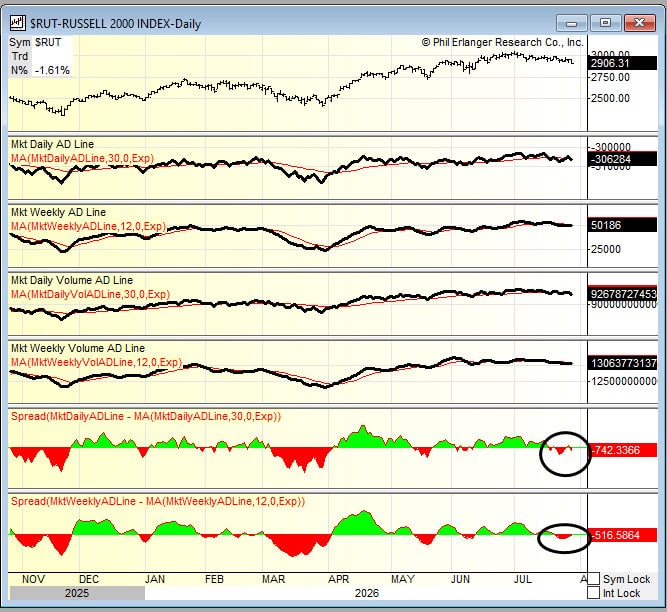
The same 285/280-area put spread structure has reappeared repeatedly across the week in growing size.
Why it matters: Small caps have been under sustained institutional hedging pressure all week — an odd contrast with prediction markets, where recession odds were reported down 32% over the same stretch.
Most active options: NVDA, TSLA, AAPL, INTC, MU, AMD, GOOGL, MSFT, TSM, ORCL
Rising volume to watch: INTC, MU, SOFI, PLTR, NFLX, TSM, ORCL, BE, WULF, NOW, CRWV
TOP TICKERS
META, MSFT, HOOD, QCOM, VRT, SKHY, MU, NVDA, SBUX, CMG
QUESTIONS FROM THE ROWDY REBELS
Q: Is anyone stepping into a call in SPY or QQQ heading into the Fed decision? Seems like a hike is priced in — Luciano I.
A (Mike Mead): “You gotta know I’m in on SPY 736 and 737 calls.”
Q: With the NDX breaking its 100-day moving average, are we road-tripping to the 200-day next? — Dennis M.
A (Chris Sykora): Not sure how far it goes, but it does feel like a rotation is underway; a slight overshoot of the 200-day on the Qs would retest the old highs, so that’s a natural target.
Q: With the failure to pass the Clarity Act, is there any catalyst left to salvage IBIT August calls? — John W.
A (Chris Sykora): Bitcoin may still be stuck without that catalyst, though this afternoon’s Fed news could move things a little — but he’s not counting on it; shelving the bill really ended that particular theory.
Q: What is “EVS”? Geoff mentioned 5MA/20 MA crossovers and EVS crossing above or below in a July 22 post — Howard S.
A (Mell Underwood): It’s the Erlanger Volume Swing, a feature built into the Erlanger software platform to track volume. Geoff will review tomorrow on The Horn.
AI CapEx & Credit
Bull: Microsoft’s Azure print — a first-ever $100 billion year, growth accelerating to 43% ex-FX, 30 million paying Copilot seats — argues the earnings underneath AI infrastructure are real enough to eventually justify the leverage; a stabilization in Nvidia’s CDS spread would be the tell.
Bear: Nvidia’s record CDS jump and Microsoft’s ballooning off-balance-sheet lease obligations suggest credit markets are pricing debt risk on their own timeline, independent of any single earnings beat.
Rate Path / Bond Vigilantes
Bull: Fed swaps already pared back September hike odds right after the meeting, and Goldman’s read on today’s move as positioning-driven would argue the yield spike fades as fast as it appeared.
Bear: A 30-year yield near a near-two-decade high, alongside investment-grade bonds richest relative to equities since 2002, suggests credit isn’t waiting for confirmation — it’s already pricing higher-for-longer as the base case.
The Fed didn’t hike today. The bond market already did — and Microsoft’s clean beat wasn’t enough to make it change its mind.