Newsletters
Rebel Roundup Newsletter For 7/30: Microsoft’s Record Day Cleared Positioning, Not The AI Debate
TODAY, WRAPPED:
The day’s dominant market belief: the AI-stock carnage of the past week was a positioning problem, not a fundamentals problem — and today’s rally is the proof. The S&P 500 closed at 7,437.63, up 1.66%; the Nasdaq 100 surged roughly 3.2% to snap a six-session losing streak; the Dow added 613.92 points (1.19%); the Russell 2000 gained 1.39%. The VIX fell roughly 10% to the mid-18s, its sharpest one-day drop of the stretch.
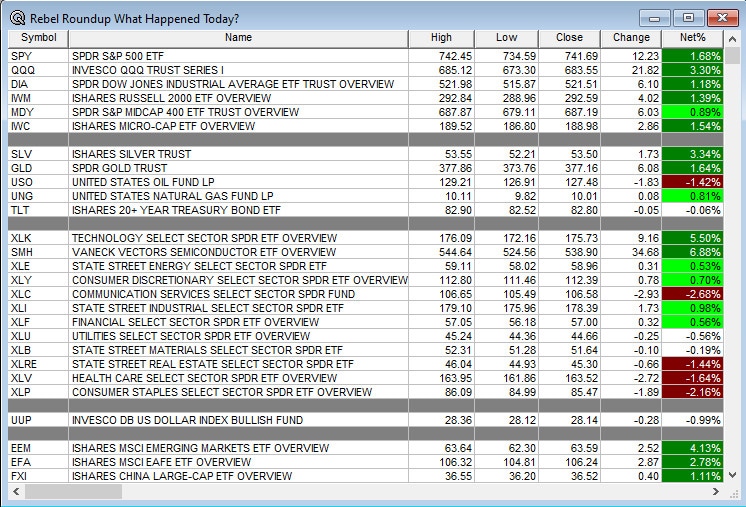
Under the hood the picture is less clean. Advancers led decliners 54.4% to 41.6%, but new 52-week lows (167) still outnumbered new highs (143). The CNN Fear & Greed Index ticked up to 39 (Fear) from 32 the prior close, still nowhere near greed. Microsoft (MSFT) alone added roughly $491 billion in market capitalization — the largest single-day gain in stock market history — and was responsible for more than half of the S&P 500’s percentage move. That concentration explains why today’s rally looked stronger than the broader market actually was.
THE LEAD
Call it what it is: a deleveraging event wearing an earnings rally’s clothes.
The mechanical driver has a name now. Citadel Securities paid roughly $10 billion for the bulk of the public-equity portfolio held by Situational Awareness, the AI-focused hedge fund run by former OpenAI researcher Leopold Aschenbrenner — down from a reported $45 billion net asset value on July 1. The fund ran AI-infrastructure longs against software shorts at roughly 4x leverage; both legs moved against it in the same three weeks. That single unwind doesn’t explain today’s tape by itself, but it’s the visible tip of something larger: hedge funds sold more global information-technology equities in the three sessions ending July 28 than in any comparable stretch since the data series began in 2016, and cut total equity exposure by the most since November 2022. Today’s biggest movers read like a liquidation-unwind list: Bloom Energy (BE) up 27%, Nebius (NBIS) up 28%, Micron (MU) up 18%, Advanced Micro Devices (AMD) up 13%.
One genuinely clean earnings beat gave that unwind a face. Microsoft (MSFT) reported EPS of $4.74 versus $4.25 expected on revenue of $90.01 billion versus $87.72 billion, with Azure growth accelerating to 43% ex-FX against roughly 39.6% expected — the first year Azure revenue crossed $100 billion, per CEO Satya Nadella. Amazon (AMZN) topped $200 billion in quarterly revenue for the first time, with AWS accelerating to 37% ex-FX growth; net income tripled to $62.6 billion, though most of that traced to a $53.4 billion pretax gain on Amazon’s Anthropic stake rather than operating profit. Apple (AAPL) and Meta (META) tell the more complicated version of today’s story — both remind investors that not every AI-adjacent leader was rewarded equally today, and both get the detail they deserve in THE BUZZ below.
Institutional flow had been building the Microsoft case for a full week before any of this printed — see UOA & TOA below for the specific rolls.
The closest precedent isn’t an earnings reaction at all — it’s April 9, 2025. Several relative-performance measures matched or came close to that day’s records: SPY versus the equal-weighted RSP, large-cap growth versus small-cap value, technology versus staples all posted their best or second-best sessions since that post-tariff reversal. The rhyme is real: both were violent short-covering rallies following a positioning shock. The difference is what’s underneath it. April 2025 was a policy reversal that cleared out capitulation broadly. Today’s move traces to one fund’s liquidation plus one company’s quarter — a narrower trigger, and the market hasn’t confirmed it’s more than that yet.
Geoff’s Take. Asked directly whether today’s move was a short squeeze or margin calls unwinding, Geoff Garbacz wasn’t interested in picking a label. He pointed instead to the NYSE advance/decline line as “a problem” and flagged that momentum names trading on total addressable market rather than earnings are “for sure being squeezed” — a narrower, more specific read than “squeeze” alone would suggest.
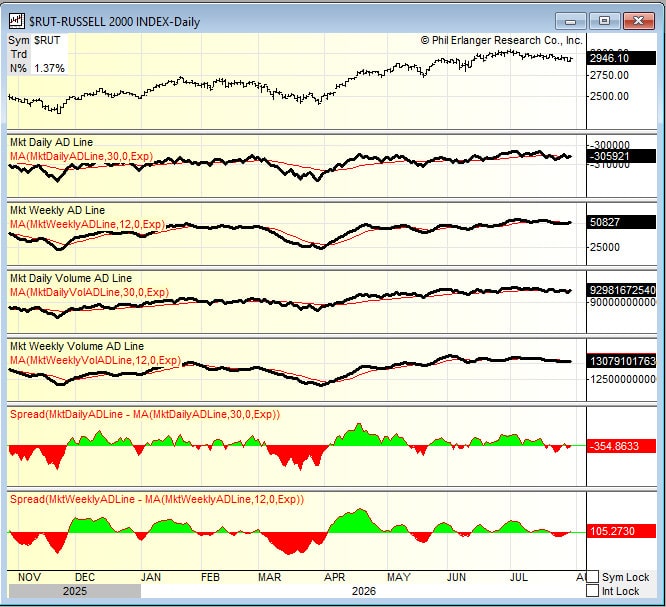
So what happens now: today resolved how the market got here. It didn’t resolve where the AI trade goes next.
THE MARKETS
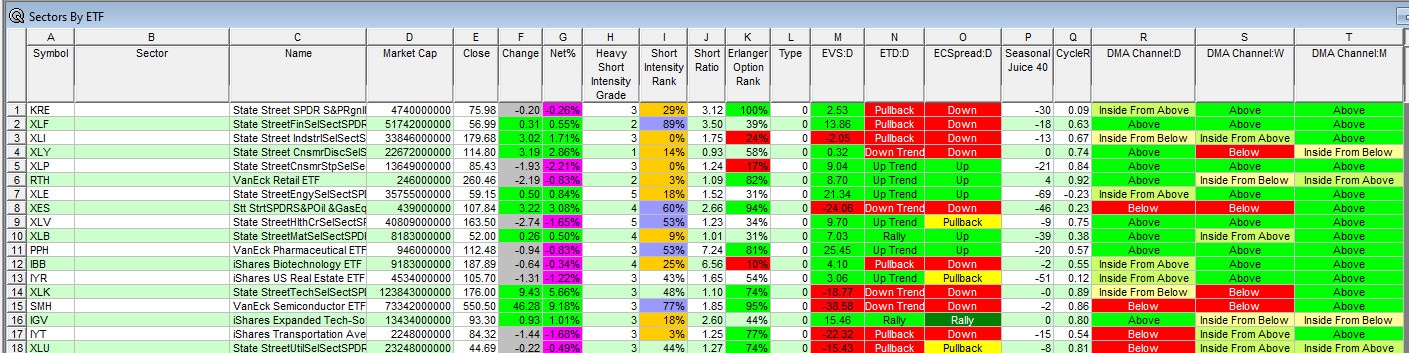
Technology’s 5.55% one-day gain flipped its own weekly script — the sector is still down 1.04% on the week even after today. Consumer Defensive, last week’s leader at +3.19%, was today’s worst sector at -1.89%; Communication Services also lagged at -2.26%, dragged by Meta (META). Leadership narrowed dramatically back toward large-cap AI names, and today’s sector table is the clearest evidence of it.
THE BUZZ
-
Apple (AAPL) beat on nearly every line — EPS $2.02 vs. $1.89 expected, gross margin 50.1% vs. 47.92% expected — but Services revenue missed at $30.74 billion against $31.22 billion expected, and shares fell anyway
-
Meta Platforms (META) missed on EPS ($6.18 vs. roughly $7.18 expected) despite beating revenue, guided Q3 below the Street’s midpoint, and is now on an 11-session losing streak — the longest on record
-
Reddit (RDDT) and Rivian (RIVN) both beat on revenue after the close — full detail in AFTER THE CLOSE below
-
Coinbase (COIN) fell over 7% after missing earnings estimates
-
Q2 GDP came in at 1.5% versus 2.1% expected, the first reading of three
-
Initial jobless claims: 197K versus 200K expected
-
James Bullard, former St. Louis Fed president, called the bond selloff “nerve-wracking for a central banker” and said Warsh “didn’t do very much” to create optionality for September
-
Jersey Mike’s (JMKE) is trading roughly 6% below its $23 IPO price after a syndicate reportedly failed to defend the deal on day one
-
Intercontinental Exchange (ICE) agreed to buy MarketAxess (MKTX) for roughly $6 billion in cash
UOA & TOA
-
Microsoft (MSFT) — Bullish Call Buying, Rolled Higher (7/23, 7/27, 7/30)
8,500 07/31 $435 calls bought 7/23 for $3.00-3.20 above open interest — that same contract is worth roughly $23.15 today, a ~7.5x. The trade was rolled into a 7,500-lot 08/07 420/460 call spread on 7/27 ahead of earnings, then added to again post-earnings on 7/30 with 15,000 08/07 $470 calls and a fresh 9,895-lot 09/04 $465 call buy.
Why it matters: institutional buyers spent a full week building conviction into a beat that hadn’t happened yet, then added more once it did. -
SPY (ETF) — Split Positioning (7/30)
9,526 04Aug $744/$749 call spread bought in the morning; 5,200 20Nov $685/$650 put spread bought that afternoon.
What we’re watching: the same session pressed near-term upside and added a crash hedge four months out — two different time horizons, not a contradiction. -
TLT (ETF) — Bullish Call Buying, Underwater So Far (7/24, 7/27)
20,000 31Jul $83.50 calls bought 7/24, followed by smaller August-dated call buys on 7/27 — all betting on falling yields.
Risk: the 30-year’s real yield hit 3.00% today, the highest outside a brief GFC-era spike since the early 2000s. This trade hasn’t worked yet. -
IWM (ETF) — Bearish Put Spreads, Third Straight Week (7/23, 7/27, 7/29)
The same 285-area put spread structure reappeared across three consecutive weeks in growing size, up to 110,000 contracts on 7/23.
Our read: small-cap hedging hasn’t let up even as the broader tape ripped higher today — caution here looks unrelated to the MSFT-driven bounce.
Most active options: NVDA, TSLA, AAPL, MU, SOFI, INTC, AMD, SPCX, AMZN, GOOGL
Rising volume to watch: MU, SOFI, INTC, SPCX, NOK, F, IREN, MSTR, NBIS, CRWV
TOP TICKERS For TRADING
MSFT, AMZN, AAPL, META, MU, AMD, INTC, COIN, NVDA, JMKE
AFTER THE CLOSE
Reddit (RDDT) beat cleanly on every line — revenue $805M vs. $730.4M expected, EPS $1.25 vs. $0.95 expected, adjusted EBITDA $343M vs. $297.2M expected. Rivian (RIVN) beat on revenue ($1.66B vs. $1.51B expected), posted an EPS loss of $0.63, and raised full-year delivery guidance to 65,000-70,000 vehicles from 62,000-67,000, citing roughly $100M in incremental R2 ramp costs. One stock rose and one fell. Guess what rose?
THE REAL STORY
Equities Are Cheering The Unwind. Credit Is Still Grading The Debt.
The equity question may be settled for now. Credit still isn’t convinced.
Jargon note: an SPV, or special-purpose vehicle, is a separate entity a company uses to finance an asset — in this case AI data centers — so the debt sits off the parent company’s own balance sheet.
Three data points from this week point the same direction. The New York Fed’s index of investment-grade bond market dysfunction hit its highest level in nearly three years. Two separate AI-adjacent loan deals had to be sweetened to get done: CoreWeave reworked terms on a $2.6 billion loan funding compute for customers including Anthropic, and Thoma Bravo’s Proofpoint offered major concessions on a $5 billion loan after lenders grew anxious about AI-driven disruption. Goldman is now gauging investor appetite for a $5.4 billion bond tied to a Blackstone-backed, Microsoft-linked data center, explicitly citing bubble concerns pushing up financing costs.
The two biggest hyperscalers are telling the same story through their own numbers. Meta Platforms (META) spent zero dollars on buybacks last quarter, borrowed $24.9 billion instead, and saw free cash flow fall to its lowest level since the third quarter of 2022. Alphabet (GOOGL) has now gone two straight quarters with zero buybacks — down from $13.2 billion a year ago — while capex nearly doubled to $44.9 billion; its off-balance-sheet SPV commitments climbed another $15 billion this week to $826 billion, a pace of roughly $500 billion per quarter. Across all hyperscalers, off-balance-sheet AI commitments now exceed $3 trillion, having doubled in a single quarter.
This is the same story running through THE LEAD, seen from the lender’s side instead of the buyer’s. Nobody’s questioning whether Microsoft (MSFT) or Amazon (AMZN) can grow revenue — today’s prints answer that. What’s still unresolved is whether the debt underneath that growth is priced correctly, and lenders keep answering by demanding better terms rather than by refusing to lend.
Playbook
-
Watch: hyperscaler CDS spreads and the 30-year real yield (3.00% today) relative to how equities react to the next wave of earnings.
-
Confirm: loan terms on AI-adjacent debt stop requiring sweeteners, and buybacks resume at Meta or Alphabet.
-
Failure: equities keep rallying on beats while the NY Fed dysfunction index and AI-loan concessions keep climbing.
Q&A FROM THE ROWDY REBELS
Q: Breaking syndicate on the Jersey Mike’s IPO — what happened? — Jackie H.
A (Gregg Tenser): Deal priced at 23; it’s the syndicate’s job (Morgan Stanley, Jefferies, and JPMorgan lead) to hold the line and keep the stock from breaching IPO price, at least on day one. Being unable to do so means they mispriced the deal — which is apparently what happened.
Q: Do you think August calls in AAPL are far out enough heading into earnings? — Donna R.
A (Mike Mead): You should own August, September, October, and November in AAPL, but he’s cautious going into the print itself.
Q: Aren’t tools like the CME rate-hike odds useless with a Fed chair who won’t give projections and a divided Fed? — Allen F.
A (Chris Sykora): True, but there should be some volatility around the first few meetings before the market finds the trend and moves become less extreme.
Q: Is this squeezing some shorts? Margin calls? — Mike M.
A (Geoff Garbacz): Somewhat, but the NYSE advance/decline line is a problem. Momentum names based on a high total addressable market but no earnings yet are for sure being squeezed.
WATCHLIST
Positioning Unwind vs. Genuine Repricing
Bull: Documented at the fund level (Situational Awareness) and market-wide (record 3-day hedge fund tech-selling) — combined with Microsoft’s clean beat, that argues today’s snapback is a healthy clearing event. Fear & Greed sits at just 39, nowhere near euphoria.
Bear: New lows still outnumbered new highs today, and Technology remains down on the week despite a 5.55% single-day gain. A rally where one stock adds more market cap than most S&P sectors combined is a fragile foundation.
AI CapEx & Credit
Bull: Microsoft’s clean beat and Amazon’s AI run-rate crossing $25 billion argue the revenue underneath AI infrastructure is real enough to eventually justify the leverage.
Bear: Lenders keep grading it lower regardless of the quarter — the NY Fed’s bond-dysfunction index hit a 3-year high, two AI-adjacent loans needed sweetening this week, and Meta and Alphabet have both gone to zero buybacks while gorging on debt.
Microsoft bought the market a green day. Whether it bought a bottom is a separate question — and the lenders still grading the debt underneath it haven’t answered yet.