Newsletters
Rebel Roundup Newsletter For 7/31-8/2: Monthly Review And After The Close
By Geoff Garbacz | Market Rebellion · August 2, 2026
MONTHLY REVIEW
Going forward, we will do a month and when at the end of the quarter a quarterly review as well as semiannual and annual. We will review on the Horn tomorrow. I will then pass on the recording to Newsletter readers.
July was not kind to Space-X (SPCX) that came public on June 12 and finished June at $170.86. For the month of July, Space-X finished at $108.37. The market cap is now at $1.437 trillion. The stock was priced at $135 and went to a high of $225.64 on June 16trh. Space-X and other space names have taken it on the chin, creating an opportunity to buy these names on the cheap.
Examples include Rocket Lab USA (RKLBA) which closed July at $64.95 from $101.65 at the end of June. Intuitive Machine (LUNR) dropped to close at $12.34 from $21.93. Our third stock,
AST Spacemobile (ASTS) also fell to $58.98 from $88.86. Our fourth name that we have been tracking Planet Labs (PL) closed at $20.48 from $33.13. The space names ex Space-X fell an average of -37.91% while Space-X fell -36.57%. All in all, blood in the street for Space stocks creates an interesting opportunity.
What is also interesting is that AI, Quantum Computing and Power Supply had a very tough July along with the Space names. The Artificial Intelligence and Technology ETF (AIQ) fell from $65.61 to $58.89 a drop of $6.72 which is a drop of -10.24%, a better return than the space stocks but still a down month. However, many of the names in AIQ peaked at the beginning of June when AIQ closed at $70.14 on June 2nd giving it a drop of -16.04% inti late July. Tracking this and seeing it play was important as you will see later in our comments.
We should note that Bitcoin also peaked this spring on May 11th and fell by -23.31% to the end of July. Space, Artificial Intelligence, Quantum Computing, Power Supply and Crytpo represent the brave new frontier of investing and will continue to be volatile creating opportunities when no investor wants to own them and when every investor wants to own them.
July Summary
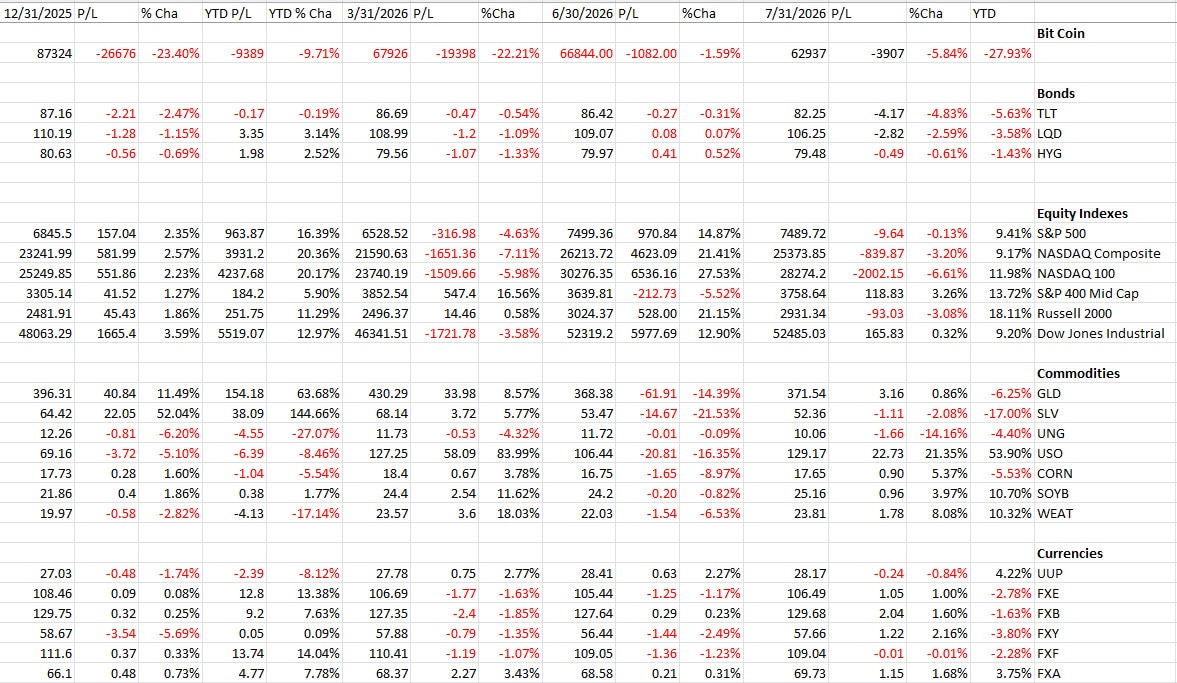
S&P 500 lost some more of its April and May gains as the S&P 500 fell -0.13% and the NASDAQ 100 fell -6.61% with the NASDAQ Composite dropped -3.20%. The S&P 500 is now up 9.41% from 11.16% at the beginning
of June. Meanwhile, the Russell 2000 is up 18.11% from 21.86% and the S&P 400 Mid Cap has gained 13.72% from 16.56% through the June close. Can the uptrend reignite itself in August and the second half of the year? This is the big question for investors.
The first quarter ended being the first negative quarter since the first quarter of 2025 when the S&P 500 fell -4.59%. The second quarter of 2025 saw the S&P 500 rebound nicely, rising 10.57% and we saw the S&P 500 rise
14.10% which was a pretty amazing run. But now the S&P 500 is stuck between $7600 and 7400.
The S&P 500 finished the second quarter at 7218.58 based on a similar rebound to the one seen in 2025. Well, the S&P 500 closed at 7499.36 beating what I thought it would do. So for the third quarter, my estimate was that the S&P 500 clears 8000, but after July that seems a longshot. Why?
If a move to 8000 is in the cards, the conclusion of the Iran conflict leads the list of catalysts which has still not happened, as it seems be a case of kicking the can down the road. Failure to get a resolution could keep inflation high and cause interest rates to clear 5.00%. The price of Crude Oil has moved from $79 on the day of the Iranian invasion to a high of $112.95 in April and closed July at $84.67. A resolution with the Strait of Hormuz and now the Red Sea would go a long way to making investors feel less nervous about the idea of $120 oil a barrel much less $150 ever being hit.
Can gold, silver and then copper which were front page news stories in 2025 return from the back pages? Gold finished up a little bit for July, 0.86% and from its July low is up 1.80%. Silver meanwhile lagged losing -2.08% for the month but is up 3.91% since its July low.
Hedge Fund Blowup
Not a traditional hedge fund in that the founders had no Street cred, which ultimately caused Situational Awareness to blow up and investors took notice in the last week when Citadel stepped in to buy the portfolio.
The fund was started by boy genius, Leopold Aschenbrenner, He graduated from Columbia at 19, was the Valedictorian of his class. Then joined FTX Future Fund in 2022 from February through November and moved onto OpenAI’s Superalignment team in late 2022 until April of 2024 when he was fired. Two months later he wrote a paper called “Situational Awareness” and raised $225 million just like that from a bunch of hedge fund founders that wanted to invest in him.
The fund was pretty simple in its structure. First, invest in the buildout of AI with the traditional vehicles – semiconductors, power suppliers, data centers and the second generation of cloud technology. Second, short software companies that were going to be destroyed by AI. Effectively, short those models could get hurt by AI, like Adobe (ADBE). Unfortunately, July happened as we have noted and it was a tough month.
The long side of his book included semis, energy players and data center. The pain on the long side was severe with Sandisk (SNDK) down -56% late June to July, Nebius (NBIS) down -48% and IREN losing -56% as examples.
The short side was crushed when shorts in software stocks rallied massively with Workday (WDAY) up 48%, Adobe (ADBE) up 36% and Salesforce (CRM) up 25%. Effectively, what the fund was long, it should have been short and what the fund was short, it should have been long.
So Schenbrenner started with $225 million and grew it to $10 billion, then levered it 5x to $50 billion before losing -67% of the fund to conclude with his original $10 or so we are led to believe. The reason this is so important to understand is our monthly overview seeks to review the month and come up with new ideas in the month ahead. Like as an example, playing gold on the long side and staying short semis.
VIX Update
The CBOE Volatility Index (VIX) closed July at15.99 from June 30 at 16.45. That was a drop of -0.46 points, which is 2.79%. The daily closing high for July was 2.88, with a closing low of 14.96. We remain in a low volatility environment BUT it did not seem that way as there were 3 days in July that lost more than -1% after having 4 days in June with losses of more than -1%.
A VIX under 20 means stocks will do well. A VIX above 30 means that the S&P 500 is in a pullback, correction or bear market. The market is now being led by the indexes that are now sprinting higher despite many thematic stocks struggling.
July’s Report Card
Equities – Only the Mid Cap and Dow were higher in July. All other indexes were lower. Year to date all are higher.
Commodities – Only Silver and Natural Gas were lower in July. All others were higher. Year to date only Crude Oil, Soybean and Wheat are higher.
Currencies – Only the US Dollar and the Swiss Franc were lower in July. All others were higher. Year to date only the US Dollar and the Australian Dollar are higher.
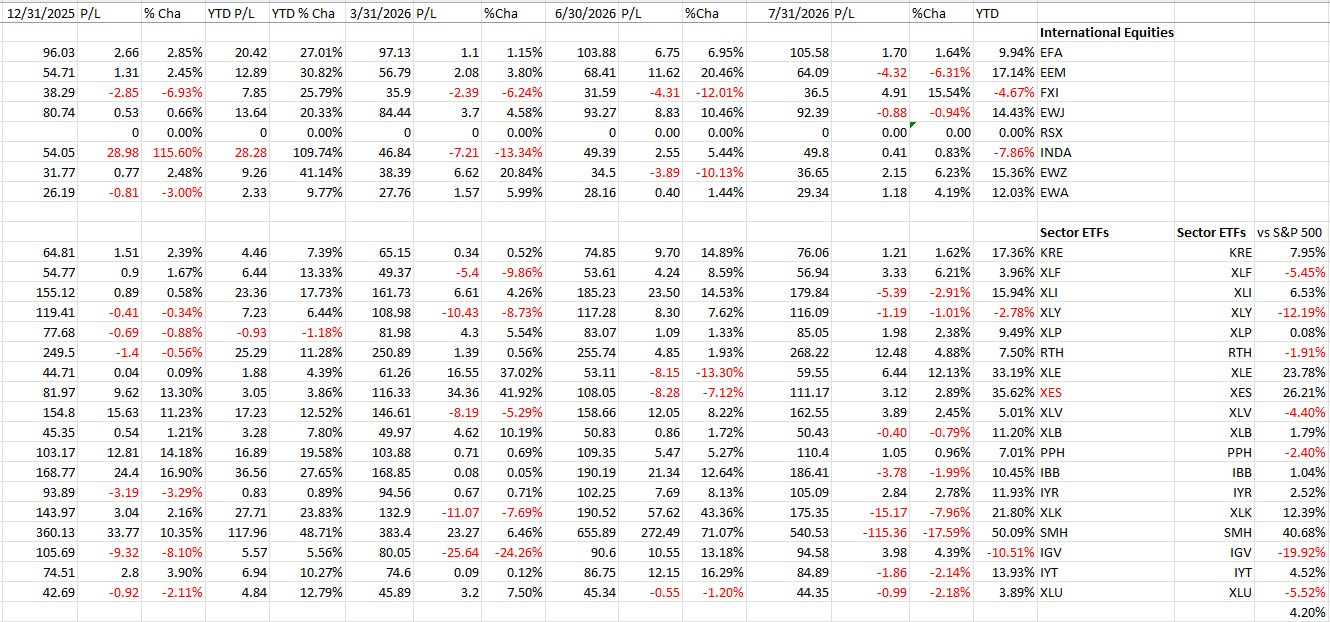
International Equities – Only Emerging Markets and Japan were lower in July. Year to date only China and India were lower.
Sector ETFs – Eight were lower lead on the downside by Industrials, Biotech, Technology and Semiconductors. Year to date Consumer Staples and Software.
Bitcoin – Was lower in July and is down YTD by -27.93%.
AFTER THE CLOSE
Notable Earnings Out After The Close:
- Beats: None of note.
- Misses: None of note.
- Flat: None of note.
Winners From After The Close: BHC (6.78 +53.05%), NEOG (12.00 +27.61%), ITGR (121.18 +22.87%), OMER (11.85 +21.04%), ASGN (28.24 +37.09%), CBZ (55.17 +29.42%), QUAD (10.23 +22.66%), FOSL (4.95 +22.1%), GRMN (296.17 +21.87%), BLKB (42.49 +29.9%), AMBA (86.56 +27.18%), MANH (191.52 +26.27%), EXLS (34.10 +23.22%), CTSH (55.34 +21.76%), MSFT (462.70 +21.22%), MKTX (162.33 +39.11%) of note.
Losers From After The Close: ALNY (205.49 -24.39%), HUN (9.9 -22.7%), OI (7.16 -21.2%), OLN (18.57 -19.98%), LII (419.66 -22.45%), MTZ (266.61 -21.08%), CHRW (148.38 -20.44%), SAIA (350.87 -17.19%), MNRO (12.29 -26.8%), AMKR (50.47 -22.31%), CVLT (116.70 -18%), TREE (32.05 -17.82%) of note.
News after the close:
- Paramount Skydance (PSKY) extended the expiration dates for its previously announced cash tender offers and exchange offers to 5:00 p.m. ET on August 14, 2026, unless further extended.
- Paramount Skydance (PSKY) asked federal judge to hold merger trial in November, but states that sued are seeking April time frame
- Amgen (AMGN) discloses cybersecurity incident.
- OpenAI finds more instances of AI agents escaping containment. (Reuters)
- Fed Chair Kevin Warsh is considering reducing the number of regularly scheduled Fed meetings. (NYT)
- Ferguson Enterprises (FERG) to join S&P 500 replacing EA on Wednesday; ADI Global Distribution (ADIG) to replace HTZ in the S&P SmallCap 600.
- Lockheed Martin (LMT) Sikorsky Aircraft awarded a $107.3 mln US Navy order.
- US and Israel planning harshest bombing campaigns to date against energy infrastructure targets in Iran THIS HAS BEEN DELAYED OVER THE WEEKEND.
- 10Q Delays – None of note.
Executive, Corporate Changes:
- Armin Zerza stepped down for personal reasons as CFO and COO of WMG.
Buybacks of Note:
- LDOS announces new stock repurchase program for up to 20 mln shares of common stock.
Dividend Info:
- PEGA said the special cash dividend will be paid September 16, 2026 to shareholders of record on August 17, 2026, excluding certain shareholders identified in the settlement agreement.