Newsletters
Rebel Roundup Newsletter For 8/17: One Good AI Story and One Bad One Ignored. Bond Market Continues to Struggle.
By Geoff Garbacz | Market Rebellion · August 17, 2026
30-Year Treasury Closes at 5.309%, Its Highest Since 2007! 10-Year Climbs To 4.73%.
TODAY, WRAPPED:
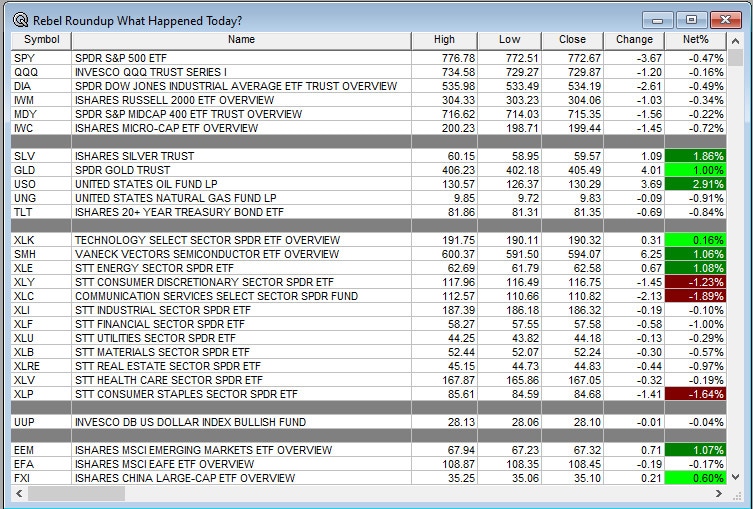
The dominant narrative today: good AI news wasn’t enough when the bond market was sending a bill. The S&P 500 closed at 7,745.06, down 0.52%; the NASDAQ Composite fell 0.32% to 26,644.9; the Dow lost 272.63 points (-0.51%) to 53,459.8; the Russell 2000 slipped 0.35%. A second straight down day for the S&P 500 and the NASDAQ 100, driven by the 30-year Treasury closing at 5.309% — its highest since 2007 — while Brent Crude topped $90. Energy (+0.85%) and Materials (+0.65%) led; Communication Services (-1.40%) and Consumer Defensive (-1.49%) lagged. That’s the story.
THE LEAD
One strong AI Story and one weak AI story that the media tried to spin positive landed today, and neither moved the tape the way bulls might have expected. Nvidia (NVDA) agreed to provide a guarantee of up to $110 billion supporting OpenAI‘s Ohio data-center project — an initial phase with room to expand toward 8 gigawatts total. But earlier this year they had promised $250 million. So where is the other $140 million coming from????
Separately, Bloomberg reported Anthropic‘s preliminary Q2 revenue climbed to $11.5 billion, more than 14-fold higher than a year earlier, with the company posting its first positive adjusted operating income. Valuation jumped to $2 Trillion which is laughable as it was $1 Trillion thirty days ago. Geoff said most tech managers laughed at the rise in valuation. NVDA closed essentially flat after being higher the first part of the day. The NASDAQ Composite fell anyway.
One possible explanation is that AI-linked borrowing is competing with Treasury supply for the same investor dollars. AI and hyperscaler debt issuance is tracking at roughly 12 times the 2015-2024 annual average this year — already $269 billion year-to-date, more than double all of 2025, per Nomura’s Charlie McElligott. That’s landing on a Treasury market already under pressure: last week’s 30-year auction priced at 5.216%, the highest auction yield since 2001, and today’s June TIC data showed net long-term foreign inflows of $172.7 billion — ahead of the $151.4 billion expected, but a sharp deceleration from May’s $231.2 billion.
Citadel Securities has told clients the Fed’s reluctance to cut is keeping long-term yields near multi-decade highs even as softer jobs and inflation data argue the other way — and separately, the firm favors cloud infrastructure names like Microsoft (MSFT) and Alphabet (GOOGL) over frontier-model developers as the AI trade matures. Neither showed up in today’s tape: MSFT fell 2.98%, underperforming the memory-chip names that actually carried the sector.
Oil supplied the rest of the pressure. The US-Iran memorandum of understanding lapsed today with no deal, Iran has reportedly shifted to a “fully offensive” posture, and President Trump repeated his threat to “bomb” Oman if it interferes with the Hormuz blockade — reviving the inflation-and-rates story just as bonds were already nervous about supply.
Institutional flow warned early here: asset managers and hedge funds had built one of the largest NASDAQ 100 futures short positions on record even as last week’s headlines turned bullish — a hedge, not a retreat, since the same funds were net buyers of individual stocks every day last week, their second-fastest buying stretch of 2026. Short the index, long the stock-picking: that divergence is the clearest sign professionals were positioned for exactly this kind of macro-driven wobble while retail chased the Anthropic and NVDA headlines.
BTIG flagged a version of today’s setup last week: since 1990, the equal-weight S&P 500 has typically suffered at least a 7% pullback in the August-October stretch of midterm election years, with valuations stretched and volatility unusually low heading in — much as it was before today. The parallel isn’t exact; BTIG’s note pointed to technical weakness building in semiconductors broadly, while today it’s the memory trade specifically holding the sector up. But the underlying pattern — complacency layered on stretched valuations, waiting on a catalyst most investors weren’t pricing — is the same one BTIG warned about.
Geoff’s Take
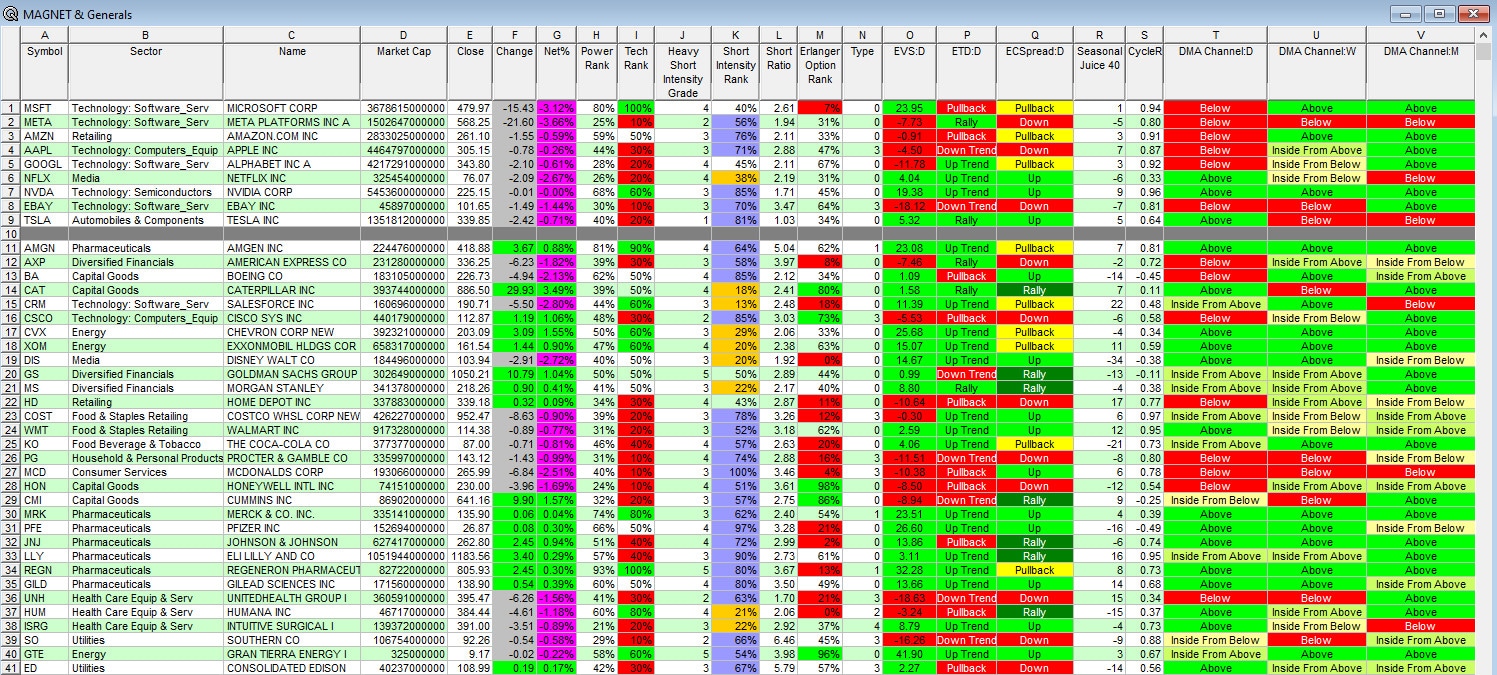
On the trading floor, the conversation centered on a near-expiring NVDA $225 put. Geoff Garbacz told Rebels he was weighing an exit or a further roll, noting the stock wasn’t far from “the line in the sand at $225” — a level that held through what he called “kind of boring sideways action.” MAGNET names ALL CLOSED LOWER. Meanwhile, the Generals saw 16 higher and 14 lower. This sets up for an ugly Tuesday if there is follow through to the downside.
So What
This is a medium-confidence read: well-evidenced, but whether it’s a real shift or a one-day pause gets tested fast — by Wednesday’s FOMC minutes, this week’s Walmart and Home Depot earnings, and whether Brent keeps climbing toward $95. The AI capex story isn’t broken but it is not as solid as the Uber AI Bulls think it is. The question is whether the bond market keeps financing it on the same terms that is has to date?.
THE MARKETS
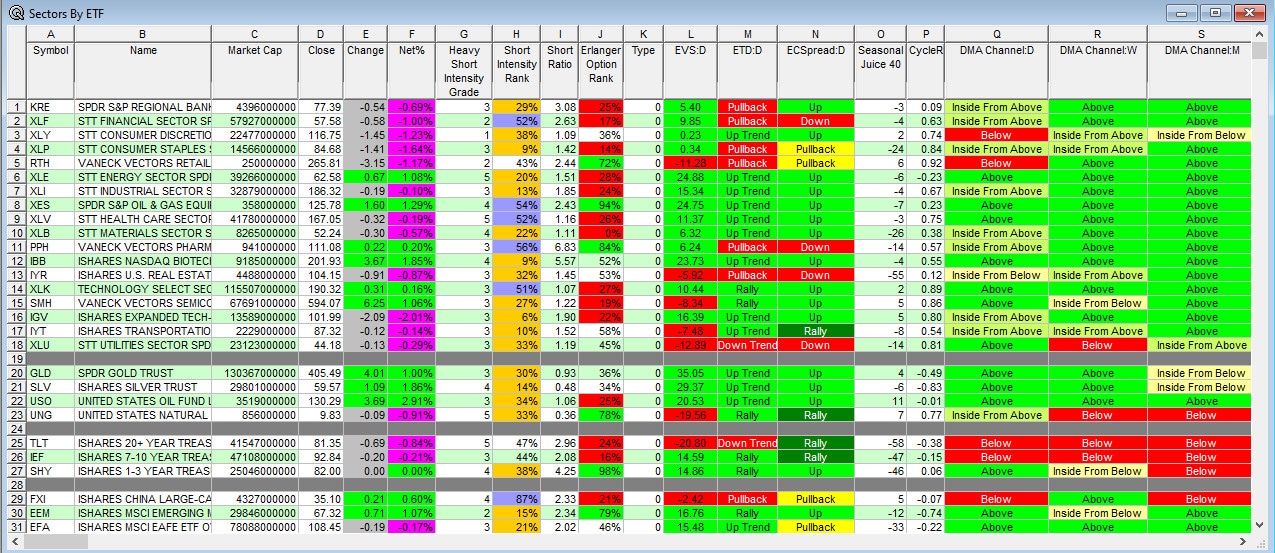
Today’s leadership was narrow — Energy and Materials were the only sectors up more than half a percent. Over the past week, the split is even clearer: Energy +2.76% and Technology +2.33% against Communication Services -2.82% and Consumer Cyclical -2.78%.
THE BUZZ
-
Meta Platforms (META) heads to trial this week over allegations tied to social media addiction and risks to children — today’s worst Mag Seven performer at -3.54%.
-
Morgan Stanley’s bull case has Amazon (AMZN) reaching $500 by end-2027 if AWS stays on a path toward roughly $1 trillion in annual revenue over the next decade; the firm’s base case target is $335. AMZN closed down 0.50%.
-
NY Empire State Manufacturing printed 20.6, well above the 11.0 expected and up from 15.6 in July.
-
NAHB Housing Market Index came in at 35 versus 33 expected.
-
Shein is reportedly targeting a valuation in the $25-28 billion range for its Hong Kong IPO.
-
Target (TGT) fell 2.25% in an otherwise broadly weak Consumer Cyclical sector (-0.91%). TGT earnings are due this week as well.
AFTER THE CLOSE
Earnings After The Close:
-
- Beats: FN 0.29, XP +0.08 of note.
- Misses: None of note.
- Flat: None of note.
Movers Last Week:
-
- Winners From Yesterday:AMLX+14.5%, FLXS +11.9%, KURA +5.4% and DUOT +5.4% of note.
- Losers From Yesterday: FN -5.9%, ANDG -5.6% of note.
News after the close::
-
- CACI International (CACI) selected on $981 mln U.S. Space Force NITE-STAR IDIQ.
- NASA awarded Firefly (FLY) a Spacecraft Processing Operations Contract that makes the company eligible to bid on task orders for payload processing facilities and services at Vandenberg Space Force Base.
- Rocket Lab (RKLB) added to U.S. Space Force’s $981 mln NITE-STAR IDIQ program.
- Parsons (PSN) awarded a $664.8 mln Army contract for technical, logistics, and program management support.
- INFQ FIRY delays 10-Q.
Executive, Corporate Changes:
-
- KALU names Fred Stephan CEO, president effective Nov. 1; Keith Harvey to become executive chairman.
- AON names Nadin Virani interim CFO; Edmund Reese exits role immediately.
- Wendy’s (WEN) announces that Pete Suerken, President, US notified the company of his intention to resign to become CEO of Quality Supply Chain Co-op, the independent purchasing cooperative for the Wendy’s system.
- MITK names Aaron Seyler chief revenue officer
Buybacks of Note:
-
- XZO authorizes $25 million stock repurchase program.
Dividend Changes & Ex-Dividend Stocks:
-
- Stocks Going Ex-Dividend Tuesday
- Stocks Going Ex-Dividend Wednesday – of note.
UOA & TOA
SanDisk (SNDK) — Elevated call and rising options volume (Aug 17)
Extending last week’s run; on both today’s active-options and rising-volume lists.
Why it matters: Memory is the one corner of tech shrugging off the rate story entirely — up from roughly $40 a share a year ago.
Extending last week’s run; on both today’s active-options and rising-volume lists.
Why it matters: Memory is the one corner of tech shrugging off the rate story entirely — up from roughly $40 a share a year ago.
Micron (MU) — Elevated call and rising options volume (Aug 17)
Also on both the active-options and rising-volume lists alongside SNDK.
Our read: Options flow looks like rotation within AI infrastructure rather than an exit from it.
Also on both the active-options and rising-volume lists alongside SNDK.
Our read: Options flow looks like rotation within AI infrastructure rather than an exit from it.
IREN (IREN) — Unusual call buying, Aug 21 $50/$55 strikes (Aug 17)
Heavy call activity intraday ahead of earnings due next week.
What we’re watching: Fresh positioning ahead of a binary catalyst.
Heavy call activity intraday ahead of earnings due next week.
What we’re watching: Fresh positioning ahead of a binary catalyst.
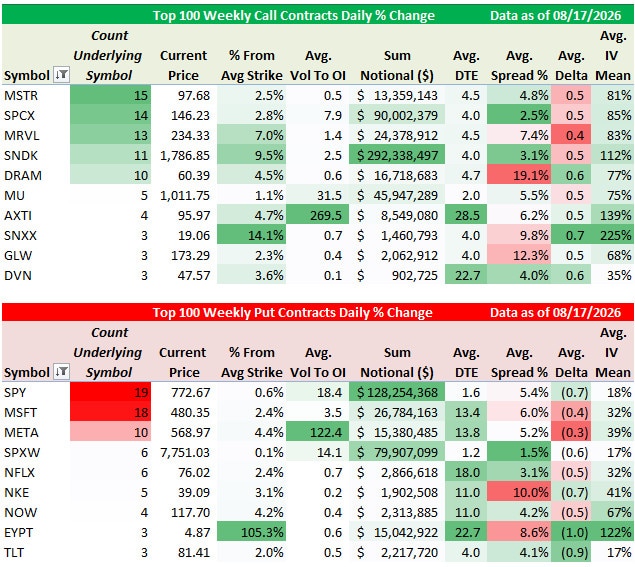
Most active options: TSLA, NVDA, SPCX, MU, AAPL, AMD, INTC, AMZN, AVGO, MSTR, PLTR, SNDK, SMCI, NBIS, MSFT
Rising volume to watch: SPCX, MU, INTC, AVGO, MSTR, PLTR, SNDK, NFLX, ONDS
TOP TICKERS
SanDisk (SNDK), Micron (MU), Meta Platforms (META), Microsoft (MSFT), Nvidia (NVDA), Target (TGT), iREN (IREN)
THE REAL STORY
If the equity story today is “AI borrowing is competing with the Treasury for capital,” the credit market tells a more complicated version — and doesn’t fully agree.
“Project Odyssey,” a Microsoft-linked data-center financing bond, was reportedly increased toward $3.9 billion Monday after junk-like yields drew more than twice that in investor demand. That’s not a market starving AI issuers of capital — that’s a market falling over itself to fund them, at the same moment the 30-year is getting punished for oversupply.
So which is it — is capital scarce for AI, pushing borrowers to compete with Treasury and drag yields up in the process? Or is capital abundant for AI specifically, while sovereign debt gets punished for entirely separate reasons — deficits, oil, a foreign-buyer slowdown per today’s TIC data? The credit-market evidence leans toward the second: investors aren’t rationing AI credit, they’re avoiding long-duration government paper. That’s a less alarming read on “AI is eating the bond market” than today’s equity tape suggested, and it changes what would actually break the current setup — not AI issuance volume alone, but oil and fiscal supply concerns that happen to be colliding with it.
Playbook
-
Watch: Whether AI credit deals keep clearing oversubscribed even as Treasury yields climb.
-
Confirm: A 30-year push toward 5.35%+ alongside continued strong AI-bond demand would point to oil and fiscal supply, not AI borrowing, as the real driver.
-
Failure: AI-linked credit spreads widening alongside Treasury yields would confirm capital is genuinely getting scarce — a more bearish setup than today implies.
QUESTIONS FROM THE ROWDY REBELS
Q: With NVDA‘s price rising and the 08/19/2026 $225 put expiring soon, wouldn’t it be time to exit? — Kevin C.
A (Geoff Garbacz): Considering it now, or rolling it out further — not far from the line in the sand at $225.
WATCHLIST
AI Financing vs. the Bond Market
Bull: Credit markets are still oversubscribing AI-linked debt even as sovereign yields spike — NVDA‘s Ohio financing commitment and Anthropic’s revenue trajectory suggest demand for AI infrastructure remains intact regardless of what the 30-year does.
Bear: A 30-year sustained above 5.3% raises the discount rate on every long-duration AI cash-flow story at once, and today’s flat print in NVDA despite good news is an early warning sign.
Bull: Credit markets are still oversubscribing AI-linked debt even as sovereign yields spike — NVDA‘s Ohio financing commitment and Anthropic’s revenue trajectory suggest demand for AI infrastructure remains intact regardless of what the 30-year does.
Bear: A 30-year sustained above 5.3% raises the discount rate on every long-duration AI cash-flow story at once, and today’s flat print in NVDA despite good news is an early warning sign.
Mideast Oil Risk
Bull: Barrels are reportedly still moving around the Strait via alternate routes, and Brent hasn’t broken into true crisis territory.
Bear: Iran’s offensive-posture shift and Trump’s repeated Oman threats raise the odds of an actual disruption, not just a deadline headline.
Bull: Barrels are reportedly still moving around the Strait via alternate routes, and Brent hasn’t broken into true crisis territory.
Bear: Iran’s offensive-posture shift and Trump’s repeated Oman threats raise the odds of an actual disruption, not just a deadline headline.
The AI trade didn’t lose today — the bond market just cashed a check first.
YOUTUBE