
Newsletters
Rebel Roundup Newsletter For 8/19: Treasury Bribes The Market, No Consensus If This Will Work. Meanwhile- Materials, Healthcare, Consumer Cyclicals and Real Estate Prevented Market from Weakening
By Geoff Garbacz | Market Rebellion · August 19, 2026
The 30-Year Yield Fell To 5.194% While Only Four Of Eleven Sectors Gained More Than 1%
TODAY, WRAPPED:
The day’s dominant market belief: a bond-market rescue, not a broad conviction shift. The S&P 500 snapped a three-day losing streak, closing at 7,707.98 (+0.21%), while the Dow Jones Industrial Average added 0.22% to 53,463.05 and the NASDAQ Composite edged up 0.16% to 26,331.09. But the NASDAQ 100 — the mega-cap-tech-heavy index — actually closed down 0.22% at 29,426.02, a split that tells you more about today than any headline number. The trigger was the U.S. Treasury’s surprise move to at least double its long-bond buyback program, which pulled the 30-year yield down to 5.194% and the 10-year to 4.653%.
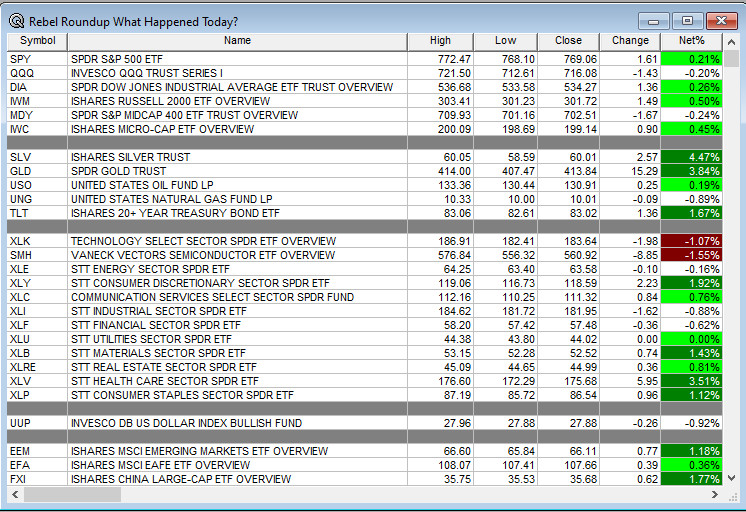
Under the hood, only four of eleven sectors gained more than 1% by the close — down from nine at midday, when the rally briefly looked much broader. Moderna (MRNA) closed up 177.48% on melanoma-vaccine data, dragging Merck (MRK) up 12.60% alongside it. That’s the story.
THE LEAD
The bond market got bailed out today. The stock market, for the most part, just came along for the ride on four sectors and the biotech miracle — and even that ride narrowed as the session wore on.
As detailed above, the mechanism was Treasury’s decision to raise its long-dated buyback cap from $2 billion to at least $4 billion per operation starting September 9, framed as “liquidity support” for a market that had seen a genuine buyers’ strike since late June. The reaction was immediate: 30-year and 10-year yields both fell sharply from Tuesday’s elevated levels (see THE MARKETS for the closing figures). TLT gained 1.67%. Gold spiked over 4% intraday. The dollar sank to roughly a three-month low. Bitcoin jumped more than 6%.
Equities, however, didn’t follow uniformly — and that’s the part the headline indices obscure. At midday, nine of eleven S&P sectors were higher and the equal-weighted index was outpacing its cap-weighted counterpart, a genuine broadening-out trade. By the close, that had narrowed to four sectors gaining more than 1%: healthcare (XLV) +3.51%, consumer discretionary (XLY) +1.92%, materials (XLB) +1.43%, and staples (XLP) +1.12% (full sector table below).
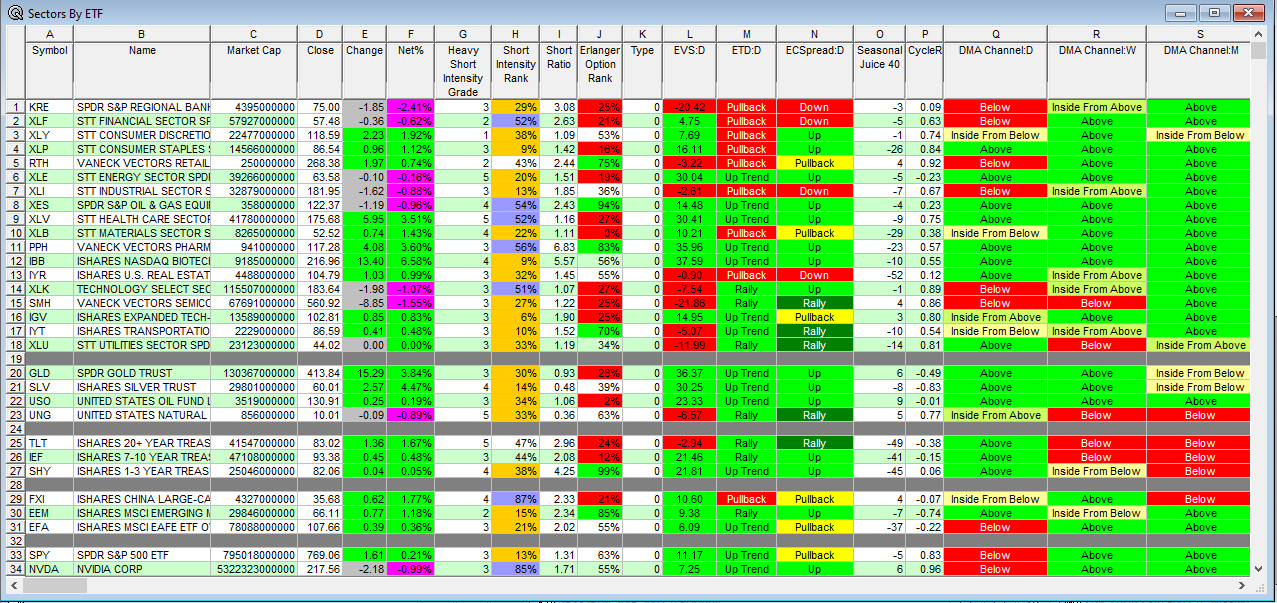
Energy flipped from a midday gain to a small loss as WTI crude gave back its entire 1.8% intraday advance to close roughly flat. Financials, industrials and technology all closed lower even as the bond market rallied hard. Semiconductor names that should have been the first beneficiaries of falling long rates instead extended their slide: Nvidia (NVDA) -0.92%, Broadcom (AVGO) -4.60%, AMD -3.63%. Advancing issues beat declining ones by a modest 55.4% to 40.3% — a positive session, not a stampede.
Healthcare needed no rate rescue. Moderna (MRNA) and Merck’s (MRK) Phase 3 melanoma-vaccine data — reported as the first positive Phase 3 result for a personalized cancer therapy — drove MRNA to a 177.48% close, the single largest mover in the S&P 500, and reportedly burned an estimated $5 billion from short sellers along the way. William Blair upgraded MRNA to Outperform intraday. Eli Lilly (LLY) hit a fresh all-time high, and the sector’s one-week performance (+4.12%) now leads every other group in the index.
Smart Money Note
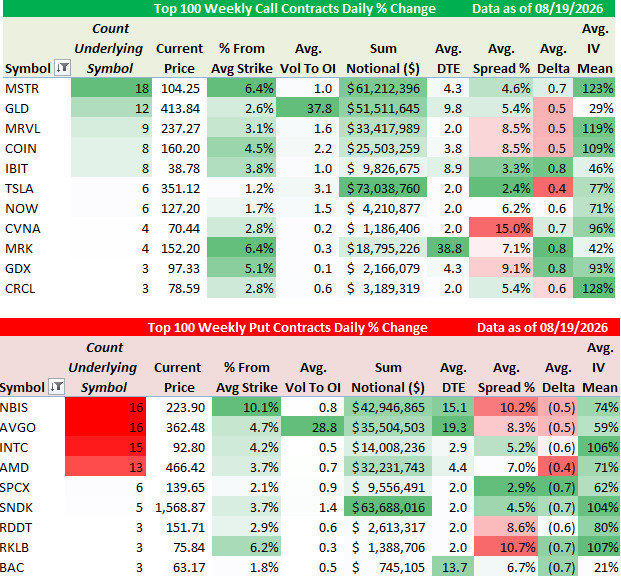
Options flow reinforced both threads early, with unusually large bullish GLD positioning alongside a rolled SMH bearish spread — a desk extending, not closing, a semiconductor hedge into today’s rally (full details in UOA & TOA below).
The later 20-year auction complicated the relief narrative, with demand coming in weaker than the headline bond rally suggested — more on that in THE REAL STORY.
History
The closer parallel isn’t 2008 — it’s September 2019, when a repo-market seizure forced the Fed into emergency liquidity operations it insisted, at the time, weren’t quantitative easing. Bloomberg’s own framing today — “Operation Twist Redux” — leans on the same 1960s-vintage playbook of buying long-duration debt to flatten the curve without formally restarting QE. The parallel isn’t exact (this is Treasury debt management, not Fed balance-sheet policy), but the pattern of “temporary liquidity support” quietly becoming a repeated tool rhymes across both eras.
Geoff’s Take
Geoff recommended a Carvana (CVNA) put, opened into Tuesday’s close, faced a reversal Wednesday after new reporting complicated the thesis around a potential sale of Mark Walter’s CVNA stake. Geoff reiterated in chat that one session doesn’t invalidate the thesis and that the trade still has time to develop (full exchange in Q&A below). Moreover, if rates fail to drop, then watch out as car sales will plummet.
So what. This was a rate-driven relief rally with a genuine fundamental story riding shotgun in healthcare — not a broad risk-on turn, and the intraday narrowing argues it was even less broad than the opening hours suggested. Confidence here is medium, not high: the Treasury trigger and its bond-market impact are directly confirmed, but they sit alongside a tailing auction, a hawkish FOMC, and two sectors (financials, tech) that didn’t participate — enough open questions that the “relief” label could still be revised by Friday.
THE MARKETS
Sector ETFs: XLV +3.51%, XLY +1.92%, XLB +1.43%, XLP +1.12%, XLRE +0.81%, XLC +0.76%, XLU flat, XLE -0.16%, XLF -0.62%, XLI -0.88%, XLK -1.07%. Breadth was positive but unspectacular: 55.4% of S&P names advanced versus 40.3% declining, and the CNN Fear & Greed Index ticked up to 56 (Greed) from 54 (Neutral).
AFTER THE CLOSE
Earnings After The Close:
-
- Beats: WOLF +0.19, NDSN +0.16, BILL +0.13,BULL +0.08 of note.
- Misses: COTY -0.01 of note.WYFI -20.5%, LZB -16.3%, EPM -11.2%, MRCY -10.5%, AUNA -9%, BLZE -7.8%, FR
- Flat: None of note.
Movers after the close on Wednesday:
-
- Winners: BULL +13.5%, NDSN +8.7%, RARE +8.6%, SUPX +5%, ETD +4.3% of note.
- Losers: WOLF -9.8%, COTY -7.6% of note.
News after the close::
-
- U.S. Debt hits $40 trillion says Reuters.
- Trump Administration set to lower Canadian auto tariffs to 15% as part of broader trade deal.
- INFQ FIRY delays 10-Q.
Executive, Corporate Changes:
-
- MMSI names Sheri Lewis EVP of Global Operations; COO Neil Peterson to transition to senior advisor.
- AMRC CFO Mark Chiplock to depart Sept. 25; company reiterates FY26 outlook.
- COTY names British American Tobacco’s Soraya Benchikh CFO, effective Sept. 1, 2026.
Buybacks of Note:
Dividend Changes & Ex-Dividend Stocks:
-
- Stocks Going Ex-Dividend Thursday: MSFT $0.91, WPM $0.155, TRU $0.13, FBY $0.07, FND $0.05
- Stocks Going Ex-Dividend Friday:
- ETD declares special cash dividend of $3/share; reaffirms strong financial position and commitment to sustainable shareholder value.
THE BUZZ
-
U.S. national debt officially crossed $40 trillion today, per Bloomberg, as America’s borrowing costs continue climbing alongside the deficit.
-
Estée Lauder (EL) closed up 16.30% after beating on both lines. Guidance for FY27 EPS came in at $3.10 to $3.35, roughly in line with estimates, ending a run of three straight annual revenue declines.
-
Marvell (MRVL) closed up 9.85% on its Google chip-warrant deal; Broadcom (AVGO) fell 4.60% on the competitive read-through.
-
SK Hynix (SKHY) rose 9.60% after unveiling a $29 billion buyback to steady investor nerves on AI-spending durability.
-
Target (TGT) rose 4.28% despite a $1 billion-plus profit boost tied to tariff refunds inflating the headline beat; the gain had been closer to 6% at midday.
-
TJX fell 4.21% even after beating headline estimates — Marmaxx comps came in below management’s internal expectations and the full-year comp outlook wasn’t raised.
-
Lowe’s (LOW) rose 2.02% on the day despite cutting full-year guidance to the low end of its prior range on soft housing-driven DIY demand.
-
Meta Platforms (META) rose 1.70%, rebounding from Tuesday’s sharp decline tied to opening arguments in a child social-media addiction case.
-
Tuesday’s semiconductor-adjacent carnage got a name check today: Fabrinet (FN) -19.39%, Lumentum (LITE) -9.87%, Coherent (COHR) -12.84%, and Teradyne (TER) -8.77% all fell despite Fabrinet’s own better-than-expected results — optical/AI-infrastructure names sold as a group regardless of individual fundamentals.
-
Stripe agreed to buy AI startup OpenRouter for $7.5 billion.
-
FOMC Minutes: several officials said a rate hike would likely be needed if inflation didn’t cool, confirming three hawkish dissenters from the July meeting had real company inside the room.
UOA & TOA
SPDR Gold Shares (GLD) — Bullish Call Spread (Aug. 19)
55,273 September 11 430/445 calls bought/sold, both several multiples above respective open interest. Stock $412.34 at the time of the print.
55,273 September 11 430/445 calls bought/sold, both several multiples above respective open interest. Stock $412.34 at the time of the print.
Why it matters: The largest single options print on today’s entire log — unusually large bullish positioning in gold arriving well before most of the day’s price move, and consistent with today’s broader move in mining names like Newmont (NEM), up 7.63%. Geoff bought calls again after being gone for a week.
VanEck Semiconductor ETF (SMH) — Bearish Put Spread, Rolled (Aug. 19)
6,398 September 18 545/485 puts, rolled from an August 21 595/530 put spread of the same size — extending duration and lowering strikes as SMH traded near $562.70.
6,398 September 18 545/485 puts, rolled from an August 21 595/530 put spread of the same size — extending duration and lowering strikes as SMH traded near $562.70.
Our read: A desk didn’t close this semis hedge into today’s bond rally — it actively extended and re-struck it lower, a stronger signal than simply holding a position through strength.
Merck (MRK) — Call Buying (Aug. 19)
7,000 November 20 $135 calls bought well above open interest of 101 contracts, alongside the day’s oncology headline.
7,000 November 20 $135 calls bought well above open interest of 101 contracts, alongside the day’s oncology headline.
What we’re watching: Longer-dated, sized conviction on Merck’s oncology franchise beyond the immediate INTerpath-001 pop.
iShares Bitcoin Trust (IBIT) — Bullish Call Buying (Aug. 19)
Two prints: 30,000 November $45 calls and 38,000 September $39.50 calls, both well above respective open interest, as IBIT volume ran roughly double its average.
Two prints: 30,000 November $45 calls and 38,000 September $39.50 calls, both well above respective open interest, as IBIT volume ran roughly double its average.
Risk: Chat-room desks flagged the volume surge as unusual with no clear catalyst attached in real time. A potential explanation emerged later in the session, when reports surfaced of a 2:30 p.m. White House meeting with crypto-industry officials — the timing is notable given that the options activity preceded the headline.
Most active options: NVDA, TSLA, AAPL, INTC, MU, META, SPCX, AMZN, NFLX, AMD, MSFT, PLTR, SNDK, CRWV, AVGO
Rising volume to watch: INTC, MU, SPCX, NFLX, PLTR, SNDK, CRWV, AVGO, NKE, WOLF, MSTR
TOP TICKERS
Moderna (MRNA), Merck (MRK), Estée Lauder (EL), Marvell (MRVL), SK Hynix (SKHY), Target (TGT), Carvana (CVNA), Broadcom (AVGO), Eli Lilly (LLY), TJX
THE REAL STORY
The Treasury bought a rally today. It’s much less clear it bought anything durable — and four separate signals from today argue the underlying stress is still there, just deferred.
Jargon note: a “tail” in a Treasury auction means the yield priced above where the market expected right before the deadline — a sign real demand was weaker than the buying interest suggested.
First, the auction, as flagged above: the $16 billion 20-year sale hours after the buyback headline tailed by the most since February and priced at the second-highest 20-year auction yield on record. Buyers showed up; they weren’t fully convinced.
Second, the Fed. July’s FOMC minutes, released the same afternoon, showed several officials saw a rate hike as likely necessary if inflation didn’t cool — a genuinely hawkish signal landing on the same day markets celebrated a dovish-looking bond rally. Those two things don’t square unless investors believe Treasury and the Fed are operating from different playbooks right now, which increasingly they are. Bloomberg separately noted the buyback move “could make Kevin Warsh’s job harder” — a pointed reference to growing debate over how fiscal and monetary policy may interact under the next Fed chair.
Third, the survey data: Bloomberg’s Markets Pulse Poll found a majority of respondents now expect the 10-year yield to top 5% before year-end — a forecast made on a day the 10-year closed at 4.653%. That’s not a market that thinks today’s relief is the new equilibrium; it’s a market treating it as a pause.
Fourth, a more speculative but pointed read on why long yields spiked in the first place. Michael Gayed of the Lead-Lag Report argues in a note circulated today that the driver isn’t routine portfolio rebalancing but forced, leveraged selling by Japanese institutions unwinding yen-funded carry positions — a dynamic he frames as a margin call rather than a rotation, and one he argues short-rate cuts can’t fix since the pressure sits at the long end of the curve.
This is a single strategist’s Narrative-level thesis, not confirmed flow data, and Gayed offers his own falsification test: the yen stabilizing without intervention and 30-year yields falling meaningfully without a matching move in real yields. If his framing has any merit, though, it means Treasury’s buyback is treating a symptom — dealer and auction stress — rather than the underlying source of selling pressure.
None of this means the rally reverses tomorrow. It means the gap between the “relief” headline and what the auction, the Fed, the survey data, and the deeper question of who’s actually selling all point to is exactly where the next surprise is most likely to come from — in either direction.
Playbook:
-
Watch: The 10-year and 30-year yields into September 9, when the expanded buyback size takes effect — a clean move back above today’s pre-intervention highs would say the fix didn’t hold. USD/JPY is worth watching alongside it if the Gayed thesis has any legs.
-
Confirm: Whether semiconductor and financial names (SMH, XLF) start participating in the next leg up — broad confirmation beyond healthcare would support a genuine regime change.
-
Failure: Another weak or tailing Treasury auction, or fresh corporate AI-debt issuance that further crowds out sovereign supply, would confirm today was a narrow, rate-driven bounce rather than a turn.
QUESTIONS FROM THE ROWDY REBELS
Q: What was your confidence level on the CVNA put trade? — Vinnie C.
A (Geoff Garbacz): Bottom line is Walter has to sell his stake in Carvana, which is 4-5% of the shares, and it will get hit. The Yahoo article validates that he’s liquidating to cover losses on the insurance side. My confidence is a 3.
A (Geoff Garbacz): Bottom line is Walter has to sell his stake in Carvana, which is 4-5% of the shares, and it will get hit. The Yahoo article validates that he’s liquidating to cover losses on the insurance side. My confidence is a 3.
Q: I’ve been away today — are we still holding the CVNA put, or is the thesis invalidated? — Desha D.
A (Geoff Garbacz): One day doesn’t kill the idea. There’s plenty of time for it to work. I remember when everyone had given up on NVDA earlier in the week — look how that turned out.
A (Geoff Garbacz): One day doesn’t kill the idea. There’s plenty of time for it to work. I remember when everyone had given up on NVDA earlier in the week — look how that turned out.
Q: I’m seeing a lot of volume in IBIT with no news — is that unusual options activity? — Dennis M.
A (Chris Sykora): There’s a lot of volume in there today, and some activity in ETHA too, but the September $40 line looks more like trading than solid positioning. Geoff noted there was a meeting at the White House at 2:30 p.m. EDT with Crypto CEOs.
A (Chris Sykora): There’s a lot of volume in there today, and some activity in ETHA too, but the September $40 line looks more like trading than solid positioning. Geoff noted there was a meeting at the White House at 2:30 p.m. EDT with Crypto CEOs.
WATCHLIST
Rate-Driven Relief vs. A Skeptical Bond Market
Bull: If the 20-year and 30-year auction calendar improves from here and yields stay contained into the September 9 buyback expansion, today’s narrow bounce broadens into genuine relief across financials and semis.
Bear: Another weak auction, or a hawkish Fed follow-through on the July minutes’ rate-hike language, would confirm today’s rally borrowed stability from a market that hasn’t actually been convinced.
Bull: If the 20-year and 30-year auction calendar improves from here and yields stay contained into the September 9 buyback expansion, today’s narrow bounce broadens into genuine relief across financials and semis.
Bear: Another weak auction, or a hawkish Fed follow-through on the July minutes’ rate-hike language, would confirm today’s rally borrowed stability from a market that hasn’t actually been convinced.
Healthcare Breakout vs. Semiconductor Laggards
Bull: With healthcare’s one-week performance now leading every S&P sector and multiple names at fresh highs, this could signal a genuine rotation away from AI-concentration risk, though it’s too early to call it confirmed.
Bear: If the healthcare strength proves largely a single-stock event (MRNA) and semis keep sitting out — as SMH’s rolled put spread suggests at least one desk expects — the “breadth improvement” story doesn’t survive scrutiny into next week.
Bull: With healthcare’s one-week performance now leading every S&P sector and multiple names at fresh highs, this could signal a genuine rotation away from AI-concentration risk, though it’s too early to call it confirmed.
Bear: If the healthcare strength proves largely a single-stock event (MRNA) and semis keep sitting out — as SMH’s rolled put spread suggests at least one desk expects — the “breadth improvement” story doesn’t survive scrutiny into next week.
Four sectors and one blockbuster biotech carried today’s tape — not a market suddenly convinced the debt math or the AI-financing math got easier.
YOUTUBE