
Trading Insights
Put Buyers Crowd Into These 5 ETFs Ahead of September FOMC
_ Last week, the August CPI Report brought the market to its knees. While many expected falling energy prices to lead inflation lower, it wasn’t enough to counter the rapid rise in the cost of food, electricity, natural gas, and other key categories. As a result, the market opened low, and continued lower. By the […]
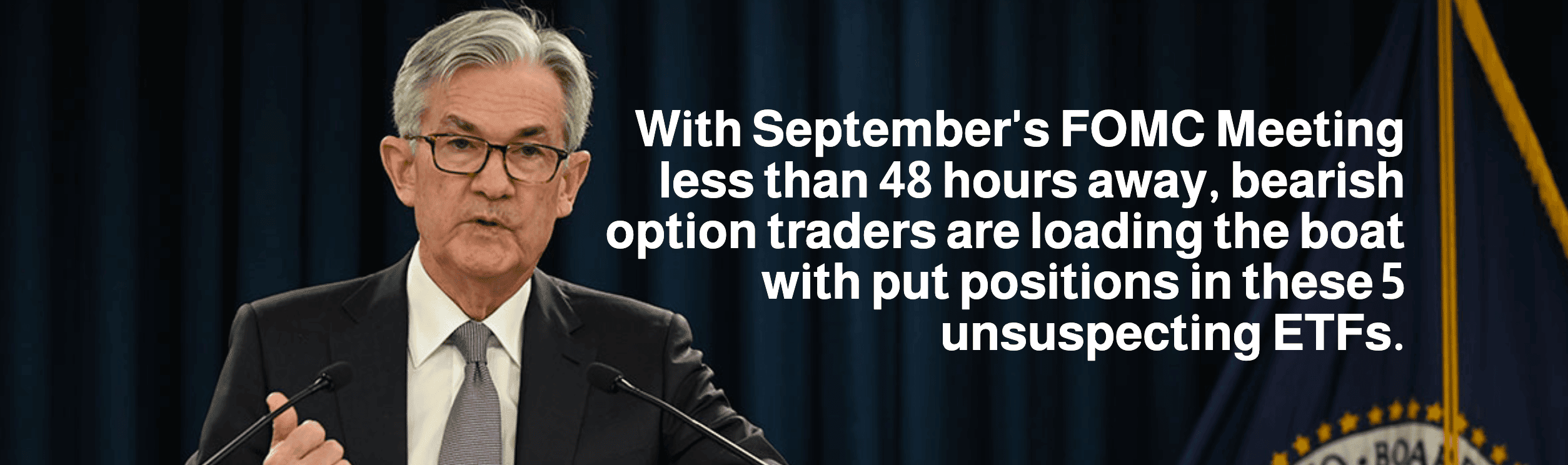
Table of contents
_
Last week, the August CPI Report brought the market to its knees. While many expected falling energy prices to lead inflation lower, it wasn’t enough to counter the rapid rise in the cost of food, electricity, natural gas, and other key categories.
As a result, the market opened low, and continued lower. By the close, every single Nasdaq stock had finished in the red, and as a whole, it was the worst day for the stock market since June of 2020. The institutions wasted no time following the downside momentum, with unusual options activity rushing in within minutes of the opening bell. Those bearish options trades quickly flourished.


The unusual option activity trades depicted above are just a sample of the bearish activity that Market Rebellion identified all day following the August CPI. Source: Market Rebellion’s Unusual Options Activity Service, Google Finance
Now, less than 48 hours before September’s all-important FOMC Meeting, the “smart money” buyers are loading the boat with bearish put options yet again — and they used Monday’s rally to do it. Here are 5 ETFs they’re targeting for more potential downside.

SPDR S&P Metals & Mining ETF — XME
$408,000 in OTM Put Options Expiring October 21st


Performance of XME since the release of the August CPI Report. Source: Google Finance
Financial Select Sector SPDR Fund — XLF
$2,085,000 in OTM Put Options Expiring December 16th


Performance of XLF since the release of the August CPI Report. Source: Google Finance
SPDR S&P Homebuilders ETF — XHB
$2,327,500 in OTM Put Options and Put Spreads Expiring November 18th


Performance of XHB since the release of the August CPI Report. Source: Google Finance
Consumer Discretionary Select Sector SPDR Fund — XLY
$3,300,000 in OTM Put Options Expiring October 21st


Performance of XLY since the release of the August CPI Report. Source: Google Finance
United States Oil ETF — USO
$4,981,490 in OTM Put Spreads Expiring October 21st & December 16th


Performance of USO since the release of the August CPI Report. Source: Google Finance
Unusual options activity not your thing? Try trading the technicals with Rebel Weekly. Ride the waves of market momentum with two option trades every week.
Recessionary Fears: Tying These Bearish Option Trades Together
Outside of the consumer discretionary sector ETF, these look like low-multiple, well-valued ETFs. So why target these sectors ahead of the next rate hike? Conventional wisdom says that if rates are going higher, it might make more sense to short something with a high valuation — a CLOU, a BKCH, etcetera. Instead, these bearish option traders are targeting the materials sector with an attack on metals and mining, the US Oil ETF, the financials, and the homebuilders. Why? It’s simple: The theme that ties all five of these bearish ETF trades together is a possible recession. That doesn’t necessarily mean that the option traders responsible for making these bearish moves are anticipating an actual near-term recession — more likely, these traders are anticipating recessionary fear.
Recessionary fear is something that the market could easily take away from Powell’s FOMC speech on Wednesday. All it might take is another homage to Paul Volcker. Another reference to “pain for households and businesses”. Another reminder that rates will have to stay higher for longer in order to achieve the Fed’s goals. Any sign that the Fed is willing to inflict economic pain in order to achieve its goal of reducing inflation could be a negative shock to these five sectors — all of which rely on a strong economy, a strong consumer, and steady demand in order to thrive.
Will these trades pan out like the CPI trades from last week? Or will the market choose to see the glass half full when Powell takes the stage at 2:30 EST?