
Trading Insights
Russia and Ukraine: What it Means For Markets
Russia and Ukraine are at war, and the effects have been felt across the world. Here are just some of the ways the conflict has affected the stock market. Before we begin, let’s be clear. The Russian invasion of Ukraine is a tragedy. But as with any tragedy or major global event, traders and investors […]

Russia and Ukraine are at war, and the effects have been felt across the world. Here are just some of the ways the conflict has affected the stock market.

Before we begin, let’s be clear. The Russian invasion of Ukraine is a tragedy. But as with any tragedy or major global event, traders and investors must be nimble as they learn to navigate their way through the new market environment.
From the macro ETF’s of America and Europe to the pricing of many commodities, markets around the world felt the economic consequences of the Russia and Ukraine conflict almost immediately. Let’s take a look at several charts to try and pinpoint exactly how the largest conflict since World War 2 has affected global markets.
America’s Economic Reaction (SPDR S&P 500)
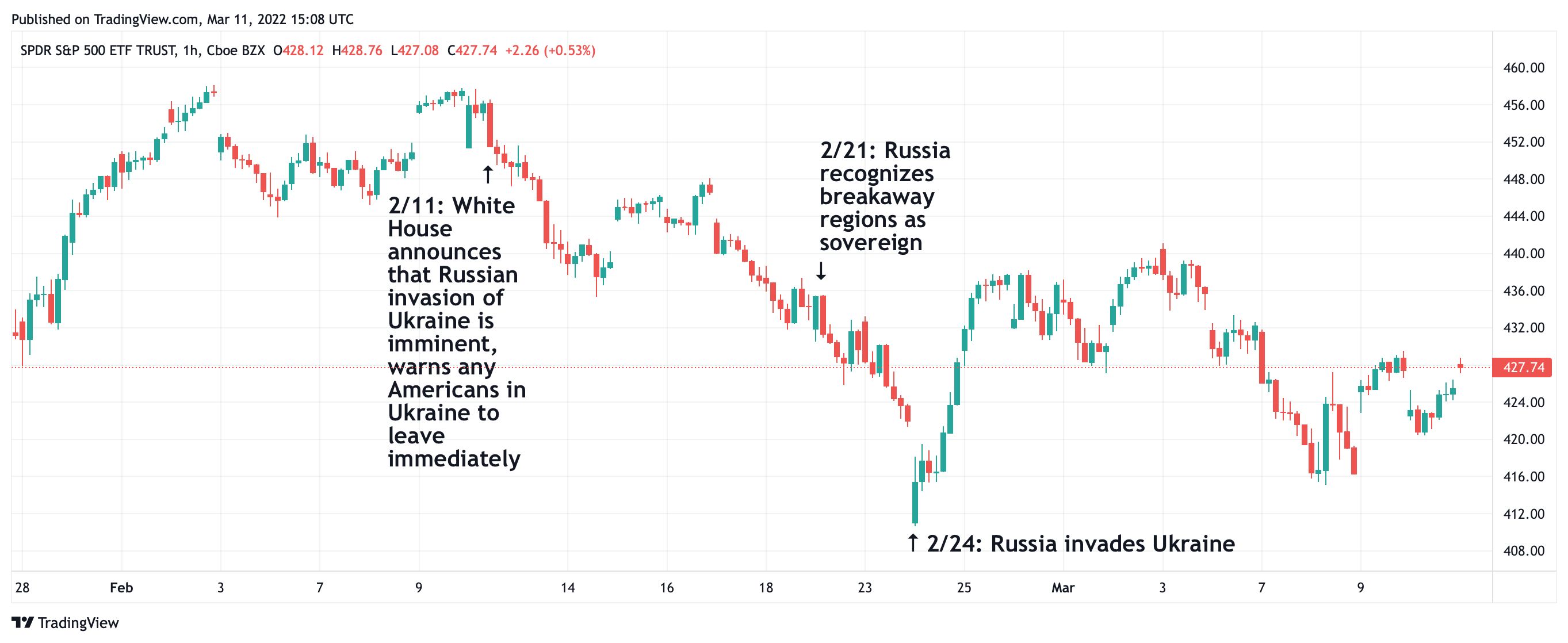
Starting with a look at the SPDR S&P 500 ETF ($SPY), the chart paints a clear story. As tensions rose in Europe, a bubbling late-January rally came to a screeching halt. On February 11th, the White House announced that a Russian invasion of Ukraine is imminent, warning any American currently residing in either country to leave immediately. This kicked off a panic, dragging down the index ETF by several percentage points.
This drawdown became further exacerbated when Russia recognized separatist regions of Ukraine as sovereign on February 21st. But here’s the interesting part: the market formed a bottom on the 24th, the first day of Russia’s invasion.
Why would that be? While it may sound contrarian, American investors were likely looking to the trends of the past when they “bought the dip”. Between the Vietnam War, the Gulf War, the Afghanistan War, the Iraq War and the Crimean Crisis (which in many ways foreshadowed this conflict), investors who bought the dip in American stocks during the invasion were often rewarded.
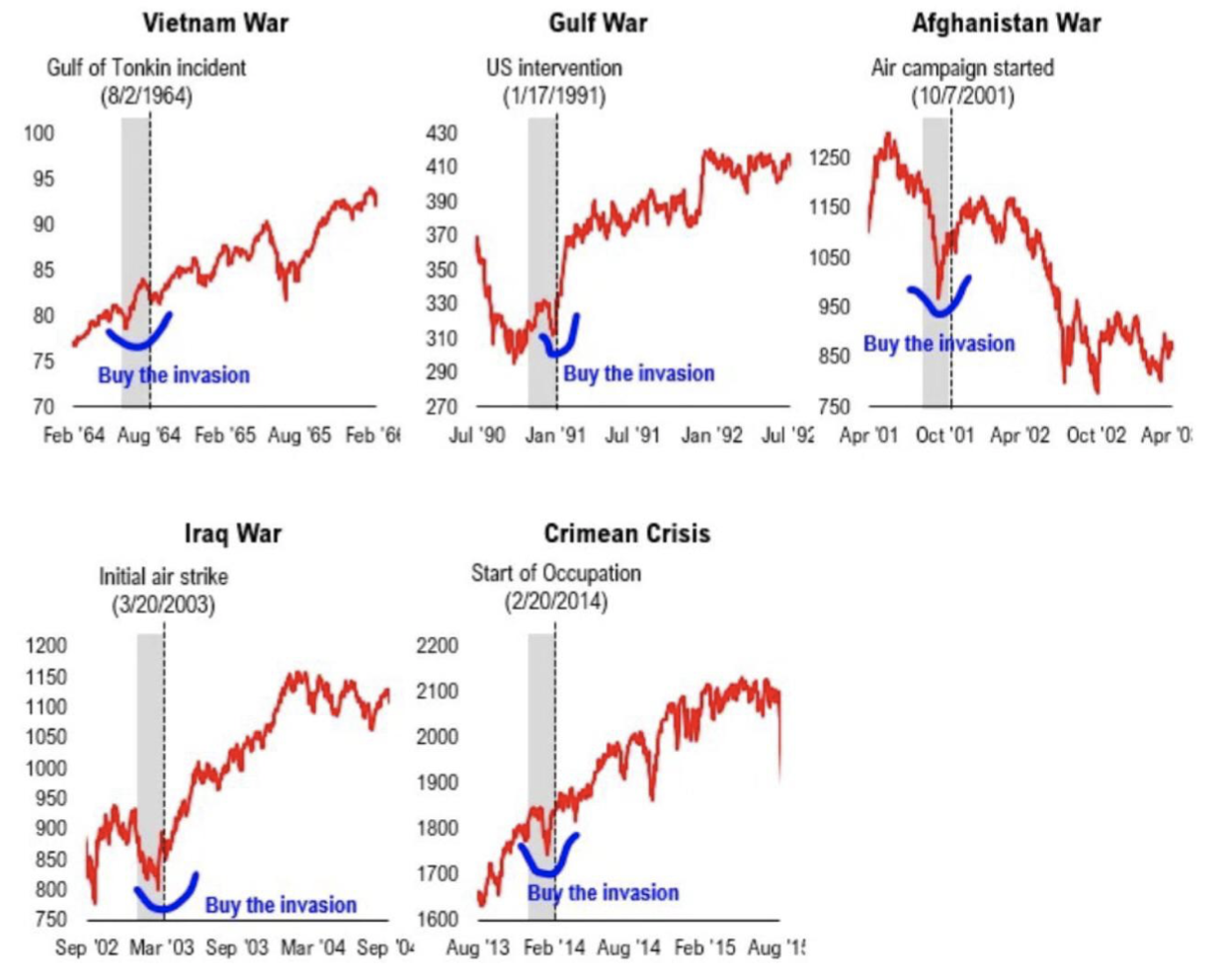 Charts courtesy of Enrique Abeyta, Empire Research
In nearly every case, the panic-selling into the lead-up of the conflict proved to be worse for the market than the resulting conflict itself. While this was true for the American stock market, the same could not be said for European markets. Let’s take a look at those in comparison.
European Economic Reaction (SPDR Euro STOXX ETF)
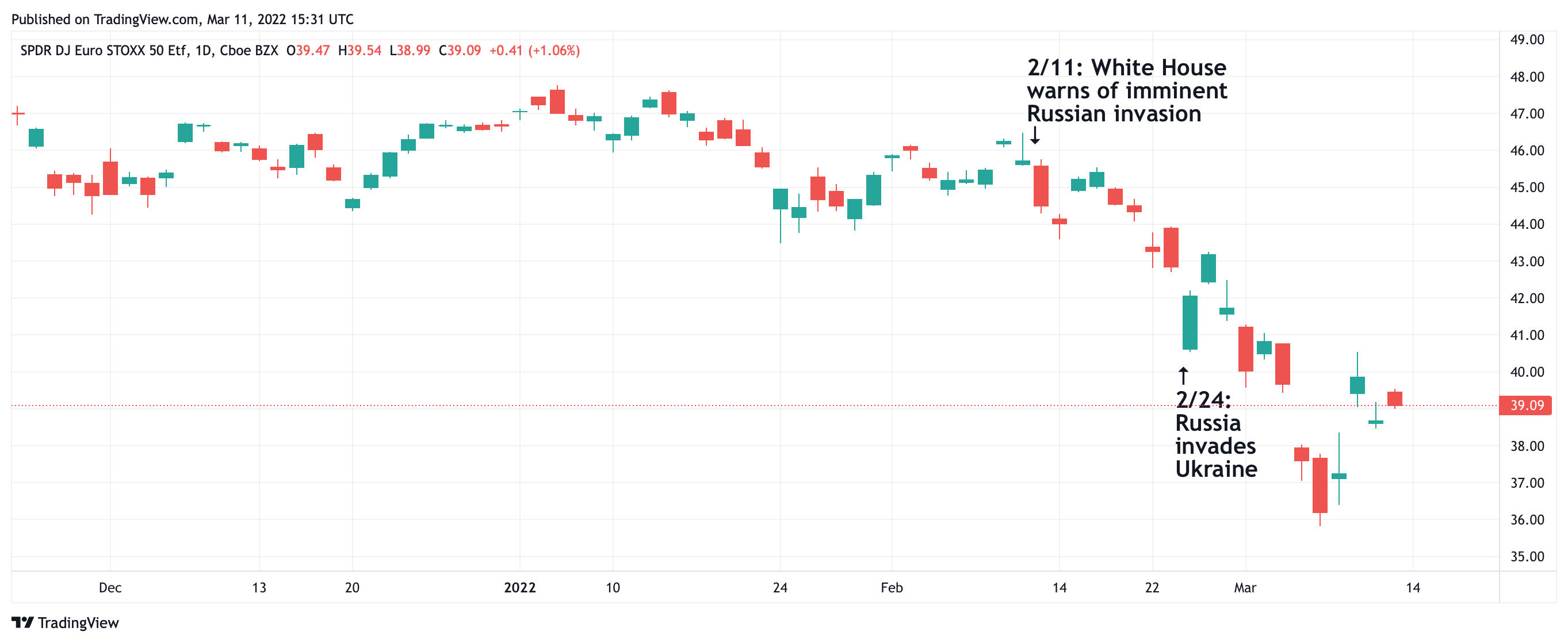
Using the SPDR Euro STOXX ETF ($FEZ) as a representation of the European economy, it’s clear that the story begins the same. Upon rising tensions and the February 11th White House announcement, stocks began to dive. However, the February 24th invasion did not signal a bottom for the European $FEZ — likely due to their economies being more closely entangled with Russia and Ukraine’s. This price action looks bearish, but it pales in comparison to the sinking ship that is the Russian economy.
Russian Economic Reaction (VanEck Russia ETF)
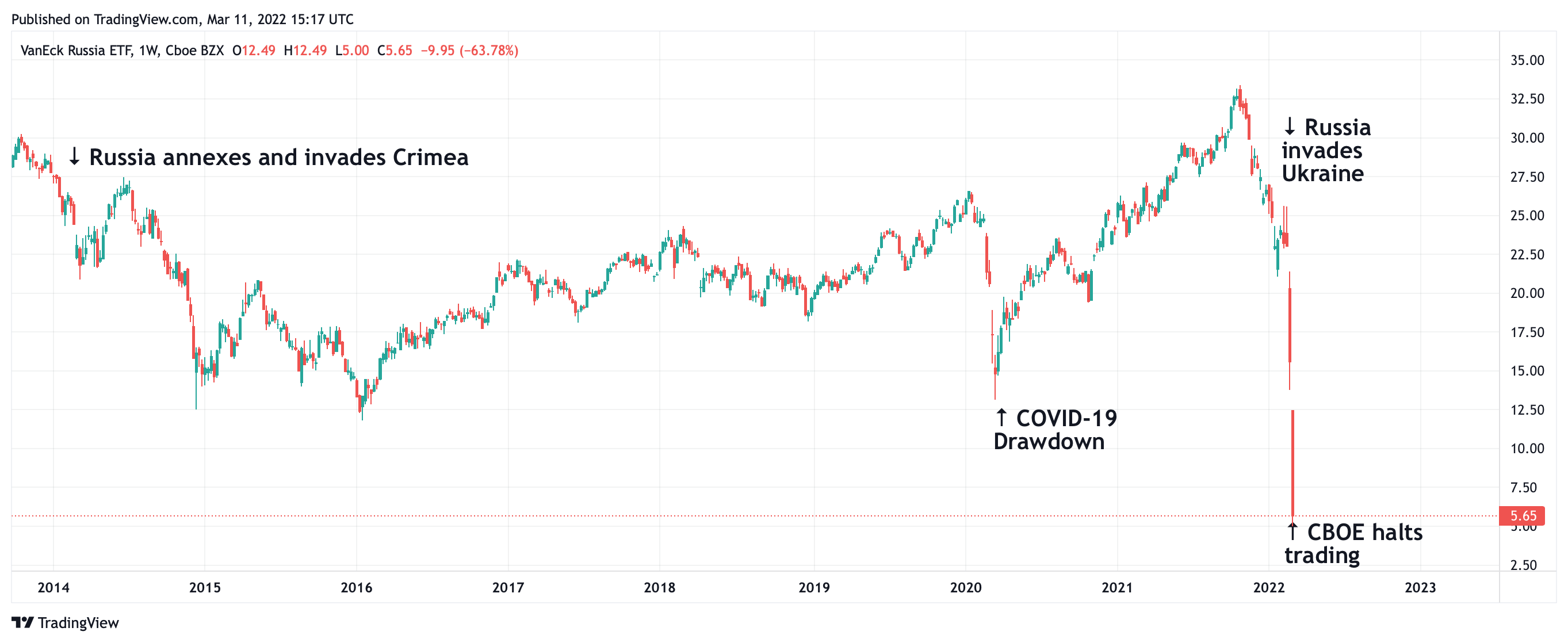
This chart of the VanEck Russia ETF ($RSX) is intentionally zoomed out to include the Crimean Crisis, during which Russia annexed a portion of Ukraine in 2014. The Crimean Crisis led to a ten-month bear market in Russian equities, in which the $RSX lost more than half of its value. The 2020 COVID-19 lockdowns are also annotated to show a similarly large “crash” that resulted in a roughly 50% drawdown.
But these two global events were truly a blip on Russia’s radar in comparison to this month’s action, which included numerous sanctions and the exodus of hundreds of companies based in Europe and the United States.
Falling by roughly 80% in less than 4 weeks, the Russian $RSX quickly became a meme-equity and target for bearish traders, who raked in over $299 million dollars within the first week of the conflict.
One of the primary tools used to cast short-bets against the $RSX, options trading exploded in the name, with 211,000 contracts traded in the name during those 5 days — more than four times the average.
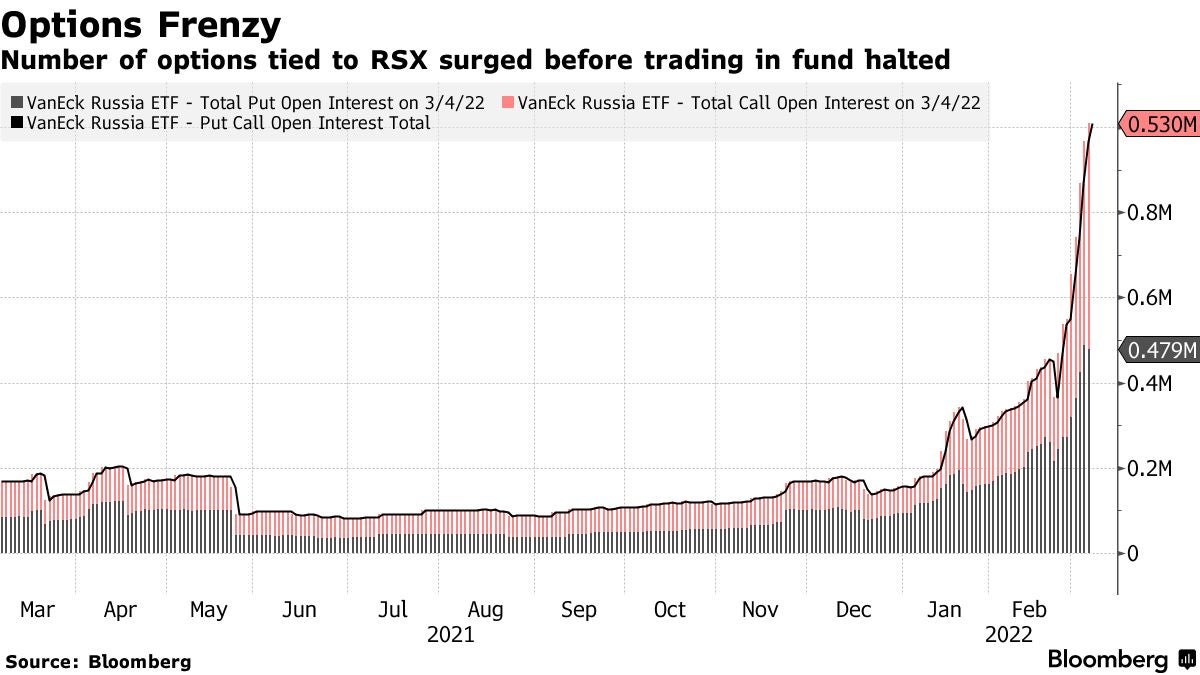
That’s notable, because in the following week the Chicago Board of Exchange would halt all trading in the name, leaving over 1 million options contracts in limbo.
What happens to those outstanding contracts?
“There’s no way to know exactly how this is going to play out,” said James Seyffart, an ETF analyst at BI. “If the fund still isn’t trading or hasn’t liquidated by the expiration dates, it’s unclear at what price. The clock is ticking, with the earliest contracts tied to RSX range expiring from as soon as March 11 until January 2024”, per BI.
With all that said, let’s look at a chart of the three overlaid.
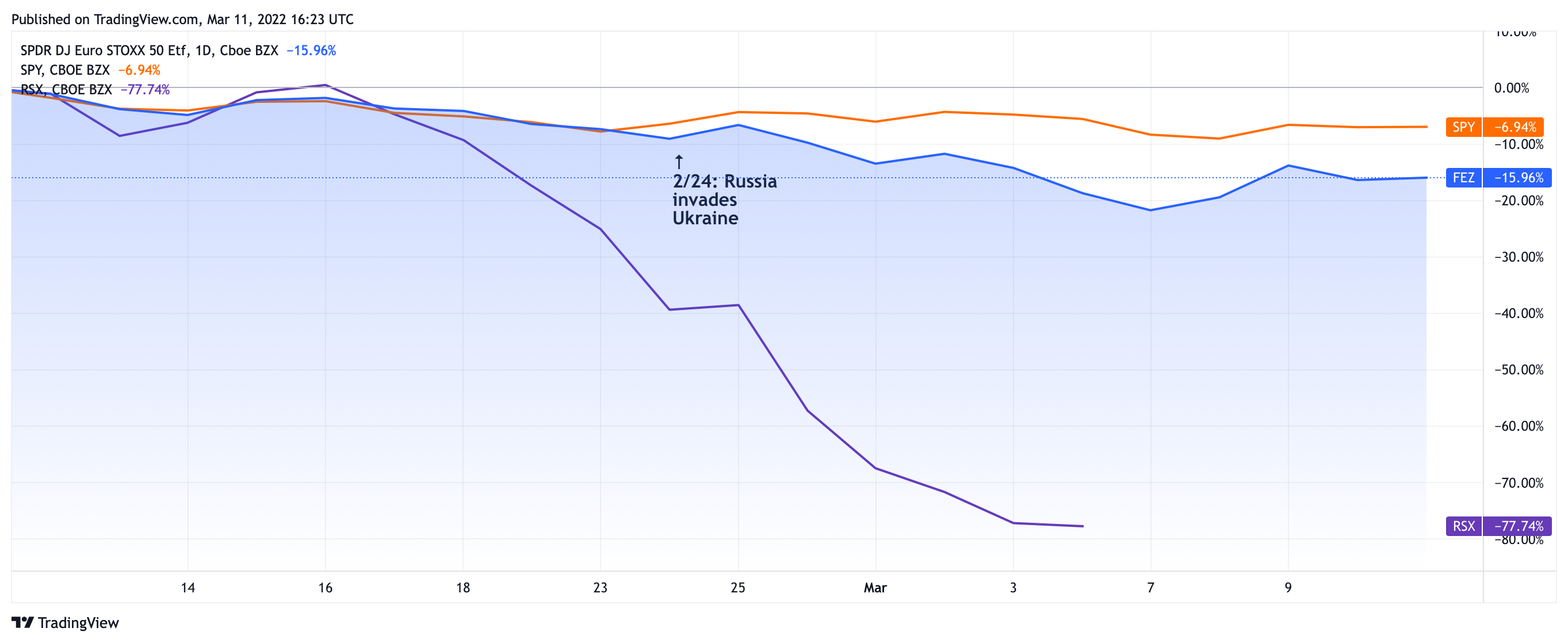
This one month chart makes it clear. Nobody was left unscathed, but the US held up reasonably (-6.94%). Europe took a little more damage (-15.96%). And the Russian economy is in shambles, having lost 77.74% of its value, now isolated from most of the world.
That’s the picture from a top-down, macro perspective. Now, let’s hone in on some of the other effects this conflict has had on the equity market, to find out where some of this macro-money has ended up.
Lockheed Martin ($LMT)
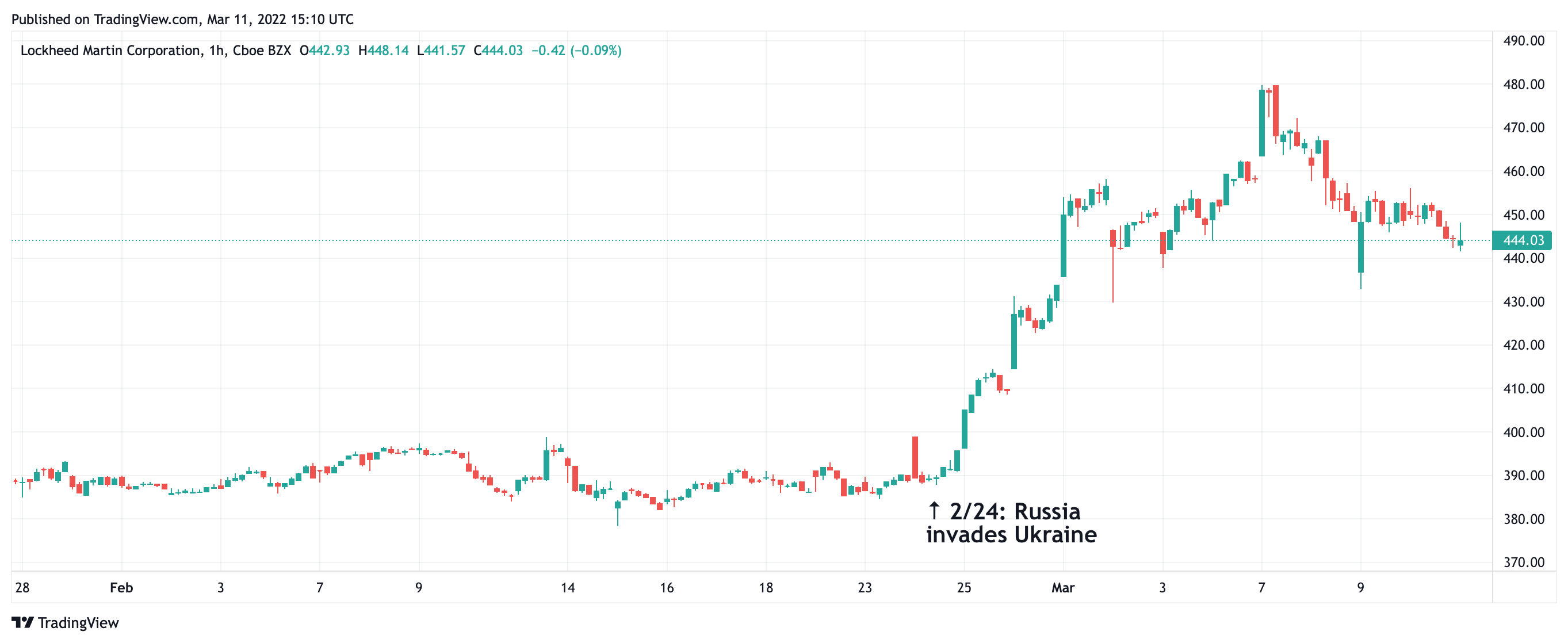
Lockheed Martin’s reaction to the Russian invasion was pronounced, and immediate. This makes a lot of sense — Lockheed is an aerospace and defense company that works with the United States military (among others). When tensions rise, and the United States begins readying itself for a potential conflict (as well as providing armaments to the parties involved), they have to purchase more arms. Lockheed is among the largest recipients of that military-money. But it isn’t just companies that saw price-hikes in the wake of the Russia-Ukraine war. In fact, the majority of the pricing-pressure took place in commodities.
Metals
S&P Metal Index
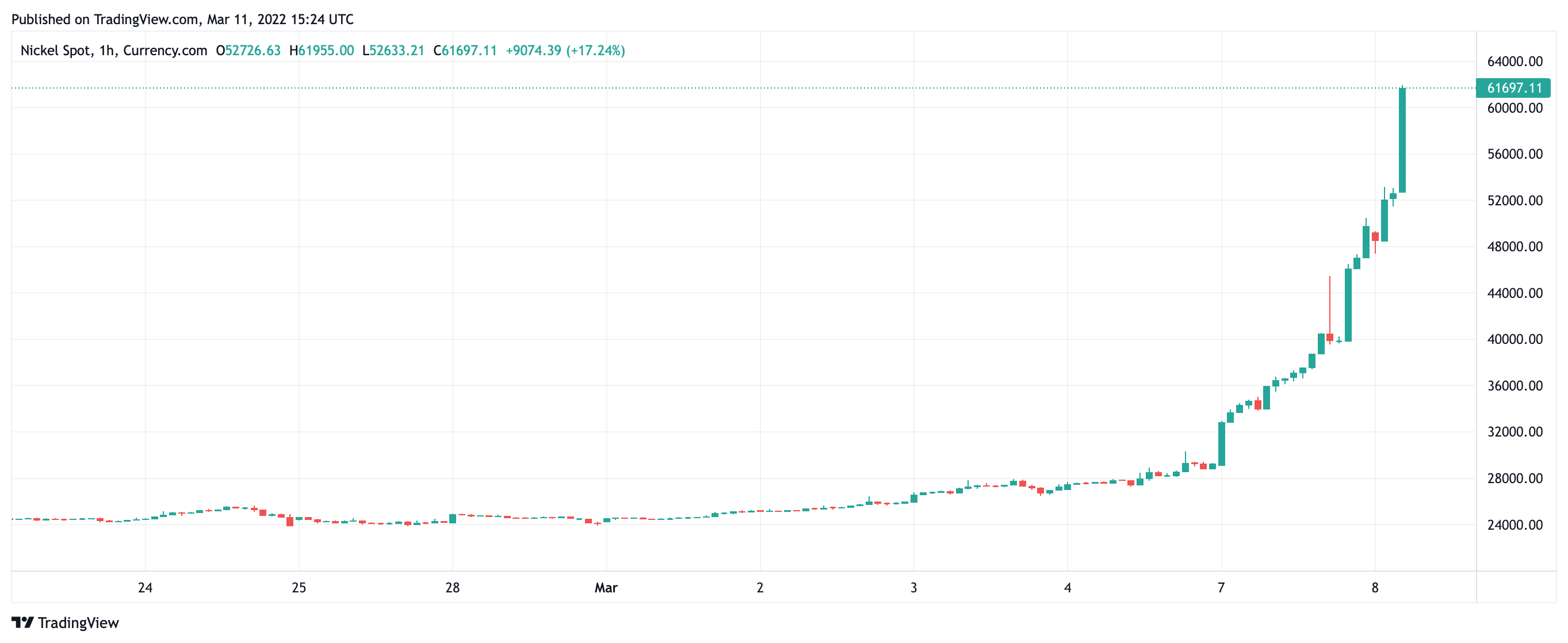
Nickel Spot Price
VanEck Steel ETF
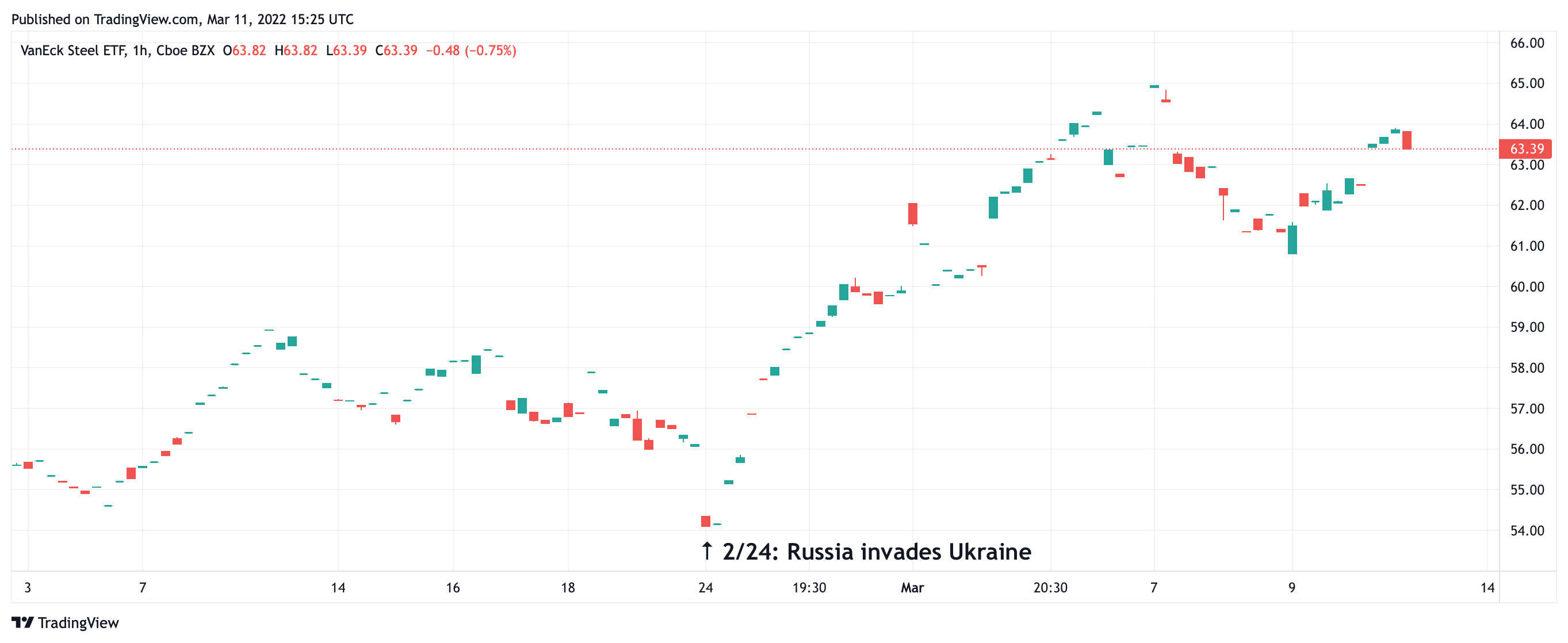
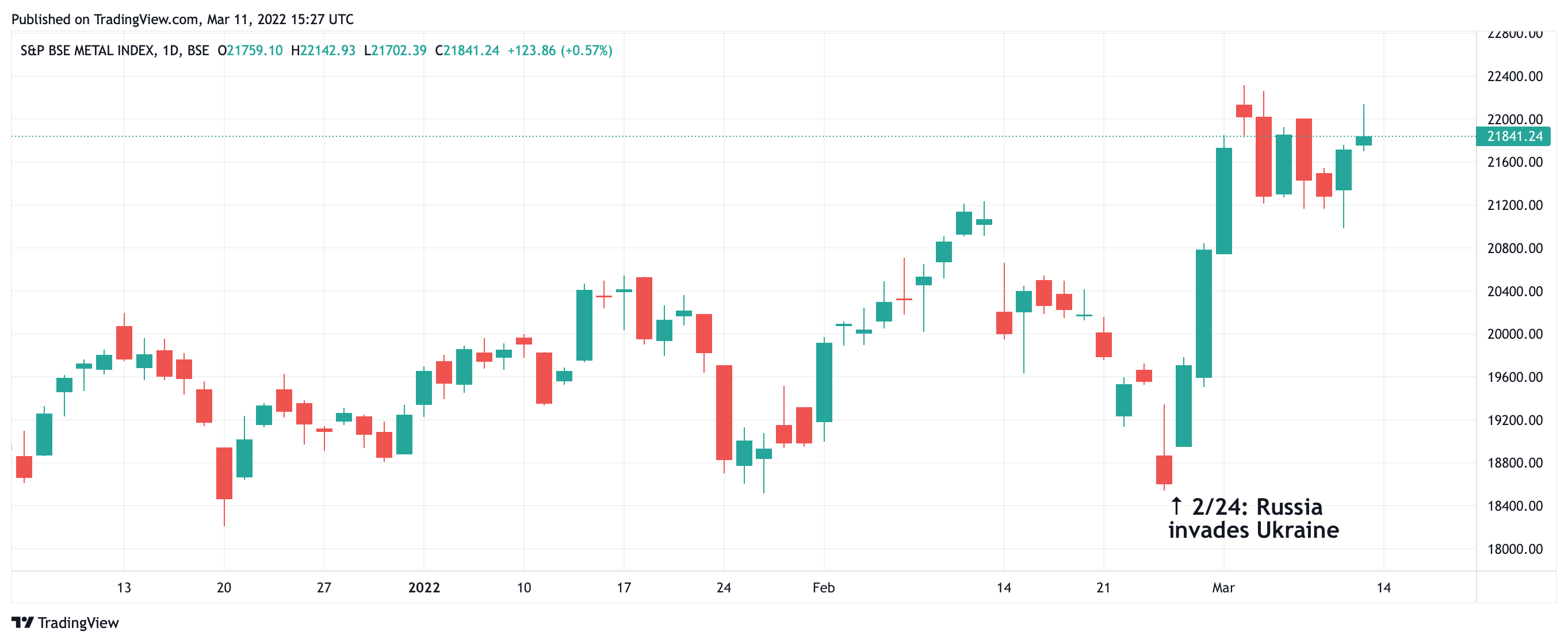
A key ingredient to the weapons of war that saw massive production increases after February 24th, the price of many different metals surged over the past month. But that wasn’t the only reason why the cost of metals, particularly nickel, soared since the conflict. Sanctions against Russia, one of the world’s largest suppliers of nickel, mean that shortages of the precious metal are likely to arise.
Adding to the nickel-fiasco is a scenario that’s unfolding in Chinese nickel titan Tsingshan. The massive consumer of nickel was using futures contracts to lock-in consistent prices when the spot price of the metal began to take flight. When futures traders are forced by rising prices to buy back contracts at a loss, it can create an upward cycle called a short squeeze. That’s exactly what happened to drive the price of nickel to an 11-year high, dealing an $8 billion dollar blow to Tsingshan in the process.
Though the price of some metals have begun to stabilize, the move has exacerbated an inflation problem that was already very serious. And metals are far from the only commodity that has experienced this phenomenon.
Agriculture
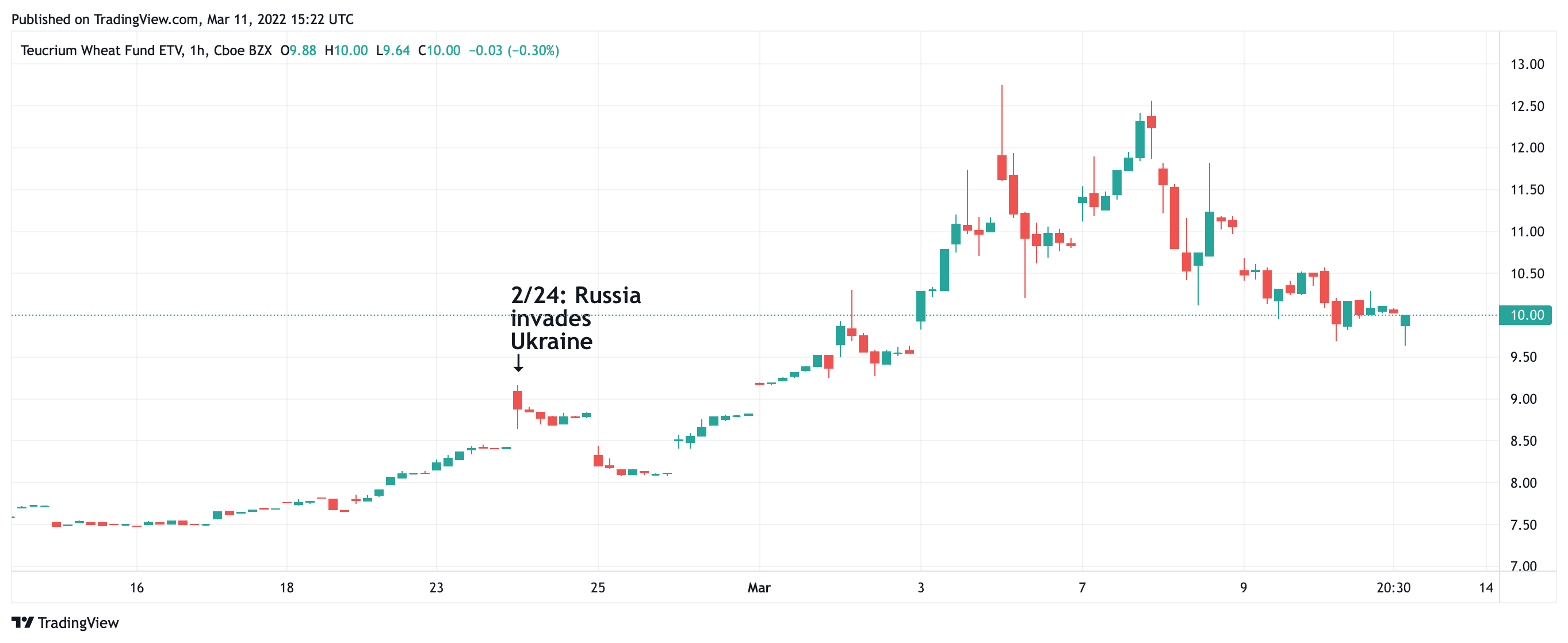
Teucrium Wheat Fund ETF ($WEAT)
Corn Cash CFD ($CORN)
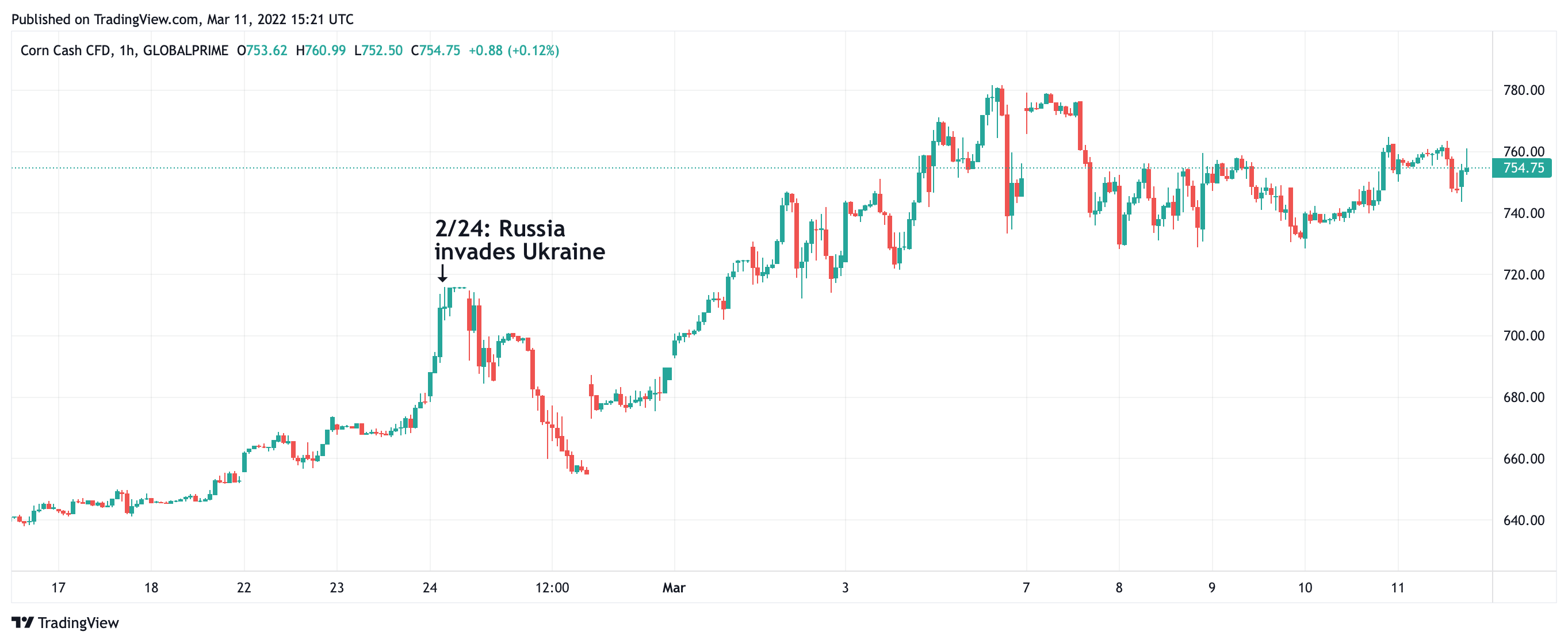
The price action in certain agricultural staples took a similar track to metals. This is because Ukraine, often referred to as the world’s “bread basket” supplies 12% of the world’s wheat and 16% of the world’s corn. Food-related inflation was already an issue that was top of mind to many consumers, with pandemic-related economic policy driving Kellogg and General Mills to pass on prices to their consumers long before this conflict began.
This action led some to make bullish options bets on the $CORN and $WEAT ETF’s, both flagged by our Unusual Options Activity team.


Compounding the issue, Ukraine’s planting season is short, and it’s about to begin. If the war between Russia and Ukraine isn’t over within the next two months, it’s likely that nothing will be planted or harvested until next year.
Further aggravating agricultural tensions is the fact that Russia is a leading supplier of the world’s fertilizer. With inflation already at a 40 year high, many consumers are left wondering when they’ll see some form of economic reprieve. And unfortunately, the commodity surge doesn’t end with food and metals.
Oil
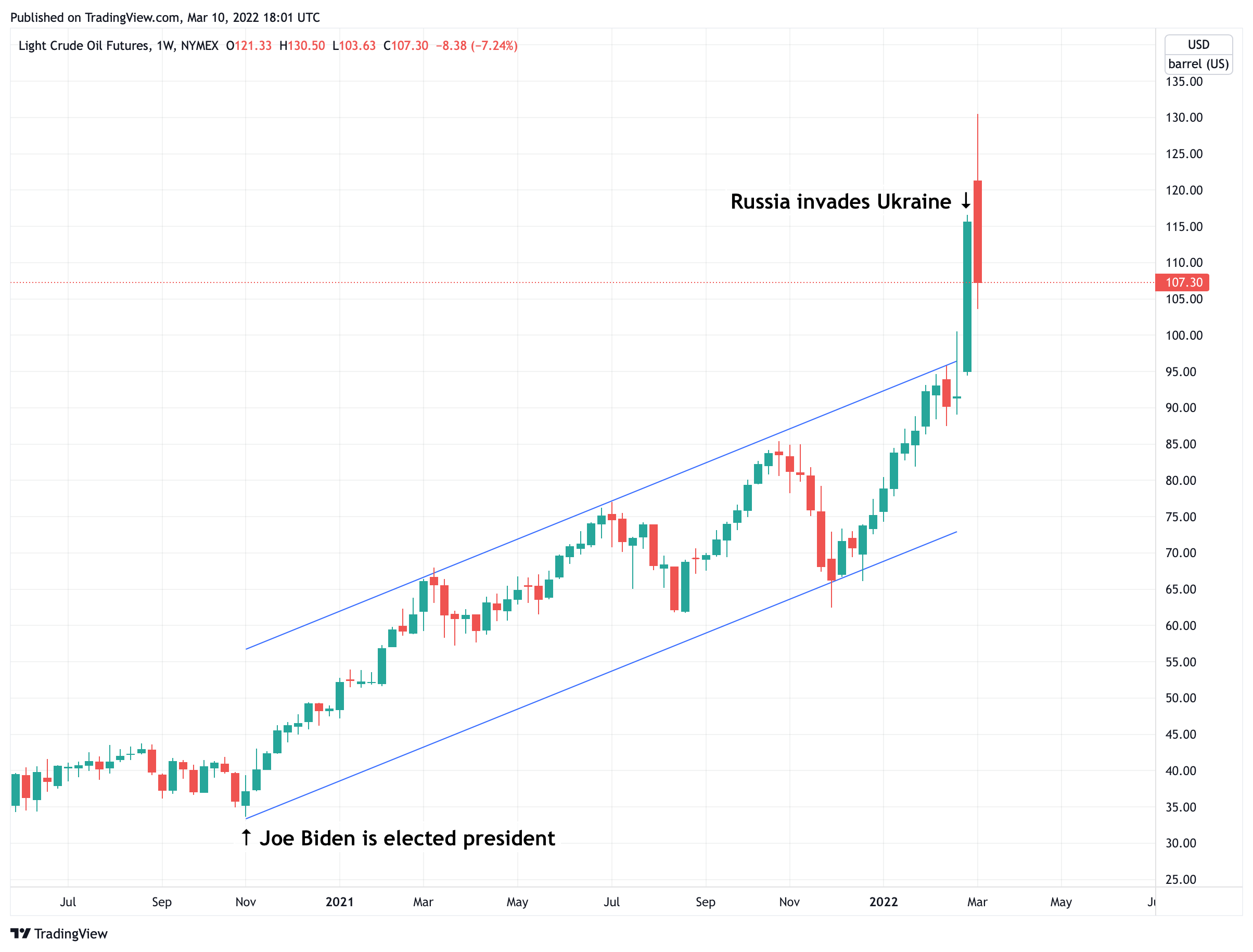
Oil has seen notable price increases since the election of President Biden. For anyone who’s had to heat their home or fuel their vehicle, energy has become the most prominent symbol of inflation. And now that the US has banned Russian energy, many economists believe that this is only the beginning of a broader trend. While the average price of gas in the United States is already at $4.17/gallon (an all-time-high), some economists believe the price is set to surpass $5/gallon within the year.
Additionally, Bank of America analysts predict that the price of oil will soon surpass $200 per barrel, and believe that this could lead to a 2% reduction in American GDP growth for the year of 2022.
More than any other sector, energy is one that Pete and Jon Najarian have been bullish on for over a year. Between the numerous reports of unusual options activity and the obvious politically-driven pricing pressures that energy has experienced, it’s no wonder that energy was the best performing sector of the past year. With this conflict in full-view, it’s likely that 2022 could see energy-stocks reign supreme once again.
Commodity Inflation: An Overview
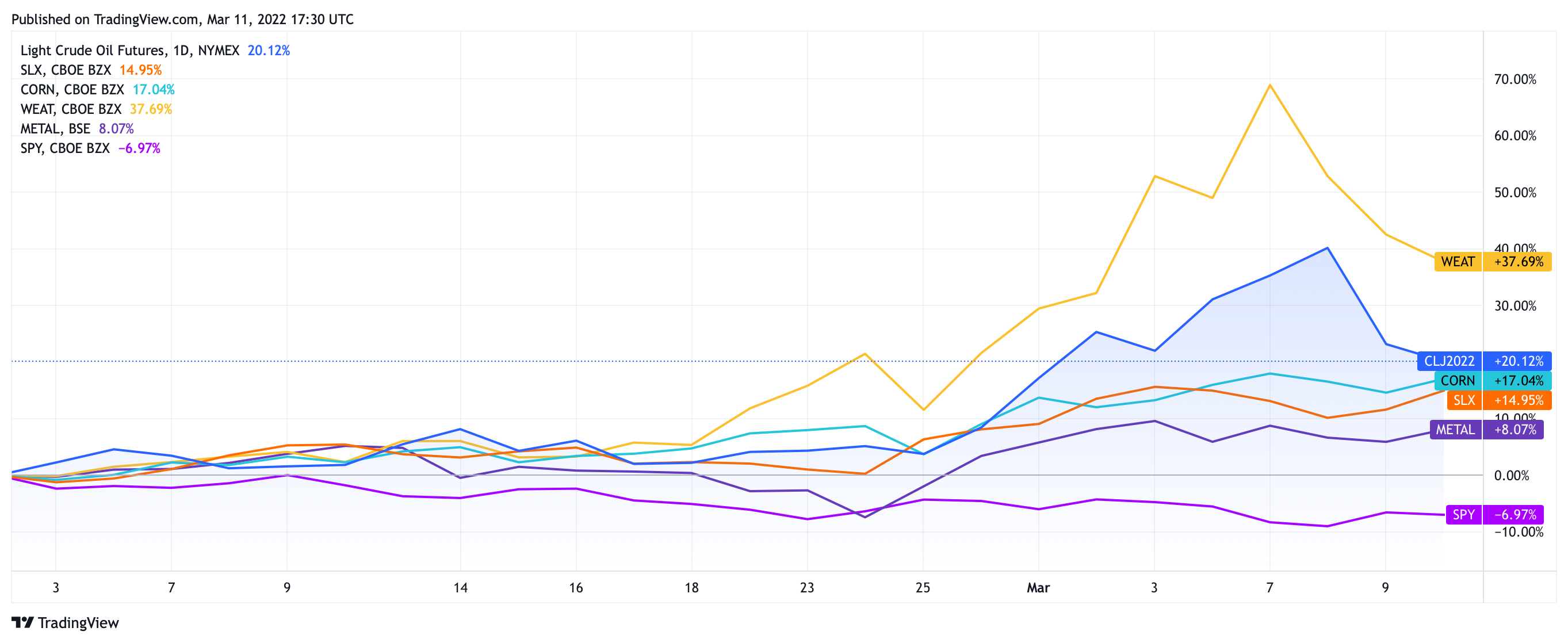
Starting from February, it’s tough to discern the different lines. But on the date of the invasion, the difference becomes clear. One line falls, the rest are clear for takeoff. With commodities (led by $WEAT) all trending higher, and the $SPY the only line in a downtrend, a troublesome scene is painted. One where the growth of inflation outpaces the growth of the US economy. That is a doom scenario that the officials at the Federal Reserve do not want to happen.
That’s why next week’s FOMC meeting on March 15th – 16th will be so critical. Jerome Powell and the rest of the officials at the Fed need to walk a fine line in an all-important meeting that will set the pace for future rate-hikes. Do too little, and they risk inflation continuing to spiral out of control. Do too much, and they risk additional turmoil in the equity market, which has already been browbeaten for months on fears of a hawkish fed.
Only one thing is for certain: the Russia-Ukraine conflict has presented a massive obstacle in the Fed’s decision making process, complicating an issue that was already complex. It’s clear that they, as well as government officials across the globe, will be watching the events in Eastern Europe very closely for weeks to come.