
Cryptocurrency
The AI Winter Vs. The Crypto Winter: Is 2019 the Inverse Moon?
As the crypto winter gets colder, individuals in the space are beginning to estimate how long the current bear market will last. Although the 2014 crypto winter was catastrophic for most altcoins, Bitcoin managed to survive. Now, some speculators are beginning to wonder if 2019 could be worse. Recently Jim Breyer, a prominent venture capitalist, […]

As the crypto winter gets colder, individuals in the space are beginning to estimate how long the current bear market will last. Although the 2014 crypto winter was catastrophic for most altcoins, Bitcoin managed to survive. Now, some speculators are beginning to wonder if 2019 could be worse.
Recently Jim Breyer, a prominent venture capitalist, commented in an article that ‘he is not afraid of the Bitcoin nuclear winter.’ The nuclear winter he is referring to is commonly associated with the AI Winter of the 1970s and 1980s. This was a time when the field of AI experienced ‘several hype cycles, followed by disappointment and criticism, followed by funding cuts, followed by renewed interest decades later.’
While, AI continues to develop and serve the world in a multitude of ways, the lack of funding essentially slowed the development of the space by about 15 years. Although it seems technology always prevails, the development timeframe is somewhat unknown. Similar to Ethereum and other platforms, there was so much expectation that decentralized applications would be ready for immediate usage. Unfortunately, the technology has not progressed at the rate at which it was expected.
A technological winter typically occurs in a cycle which involves a few specific stages. Initially, people are introduced to the potential of the new technology and excitement emerges. Crowds of people become even more excited when the value of the technology increases drastically. Eventually, the excitement dies off when the technology fails to deliver on expectations. Then, a winter occurs when people lose their excitement in the technology. They give up on the technology and claim ‘it will never work.’ Investors pull their money and projects are unable to continue research and development. Ultimately, the decrease in interest and lack of funding leads to a stagnation period where there is very little technological development for roughly 10-15 years. Then, 30 years later, masses of people are unaware that they are using the technology on a daily basis because the implementation was so gradual it went unnoticed.
One could argue that there is no shortage of interest or funding in the cryptocurrency space, nevertheless, it is important to be aware of technological history. When reflecting on the current bear market, there are a couple key factors that come to mind when evaluating current market sentiment.
First: the impact of mining losses. As the price of Bitcoin decreases, miners become less profitable. As more miners are forced to leave the network, Bitcoin’s block difficulty decreases and block rewards increase for the remaining miners. As a result, this allows the most dominant miners to operate at a loss in the short run. Miners know if they are able to outlive competition they will generate an economic profit in the long run. Therefore, Bitcoin mining will always reach an equilibrium and the network will be secure.
However, as mining corporations struggle, they are forced to sell large quantities of Bitcoin in order to cover costs. Bitmain is the largest cryptocurrency mining corporation in the world and they have had a large impact on the cryptocurrency market as of late. In Q3 of 2018, Bitmain took an estimated $740 million loss. This statistic does not even factor in the costs of the BCH hash war. Bitmain is also rumored to own a large amount of Bitcoin Cash, which is currently recording all-time lows. Through this turmoil, Bitmain was unable to launch their IPO and will most likely continue to sell large amounts of cryptocurrency.
Additionally, the price of Bitcoin will continue to fall as more miners shut down. In 2017, many miners over-invested in equipment or did not execute proper budgeting because they assumed prices would never fall to $3,300. As more miners such down operations, they sell a large amount of coins in order to cover costs. This drives prices even lower. Bitcoin will most likely overcome these problems because it already has before. Bitcoin survived through the mining crisis of 2011 when it was much more immature. Therefore, these mining problems are manageable and Bitcoin will likely recover like it has before.
Unfortunately, this is probably not the case for a majority of altcoins. Ethereum has never experienced a bear market quite like 2018. Subsequently, Ethereum is in a very dangerous situation because the vast majority of the projects on its platform are failing. In many cases, a 2017 ICO buyer could only attain ICO tokens with Ethereum. ICOs then used this Ethereum to fund their projects. As the price of Ethereum continues to drop, more failing ICOs have to sell their Ether in order to cover costs. This creates a downward spiral that could reasonably take Ethereum to a complete market cycle price of $15.
Regardless whether or not these projects survive, Bitcoin maximalists will argue that Bitcoin is already good enough (and in many ways it is). Bitcoin is the most sound money ever created and it has already accomplished the goal of creating a valuable asset that is totally independent from any third party or government. In this sense, Bitcoin has already succeeded. Consequently, ‘blockchain 2.0’ and the implementation of decentralization to the internet, may not be delivered as expected. These are the kinds of developments which are more susceptible to entering something similar to an AI Winter.
This trend has already started for many projects. Earlier this week, Coinbase security engineer Mark Nesbitt revealed that Vertcoin’s network went through repeated 51% attacks over the last few months. These attacks caused a double spend of roughly $100,000. Essentially, Vertcoin’s blockchain is now completely unreliable. Additionally, Ethereum Classic’s main development team recently announced that they are shutting down operations due to a lack of funding. Since the announcement, ETC shorts are at an all-time high. Furthermore, the social media blockchain platform Steemit recently fired 70% of their workforce. Although this does not mean the immediate demise of these coins, it is evident that these stories will instill fear in the market and only add to bearish sentiment.
When looking at the market, technicals are very unsettling for the remainder of 2018 & 2019. While it is unfortunate that many projects are running out of funding, desperation creates immense shorting opportunities.
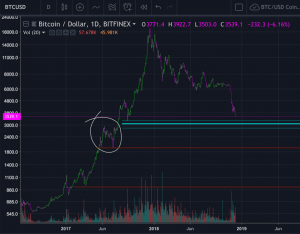
The chart above highlights Bitcoin’s historic logarithmic price action. The next support level is roughly $3,000. There may be intermediate support at $3,200, but there is a chance that support at $3,000 may not even hold. When observing Bitcoin’s historical price action, BTC faced resistance at $3,000 during the spring of 2017. However, this resistance only had two peaks and it was not analytically significant. The next support level is around $2,800, which is a 13% gap. If these patterns play out and bearish sentiment continues to overwhelm the market, Bitcoin could decrease another 30% over the next few months. If Bitcoin were to follow these patterns, the altcoins would likely suffer much more.
While viewing the logarithmic chart, Litecoin is in free fall territory. The parabolic increase Litecoin experienced last year has left the digital asset with no historic support levels. It appears the parabolic increase will be followed by a parabolic decrease. If Litecoin breaks below the support level at $24, then again at $19, there is a 75% price channel with no logarithmic support. It would not be out of the realm of possibility to see a single digit Litecoin.
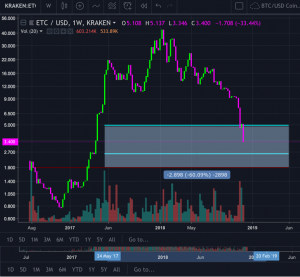
Ethereum Classic is another altcoin which is in free fall territory. The primary ETC developers are shutting down operations due to a lack of funding. This is creating fear around the cryptocurrency and there is no logarithmic support to be seen. This is a turning point because Ethereum Classic essentially has nowhere to go. The same can be said for Bitcoin Cash, which is already recording all-time lows.
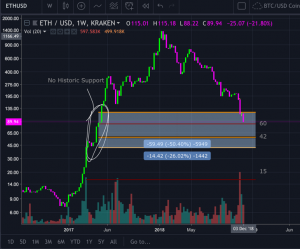
Ethereum is another short trade with immense opportunity. There is an 80% downside channel with no logarithmic support. The majority of these coins are sailing in uncharted territory and Ethereum is no exception. With a majority of Ethereum’s ICOs dying off, it would be possible for Ethereum to fall to $15 to conclude its market cycle.
Remember the gains in November and December of 2017? We may be about to witness the inverse of those events. Markets love to mirror themselves and the data below will verify this inverse pattern.
Bitcoin’s Daily Percentages:
Nov. 25, 2017: +6.5%
Nov. 26, 2017: +6.1%
Nov. 27, 2017: +7.3%
Dec. 1, 2017: +7.3%
Nov. 24, 2018: -11.2%
Nov. 25, 2018: -5.7%
Nov. 30, 2018: -6.1%
Dec. 3, 2018: -5.9%
In bubbles and market cycles, prices always capitulate and fear eventually pushes the asset to a bottom. Then there is a ‘return to mean’ stage followed by ‘the slope of enlightenment’ stage. At this point, Bitcoin’s bottom could be as low as $2,000 or even $1,500. It is still uncertain when prices will reach these points. It could take months or even upwards of a year. It is important to note that there will likely be reaction rallies in between extreme sell offs. Short sellers should be aware of this and understand the potential risk of shorting an asset when shorts are at all-time highs. Above all, the extreme prices mentioned in this article such as a $15 Ethereum or a $10 Litecoin may never happen. These prices are derived from previous support levels and technicals which attempt to understand where prices could land at the end of a complete market cycle.
Disclaimer: I am not a financial advisor. This is not financial advice. Please do your research independently and make objective decisions. This article is intended to educate readers on the recent state of the cryptocurrency market. The author of the article trades cryptocurrency.
Charts are from tradingview.com and coinmarketcap.com
Additional Source: cryptoiq.co