
Cryptocurrency
The Implications of a Digital Content Monopoly
The Implications of a Digital Content Monopoly Tech Giants Gaining Ground This past decade has been defined by the endeavors of big tech companies like Facebook, Amazon, and Google. We have seen these tech giants engaged in a never-ending battle with lawmakers as they attempt to wrangle as much of a foothold as they can, granting […]

The Implications of a Digital Content Monopoly
Tech Giants Gaining Ground
This past decade has been defined by the endeavors of big tech companies like Facebook, Amazon, and Google. We have seen these tech giants engaged in a never-ending battle with lawmakers as they attempt to wrangle as much of a foothold as they can, granting themselves as many liberties as the government will allow. Tech companies overreach, and legislators push them back; it’s a necessary dynamic that is setting the precedent under which future companies will operate. However, due to the inherent progressive nature of society, there is an inevitable tendency for the companies to slowly gain ground and increase their power.
Data Over Dollars
Senator John Sherman prolifically stated, “If we would not submit to an emperor, we should not submit to an autocrat of trade.” Anti-monopoly sentiment has been one of the defining characteristics of American capitalism since the turn of the century. The Sherman Act was written in broad terms in order to encompass whatever types of business may arise in the future, yet it still seems as though big tech companies fail to operate under the authority of these laws. A large reason why this is happening is due to the fact that these tech giants force the consumers to pay with their data rather than their dollars. It was far more evident in the past when a monopoly was gouging the consumer because there was an indisputable quantitative figure that can show how much the price of a barrel of oil or a ton of steel has changed over time. These historical instances of trust-busting have resulted in the misconception that the goal of the Sherman Act was to keep prices stable, but the reality is that the Act makes no explicit mention of price at all. So if price is not the goal, then what is? Sally Hubbard, former assistant attorney general in the New York AG Antitrust Bureau, put it quite succinctly:
Competition should be the goal. Competition maximizes consumer choice, innovation and quality, and combats the concentration of economic and political power.”
Coke or Pepsi? Mac or PC? YouTube or …?
If lack of competition is the metric by which we measure the extent of a monopoly, then Google currently owns every property on the playing board and YouTube is their Park Place and Boardwalk. Think about it, when was the last time you fired up your computer and navigated over to Vimeo in order to watch some online content? The fact of the matter is, if you live in the United States, you are most likely watching videos on YouTube. The internet consumer has very few options when it comes to watching videos and equally important, the content creator has very few options when it comes to where to upload their content. It is true that in many ways this is merely the result of YouTube providing a better service than their competition, but this seemingly harmless gravitation towards YouTube has some serious implications.
Algorithmic Crackdowns
YouTube’s dominance over online video content means that people have fewer options when surfing the web, and therefore are forced to bend to the whims of YouTube’s ever-changing terms of service. What’s worse is that the rules that users are forced to operate under are constantly changing and generally ambiguous. YouTube has done an awful job clearly defining the content that is friendly to their site and the advertisers that keep it going, and people are being needlessly punished. Much of YouTube’s enforcement is done by an algorithm and no human beings are actually required to view the video until a manual review is requested. Artificial Intelligence has many feasible applications, but applying context in order to make judgements is certainly not its strong-suit. This past week we saw a massive crackdown on cryptocurrency related YouTube channels and many innocent and informative channels fall victim to the ban hammer. Their entire livelihoods were made temporarily ambiguous because of YouTube’s “mistake.” These content creators had essentially no recourse other than to wait for YouTube to manually review their content, which never seemed like a certainty. This incident emphasized the fact that there are almost no other platforms where they can post their content and that their futures were entirely in YouTube’s hands. So will this incident be the spark that the community needs to motivate them to move to a new platform, or will this merely be a reminder that YouTube is king when it comes to online content? I think the CEO of Binance, CZ, said it best:
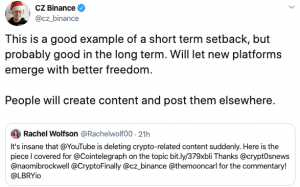
Source: @cz_binance on Twitter
It is looking like either YouTube will need to make a change to their policy or the community will need to uproot and move elsewhere. Until then, content creators and content observers will be forced to abide by the enforcement policies YouTube currently has in place.