
Options News
The thing the bond market most feared is beginning to happen via @MSN
As equities consolidate their recent gains on the back of the G20 summit in Argentina over the weekend, the bond markets have spoken a different tune. Bond purchases, driven by funds seeking safety and a lower multiple, and possibly foreign interaction, have driven the yield on the U.S. 10-year note to below 3%. This brings […]
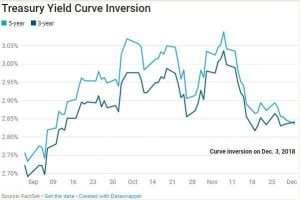
As equities consolidate their recent gains on the back of the G20 summit in Argentina over the weekend, the bond markets have spoken a different tune. Bond purchases, driven by funds seeking safety and a lower multiple, and possibly foreign interaction, have driven the yield on the U.S. 10-year note to below 3%. This brings with it the risk of an inverted yeild curve, in which the 10-year yields less than the 2-year, and has historically been a barometer for recession, even while other markets, “party on”. The inversion has been seen in other Treasury pairs such as the 3-year and 5-year, and also the 2-year and 5-year, potentially signalling the most watched 2s/10s spread to follow, as further explained in this article, published by MSN,
“The bond market sees storm clouds on the horizon, despite the trade ceasefire between President Donald Trump and China.
“But not all strategists agree with the dire warnings, though they do note some unusual behavior.
“On Monday, the difference between the 10-year Treasury yield, at 2.97 percent, and the 2-year yield, at 2.82 percent, dramatically narrowed by 5 basis points, the biggest one day move since late March.
“Traders have been watching the difference between the yields on various Treasurys for months, along what is called the yield curve between the longer and shorter-term bonds. And in this time, the longer duration 10-year yield has gotten closer and closer to the yield on the 2-year. If the two should flip, and the 2 -year yield actually rises above the benchmark 10-year, that inversion would be a signal of a recession.
“The two yields are currently just under 15 basis points apart, the narrowest since around the time they last inverted in June 2007. What’s worrisome for some is that on Monday, the difference between the yields on the 3-year and 5-year, and those of the 2-year and 5-year, inverted.
“‘It speaks to the potential for the 2s and 10s to invert,’ said Ian Lyngen, head of U.S. rate strategy at BMO.
“The timing could vary, he said, depending on the cycle. But it’s typically a matter of months, not days or weeks, when such an event could happen. ‘That might put 2s and 10s inversion on the table by the end of the year, and if not, then around the March FOMC meeting,’ Lyngen said.”